Airbag vests have gone from “weird space-age road-racing thing” to genuine, proven safety kit in a pretty short window. They first became normalised in high-speed tarmac racing, where brands like Dainese began developing early systems for MotoGP-level crashes, and over time the tech matured from bulky, specialist gear into integrated, wearable protection that could deploy in milliseconds.
Then the rule-makers got involved. In road racing, FIM-level regulations now require airbags in certain championships and categories, with specific technical standards riders’ airbags must meet. For example, the FIM JuniorGP regulations state that a race airbag is compulsory during on-track activity and must comply with the FIM “Grand Prix Airbags” requirements.
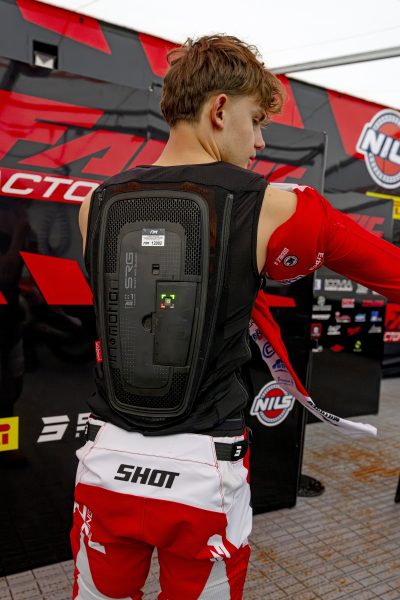
From there it pushed into the dirt world, and rally was the next big proving ground. Rally riders are dealing with high speeds, unpredictable impacts and long days where fatigue is a real enemy, so airbag protection made sense, and it’s now formally mandated in that space too. The FIM’s RallyGP class introduced compulsory airbags for 2024 (with Rally2 following in 2025), and In&motion also notes that airbags are compulsory for Dakar, with dedicated modes built from rally data.
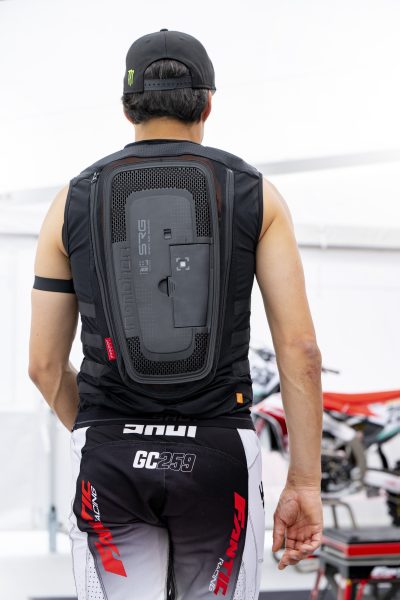
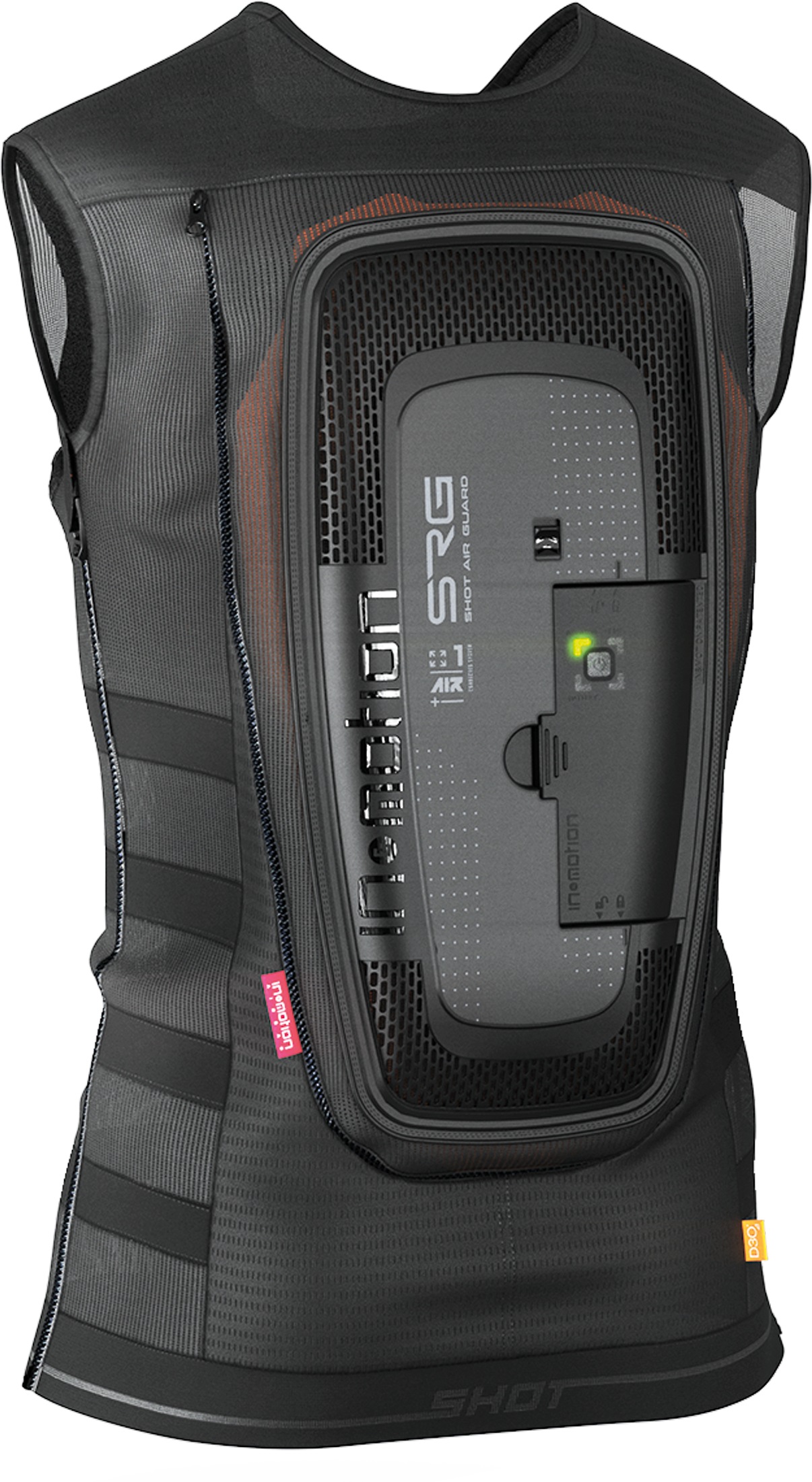
Motocross and enduro were always the hard ones to crack, because the “noise” in the data is wild: jumps, landings, braking bumps, save-the-front-end moments… the vest has to know the difference between “big hit” and “proper crash.” That’s why the new wave of off-road-specific systems matters. Shot’s SRG-1, built around In&motion tech, is positioned as an airbag designed and approved for MX and enduro competition, and that’s the real tipping point: purpose-built off-road algorithms, in a vest you can actually ride in, not just survive in.
Air vests are clearly the next big leap in rider safety, but if we’re honest, most of us still don’t really understand how they work. We know they deploy fast, we know they’re saving riders from serious injuries, but the details, how they decide when to fire, what they protect, how they cope with motocross hits versus real crashes, and whether they’re practical in heat, mud and long rides, are still a mystery to a lot of riders. That’s exactly why we got our hands on a Shot SRG air vest: to ask the dumb questions, dig into the tech, and work out whether this is just clever theory or genuinely something every off-road rider should be thinking about.
So, why?
For a long time, airbag vests were something motocross riders watched from the sidelines. Road racers had them. Dakar riders trusted them. MotoGP crashes routinely ended with riders sliding away wrapped in inflated protection. Off-road riders, meanwhile, kept wearing chest protectors, back protectors and neck braces, accepting that crashes were part of the deal and hoping the gear would be enough.
The reason wasn’t resistance to safety, it was practicality. Motocross delivers constant violence to both rider and equipment. “We have so many bumps and we take so many hits riding a dirt bike,” Air Vest Expert and Shot SRG Brand Manager Darren Jackson explains, “that it took them a long time to archive all the data and build the tech around having a system that deploys specifically for motocross.” Early airbag systems simply couldn’t tell the difference between a normal hard landing and a genuine crash. In a sport where casing a jump or smashing braking bumps is routine, false deployment would have made the technology unusable.
That challenge delayed motocross adoption for years. Road riding and rally racing offered predictable crash signatures: high-speed deceleration, separation from the bike, long slides. Motocross crashes, by contrast, are messy, abrupt and varied. Riders might loop out, high-side, get cross-rutted, or be launched sideways into obstacles. Building a system that could identify danger without reacting to aggression required a huge leap in sensor technology, processing speed and data modelling.
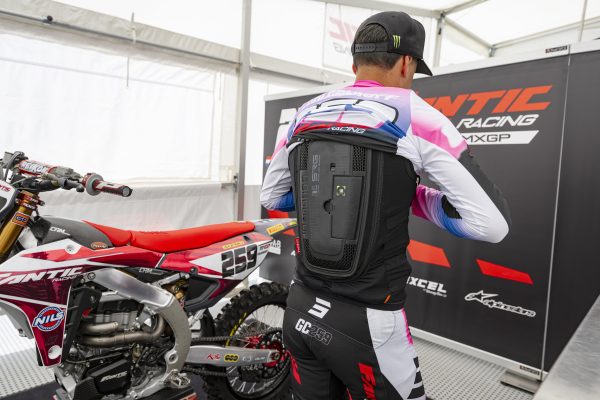
Modern airbag systems rely on a combination of gyroscopes and accelerometers to understand rider movement in three-dimensional space. “A gyroscope works off direction, up, down, left, right, sideways,” Jackson explains. “The accelerometer side of it measures motion, tilt, vibration, and converts mechanical motion into electric output.” Together, they allow the system to recognise not just movement, but context, whether the rider is compressing into a landing, swapping sideways, or genuinely crashing.
Crucially, this data must be interpreted incredibly fast. “It reads things a thousand times a second,” Jackson says. That speed matters because serious motocross injuries occur almost instantly. Chest trauma, spinal injuries and neck loading often happen before a rider even realises they’re crashing. Modern airbag systems deploy in milliseconds, not seconds. “It takes 30 milliseconds to detect and then 30 milliseconds to deploy,” Jackson explains. “That’s 60 milliseconds, which is faster than a blink of an eye.”
This is where airbag vests fundamentally change the injury equation. Traditional armour is passive, it waits for impact and absorbs what it can. Airbags are active. They inflate before the hardest contact, stabilising the torso and neck and spreading force across a larger surface area. That distinction is critical in motocross, where rib fractures, punctured lungs and spinal compression are common even in crashes that don’t look spectacular on camera.
Data collection has been the turning point. Early airbag systems were built on limited crash libraries. Today, developers feed algorithms with hundreds of thousands of kilometres of real-world riding data. “Over 12 months, we’ve already collected over 440,000 kilometres of off-road algorithm data,” Jackson says. That data includes professional racing, amateur riding, different tracks, different speeds and different styles. Each crash, and non-crash, teaches the system what not to do as much as what to do.
False deployments were the biggest concern for motocross riders, and they remain the benchmark for system maturity. “These Shot SRG airbags are designed to prevent serious injury from serious crashes,” Jackson explains. “For this to activate and deploy, it would be a significant crash.” Low-speed tip-overs, first-turn pile-ups or dropped bikes shouldn’t trigger inflation, and modern systems are now accurate enough to make that distinction reliably.
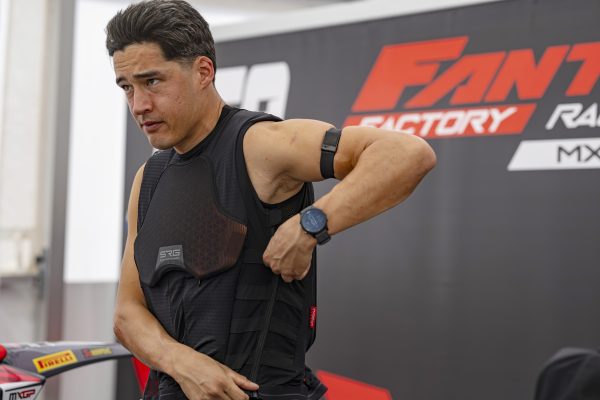
Another critical shift has been the move away from tethered systems. Early airbag vests relied on mechanical cords attached to the bike, which worked reasonably well on the road but made little sense off-road. Motocross bikes rotate, whip and crash unpredictably. Riders don’t always separate cleanly from the bike. Fully electronic, cable-free systems remove that limitation entirely. “It’s all cable free,” Jackson says. “That’s the beauty with the age that we live in now.”
Just as important as deployment is what happens before a crash. Most modern airbag vests combine active inflation with passive armour, rather than replacing it. “The harder you hit it, the more it absorbs,” Jackson says of D3O-style materials in the Shot SRG. This layered approach means riders aren’t unprotected during minor incidents, while still gaining the benefits of airbag deployment in major ones.
Comfort and heat management have also been decisive in motocross adoption. Riders simply won’t wear safety equipment that restricts movement or cooks them in summer. “Being light, lightweight and breathable was a priority,” Jackson explains. “Freedom of movement where riders can feel like they don’t even notice it.” Without that, even the best technology would stay in the pits.
Perhaps the biggest difference between modern airbag systems and earlier generations is their ability to evolve. Algorithms are updated, crash data is refined, and performance improves over time. “All this data is constantly fed into the AI and it just learns constantly,” Jackson says. “It adapts to your riding style.” In other words, the vest you buy today isn’t frozen in time, it gets smarter the more it’s used.
Motocross has never lacked bravery. What it’s lacked, until now, is safety technology that could keep up with its chaos. Airbag vests are no longer a road-racing curiosity or a Dakar novelty. They’re finally being shaped around the realities of dirt, and that may prove to be one of the most significant safety shifts the sport has seen in decades.
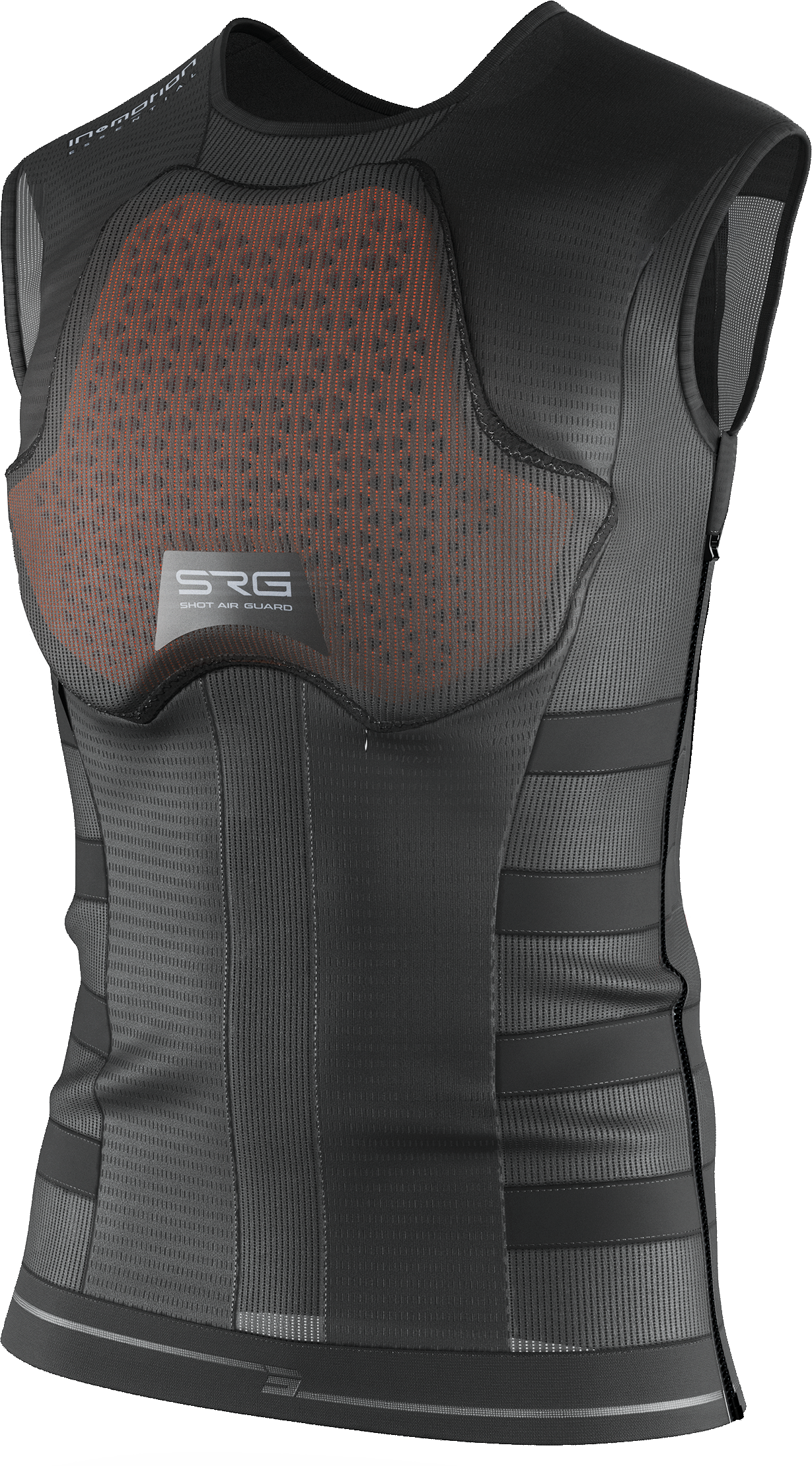
- What is the SRG airbag vest and how does it work in a crash?
The Shot SRG is a fully electronic, cable-free airbag vest designed to protect the rider’s torso, neck and vital organs. It uses gyroscopes and accelerometers to monitor rider movement “a thousand times a second” and deploys automatically when it detects a serious crash, inflating before the rider impacts the ground or an object.
- Why has motocross taken so long to get a purpose-built airbag?
Motocross generates constant heavy impacts that mimic crash forces. As Darren explains, “we have so many bumps and we take so many hits riding a dirt bike” that early systems couldn’t tell the difference between aggressive riding and an actual crash. It took years of data and algorithm development to make MX-specific deployment possible.
- What injury data shaped development?
Shot and In&motion focused on torso trauma, broken ribs, punctured lungs, spinal compression and neck injuries, which are common in motocross crashes. The goal was to stabilise the chest, back and neck in sudden impacts where traditional armour often isn’t enough.
- What triggers deployment, and how are false inflations avoided?
The system looks at direction, acceleration, rotation and force simultaneously. Darren explains that tip-overs, dropped bikes and low-speed crashes won’t trigger deployment, while significant deceleration, rider inversion or violent separation will. “This is designed to prevent serious injury from serious crashes.”
- How important was real-world data?
Critical. Shot logged more than440,000 km of off-road riding data, including factory MX riders, WSX teams and over 200 amateurs.
- What does 30-millisecond inflation achieve?
It means protection happensbeforepeak impact. “That’s faster than a blink of an eye,” Darren says. Practically, it stabilises the neck under the helmet, supports the thorax and abdomen, and spreads impact forces before bones and organs absorb them.
- How is mobility preserved?
The SRG is lightweight, breathable and worn under the jersey with no cables.
- Why combine D3O with an airbag?
Because not every crash triggers deployment. D3O provides constant passive protection, while the airbag handles high-energy impacts.
- What servicing is required?
Canister changes take about a minute and cost $150. The vest is rated for five inflations before a bladder replacement is recommended, which is handled through Shot with a short turnaround.
- What sets the SRG apart from other armour?
Versatility, speed and coverage. It offers neck, chest and abdominal protection, works across motocross, enduro, adventure and road modes, and combines active airbag tech with passive armour, all while remaining light, breathable and race-ready.