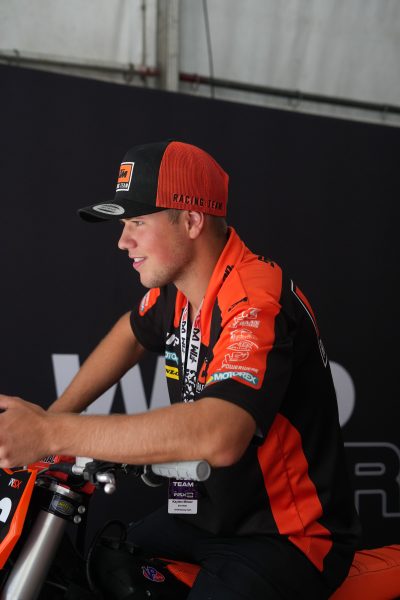
The Kayden Minear rise hasn’t been a straight line — it’s been a full-send journey that started in WA sand, got forged in the cold grind of Ross Beaton’s program at just 13, and then levelled up again when he shifted to Queensland to chase Supercross properly. Now he’s living solo in Florida, navigating visas, bills and big-league pressure, while trying to turn that junior hustle into a long-term career in the US. We sat down with him to learn about his journey to where he is now.
Q: Kayden, you’re a West Australian kid originally, and you left home young. Take us back to the start — what did you grow up riding, and who did you look up to when you were coming through?
A: The biggest people I grew up watching was Gibsy [Kirk], Waters [Todd], them kind of boys. I remember they always used to come over. They used to have a round in WA for the pro Nationals. I remember going, getting all the signatures on the goggles, getting jerseys and stuff like that. But then it kind of shifted to when I got a little bit older, it was like Kyle Webster, because obviously he was a WA boy and then Regan Duffy, another one that’s only a little bit older than me. They were like the two main big ones. I’d almost say I followed Regan’s path a bit and moved over East and started training over there. So that’s kind of how it all started.
Q: You followed that path early. When did you actually move east, and what was the first big step that made it real?
A: I moved to Ross Beaton’s on my own at 13. I remember that year was a big group, but I know the main ones, Jed wasn’t back at the time. Jed was still racing in MXGPs. It was Webster, Duffy. They’re kind of the main ones I can remember. I know there was a lot of others, but they’re the ones off the top of the head.
Q: So you’re 13, you’ve moved across the country, and you’re suddenly on Ross Beaton’s program. What was that like, and when did MX3 come into it?
A: So I moved over there at 13 by myself, which was a pretty big reality shock. I think that was definitely the biggest move in my lifetime. So I moved over there, grinded it out for a bit. And yeah, that’s when I started competing in their MX3 class.
Q: Living on the other side of Australia at 13 is wild. Who were you living with, and who were the big rivals you were dealing with in MX3?
A: I moved over and lived with Mick and Linda Lillis. At the time, he was Webster’s mechanic on the 250. So I was living with them. I think my first year was Blake Fox as my biggest rival in that class. And then second year , once I started fighting for wins and stuff like that, my biggest competition was Campbell Williams. I know he had the red plate a lot of the season. Alex Larson, he was really fast that year.
Q: You were seriously young winning MX3. How old were you when you wrapped that title up?
A: I turned 15 just before I wrapped up the championships. So I was basically 14 when I won it.
Q: The thing people don’t always get is the real-life side of it. You weren’t just training — you were living out of home as a kid. How did you even exist day-to-day at 13? Food, basics, all that stuff?
A: I know. It was pretty crazy. Grocery wise, I used to have mum order me stuff to the house, but if I needed anything extra, I remember just getting on my push bike riding down to the shops, it was fun around there at the time. It was hard work. It was definitely tough at that time, but now I look back and I’m like, man, that built me to be the person I am now, so I’m really grateful for the hard times, definitely .
Q: Did you ever go back to WA once you’d moved east, or was it basically east coast from that point on?
A: No, since then, I was permanently based on the East Coast. I know when I was young , I went home here and there. You know, it’s pretty tough being 13 and living on the other side of Australia to your whole family and friends. So I know I’ve done a lot of back and forward for a little bit there, but mostly, yeah, I was full-time East Coast. I was struggling a lot with it at the start. It was a big reality check. I wasn’t loving it. So mum ended up moving over full time with me to the East Coast. And she was with me until two years ago when I moved to the US. So mum was by my side a lot of the time, which helped a lot. To have mum there, it was definitely a game-changer.
Q: You mentioned the Beaton program being a grind. What did that environment teach you, especially at that age?
A: The biggest thing coming from Beaton’s was he taught you how to have a work ethic and train hard. That whole program is a grind. It’s hard work. It’s not easy. It’s cold, it’s miserable . Like, I remember some days I’d wake up and I’m like, I’m not, I don’t want to go training, but I still turned up.
Q: At some point it shifts from “kid racing” to “this is actually a job.” When did it start to feel like that for you?
A: I was actually speaking with my parents not long ago about this. I was like, man, when did it really become a job? IT still doesn’t feel like a job for me. I love it so much. And I get so much enjoyment out of the whole process about being the best and training hard and doing it all. But I think that what really made it clear that it was a full-time job was when I moved over East. I think first year MX 3, I made like $5,000. It was nothing but I thought I was rich. I remember winning in 22 the championship. I got $10,000 and I thought I was the biggest baller there was. I thought, you know what? I’m going to buy you a Lamborghini. I was over the moon with $10,000. And then I signed my first pro contract with KTM and went, damn! This is when it became a full-time job. That’s when my parents stopped paying for things. I had to pay for them myself. I said, damn, this kind of sucks.
Q: You ended up moving up to Queensland. What drove that decision, and what changed for you up there?
A: I moved to Queensland when I started supercross. Because as a kid coming from the West Coast, supercross wasn’t really a thing. Like we had no supercross tracks, nothing. And at the time, Melbourne was wet, it was cold, it was miserable, and there wasn’t many supercross tracks available at the time. So me and Mum, we made the decision at the last round of the ProMX at Coolum. I think we had two days to pack the whole van to the top of the roof and road trip it the whole way up to Queensland.
Q: You were still on KTM Australia at that point — how does a move like that work with a factory team back home?
A: KTM was based out of Sydney. So wherever I lived, that wasn’t Sydney, they were sending bikes anyway. So I rang them, I told them, look, I’m moving to Queensland. And they said, we don’t mind whatever’s best for your career. And it was good because it put me closer to all the other KTM riders as well. So they’re sending bikes to the same location. So it was kind of easy.
Q: You also linked up with Nathan Crawford’s OO Elite program. What did that add to your Supercross development?
A: Yeah, that was cool. I heard really good reviews about it, he’s a very good supercross coach. And basically, he taught me everything I know about supercross. To this day, obviously, I got new coaches. But he was the one that kind of taught me the fundamentals. And he was really, he was very thorough on getting everything off the bike and around your circle right before you get your riding right. I think that was the biggest one. That was kind of the moment that flicked the switch in my brain. I was like, damn, I need to sort my eating out, my training. He was very big on the off bike training. So he has partners with a gym down on the Gold Coast. So we would do off bike training with them so they can monitor it. There was no playing around. If you weren’t getting the results, you’re going to hear about it on Monday morning with the team meeting. You’re going to be held accountable.
Q: Let’s get to the big leap. How do you go from ProMX and KTM Australia to suddenly being in the US picture? How did it start?
A: It all started in Australia. I first went pro in Oz in 2021 when I was 13. I got an exemption to race the MX3 class at the ProMX. I came third in my opening year. Following year, I won it. So I won the MX3 class and then signed a factory ride with KTM Australia at 15, which was a very big milestone for me. And then I raced pro and then obviously 2024, I was runner up, second place, and I was speaking back and forward with the team. I said, I want to be in America. Obviously, KTM’s a worldwide brand. And they said let me look into it. And we ended up getting in touch with Daniel Blair. And at the time, he was running the Orange Brigade program, which is the amateur KTM program over here and he said we’d love to have you over. So I went over in ‘23, I went over there and kind of done a boot camp for a month, no racing, just training with him. And he liked what he’d seen.
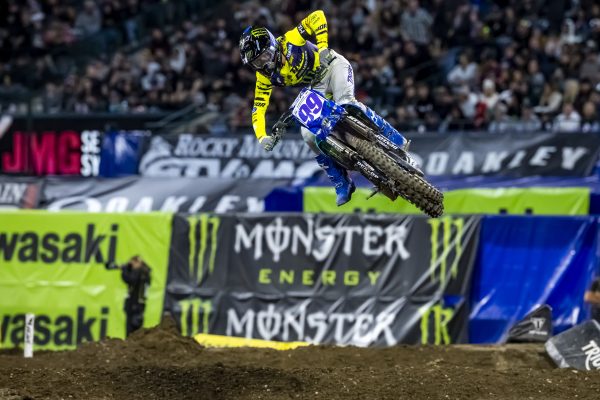
Q: That initial plan gets derailed by injury. What happened and how did it shift the timeline?
A: I ended up snapping my humorous first round of supercross in 2023. So that kind of delayed a bit and then we pushed it out to the last round at Iron Man, for the 2024 MX Sports Pro Racing Scouting Moto Combine.
Q: Ironman was the moment it really popped, right? What happened there?
A: I came over, borrowed a bike. They had a bike here for me and I went out and raced in the first race, I won by 40 seconds and everybody’s like, who is this kid? I know Star wasn’t very happy about it. I beat their rider by 40 seconds or something ridiculous like that. And that’s kind of where it took off. After that, the team reached out to me. They said, hey, we want you to come ride our bike. So I went down there, me and dad, we packed up the truck that we were staying in in South Carolina, drove down to Florida. We test rode the bike. I really liked it. And then I kind of went back to where I was training at the time. I competed at Vegas SMX on a KTM and that’s when the team brought me in the truck and said, hey, look, we want to do something. And I said, let’s do it. So I signed the deal and that’s kind of where it’s taken off from now.
Q: People think the hard part is hopping on a plane. You’ve said it’s everything after that. What’s the actual reality of trying to live in the US at 17?
A: It’s not easy. Honestly, it takes a long time to get your visa. I still haven’t got my visa sorted out. Like, I’m still going through all that. Luckily I could stay at the training facility I was riding out of in South Carolina with Daniel Blair. Jessica Patterson parents live in Tallahassee and it was just by chance they got like a second little house on their property I could stay in. So that’s kind of where I’m living out of right now because obviously I don’t have a social security number. I can’t rent a place. Even insurance, I pay something ridiculous, like $10,000 a year just to have my F150 insured. Just stuff like that that nobody knows about. I’m $35,000 into the visa already. It’s costs like that and stuff that nobody sees, which is probably the most challenging. Anybody can get in on a plane and come over here. That’s the easy, but it’s all the little stuff that it takes to live here permanently, that that was the hardest bit.
Q: You’re there solo, too. No family living with you full time?
A: No, I’m over here solo now, but dad is over visiting at the moment. But yeah, permanently, I’m over here by myself
Q: And despite all the sacrifices, you still talk like you love the process more than the “job” part. Is it still fun?
A: It still doesn’t feel like a job for me. I love it so much. And I get so much enjoyment out of the whole process about being the best and training hard and doing it all.