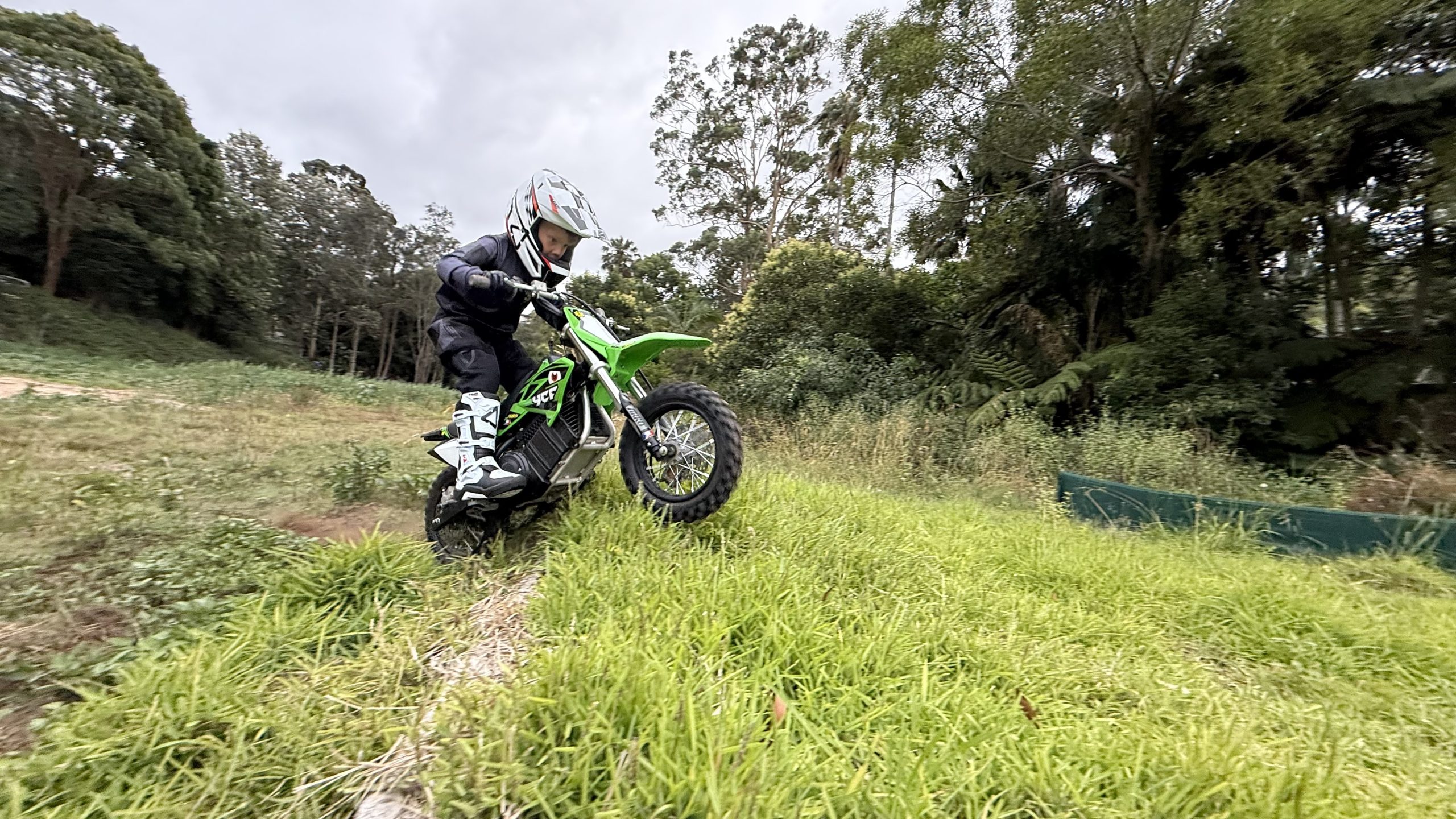
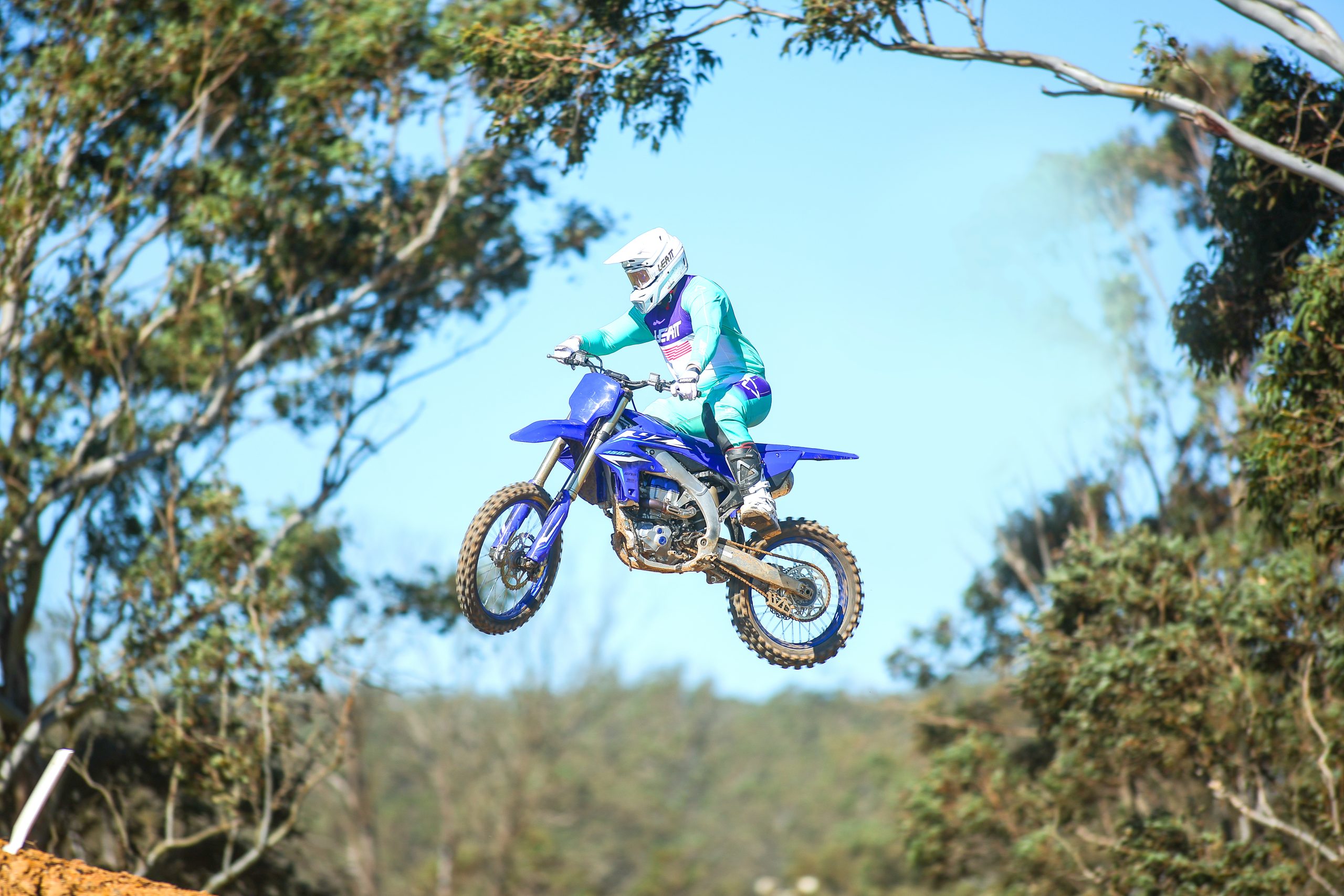
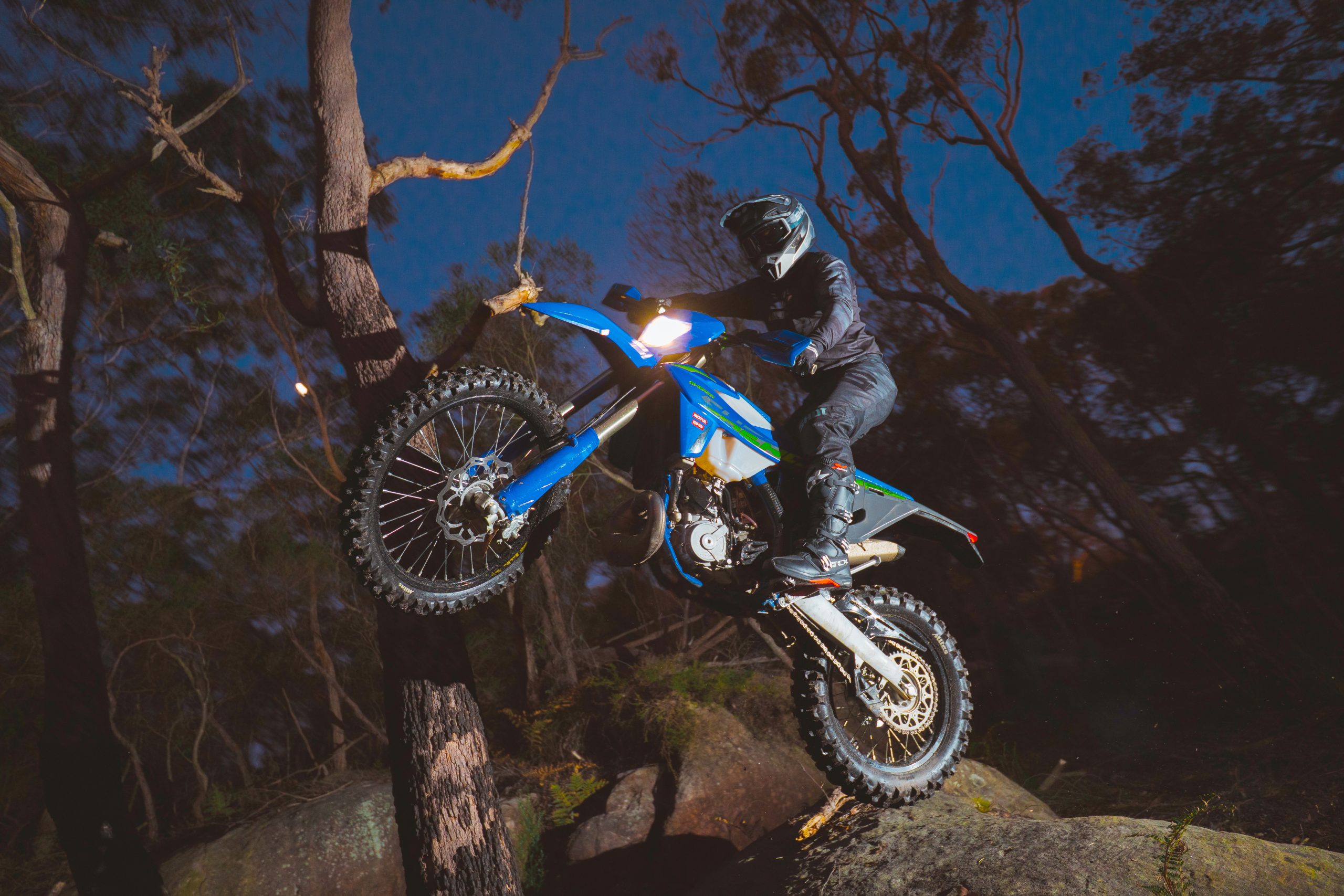
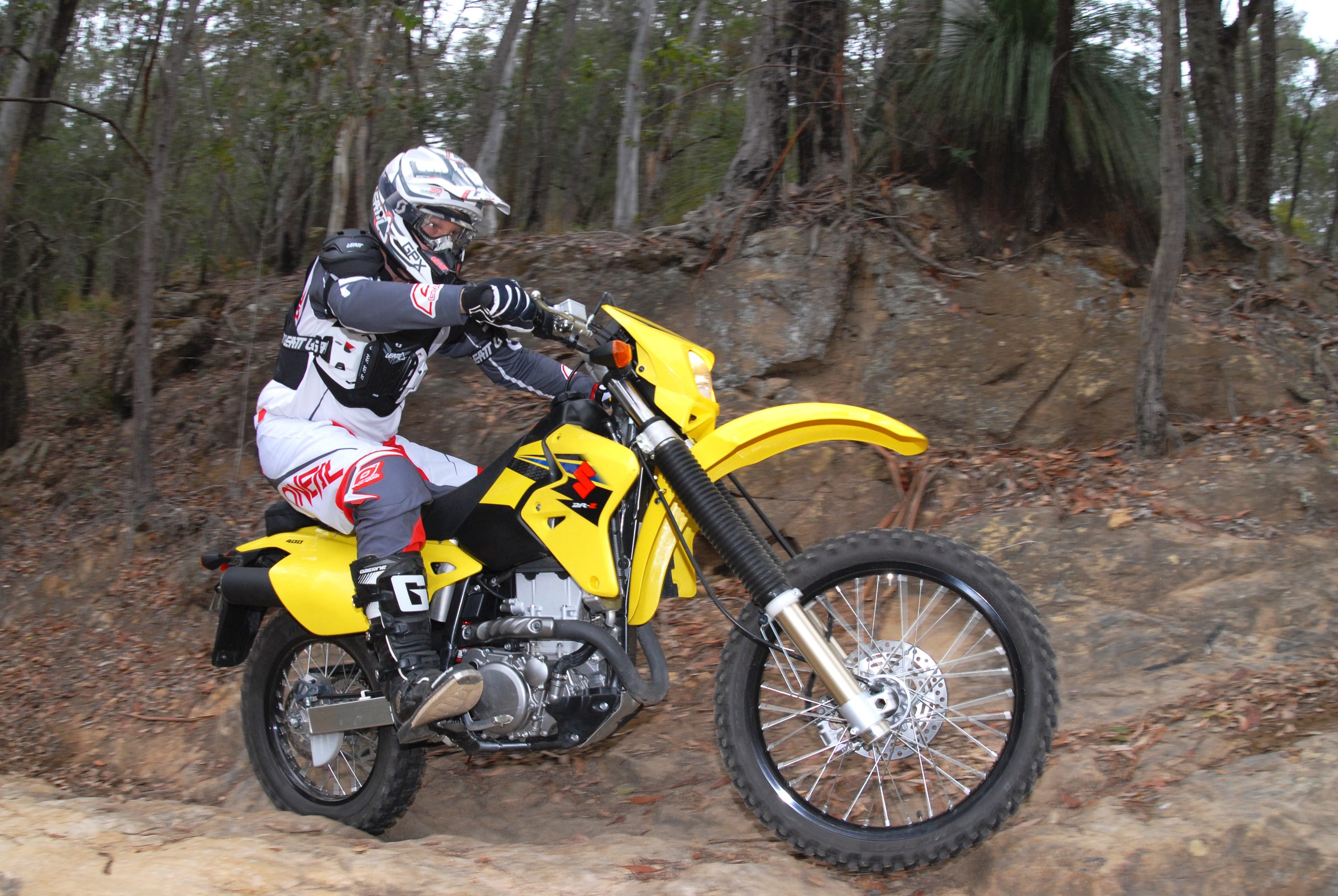
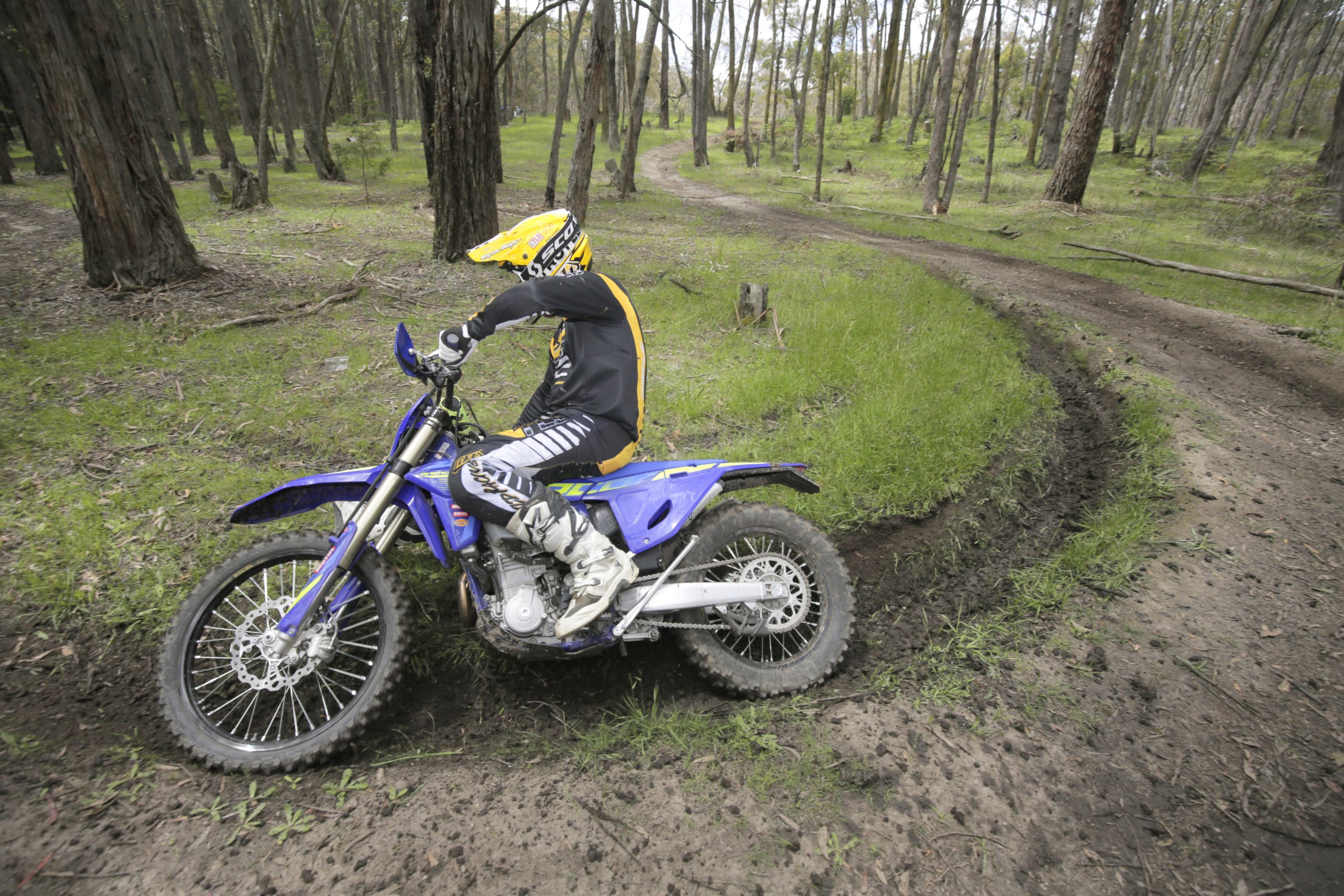
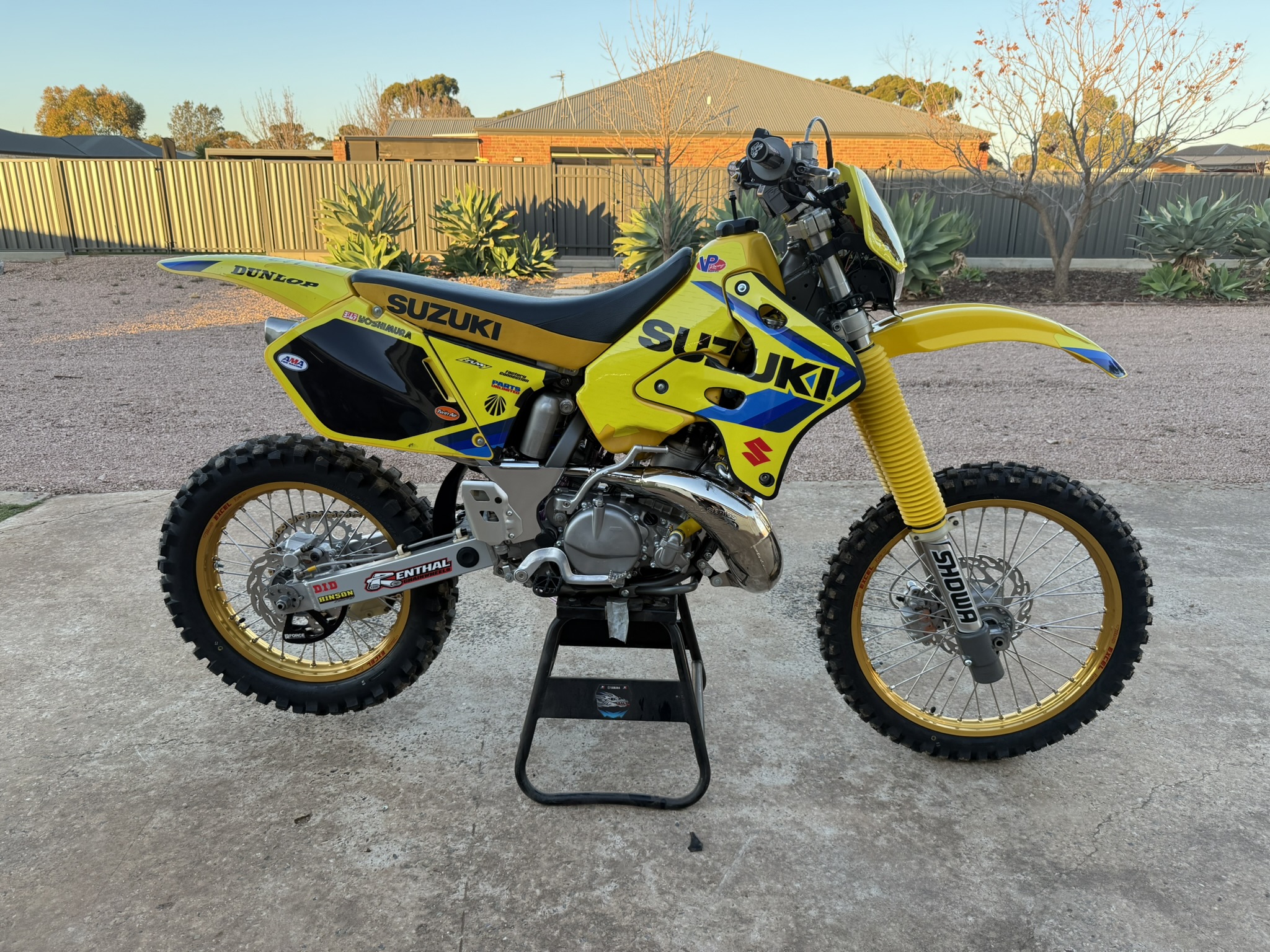
If the kids are arguing about OSETs and PW50s in the backyard, this is the grown-ups’ version of that same debate: Stark Varg versus Honda CRF250R. One is a screaming, fuel-burning cornerstone of the 250 motocross class. The other is a silent assassin with more power than any 250 has ever legally, or morally, needed. It’s the big-boy, full-noise chapter of the petrol-versus-electric saga.
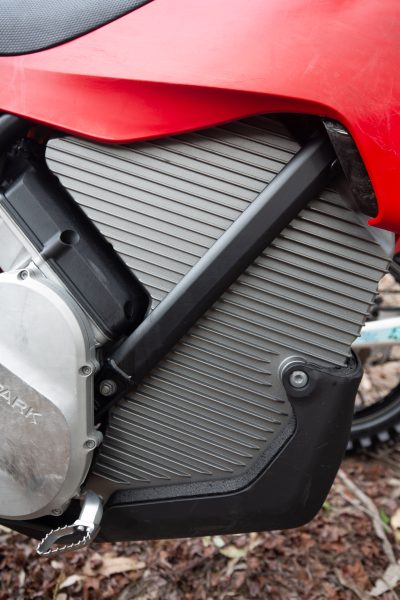
The Stark Varg can be dialled back into “250 mode,” a polite way of saying we’ve neutered it enough to not feel embarrassingly unfair. But even in that setting, you’re dealing with an electric monster capable of instant torque that no combustion engine in the class can naturally replicate. So the question isn’t whether the Varg is faster – it is. The question is whether racing a Varg in 250 trim for 20-30 minutes is faster than a combustion engine.
But here’s where it gets interesting: the CRF250R has agility, chassis precision and a handling characteristic that has defined the class for decades. In tight turns, deep ruts and long motos where fatigue creeps in, the Honda’s old-fashioned petrol heartbeat still gives riders an intuitive feel the electric guys haven’t quite recreated. When you take outright power out of the equation, does the Varg suddenly lose its shine once it has to fight on the 250’s terms?
This comparison isn’t about which bike is “better”. That argument is pointless when both bikes live on opposite sides of the tech universe. It’s about where each one thrives, where each one suffers, and what happens when you line up the most advanced electric motocross weapon on earth against the most polished, race-ready 250 four-stroke Honda has ever built. It’s the future versus the familiar and one of them is about to expose exactly how far the goalposts have moved.
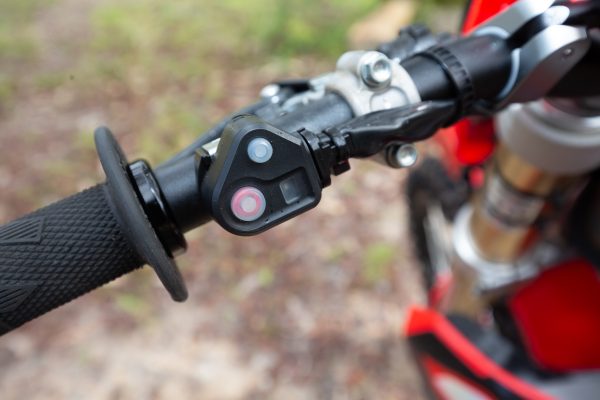
How is it fair?
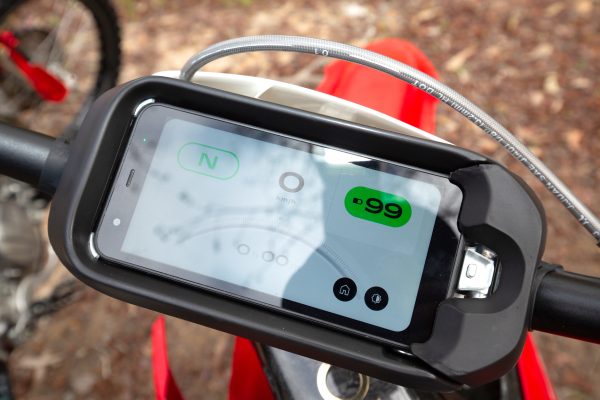
To bring the Stark back to a true 250 equivalent is actually very easy. Stark have developed software within the phone app that allows you to lock the horsepower via a passcode for 24, 48 or 72 hours. While in the app, you go to the settings page, switch on Race Mode, and then select both the duration you want it locked for and the horsepower you’d like to run. SX2 = 48 hp, while SX1 = 60 hp.
The delivery of power from the Stark is on another level, and that comes entirely from the torque of the electric motor. From traction to instant throttle response, the Stark at 48 hp feels closer to a 350F, with no lag, and it makes the bike not only easier to ride but also faster and smoother than any 250F I’ve ever ridden.
The handling of the Stark also excels, with the extra weight giving it a more planted feel, while the lower centre of mass makes it turn almost like a 125cc. The one thing I did struggle with at first was the movement in the air. A twist of the throttle or a brake tap feels far more exaggerated compared with a 250F, and it took me a little while to get used to.
If I had to pick one personally, I’d genuinely struggle. But being heavier and getting older, I’d definitely take the Stark for a race season, depending on the races. For club-level events where you have decent breaks between motos, charging isn’t an issue. I’m not sure how it would go in off-road sprint formats with 8–9 sprints in a day and limited rest time. But if I was choosing purely on performance, the Stark wins hands down. For reference, at 60 hp on a sandy track, I was down to 20% battery in 30 minutes.
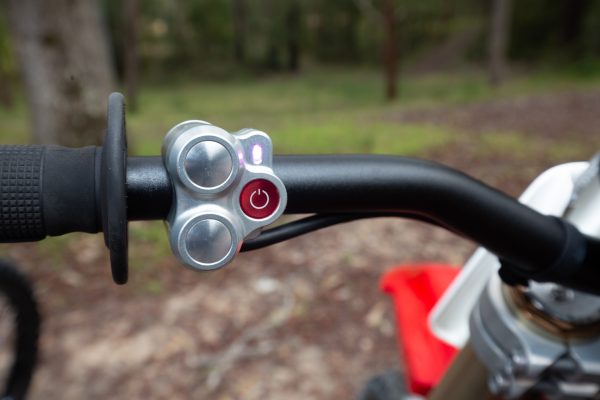
Real world thoughts
But I’m not a 250F rider. I coach a young lady named Mia Tongue and she is. So, we put up-and-coming motocrosserTongue on both bikes, back-to-back, on the same track. She rode the Honda CRF250R and the Stark Varg in 250 mode, swapping between them repeatedly to get a true feel for how each bike behaved with the same rider, same conditions, same lines and same inputs.
What follows is a straight, honest breakdown of her impressions, exactly as she experienced them.
Power Delivery & Torque Feel
The first thing Mia talked about was the power character and in particular, how the torque hits on both bikes.
She didn’t even get halfway down the first straight before noticing it: “Off the start, I reckon the Stark’s got more power. Not having to change gears makes a massive difference.”
She explained that with the Stark in 250 mode, the midrange is incredibly strong, and because you don’t have to shift, the power feels more continuous than a petrol 250F. When we asked about the way power builds: “Top end is probably even between them, but the Stark is smoother from bottom to top. It’s really consistent.”
Interestingly, Mia found the electric bike easier to manage than the Honda: “Definitely easier and more controlled on the Stark. I thought it would be the other way around, but it’s actually smoother.”
And if you’re thinking holeshots, “A holeshot? The Stark in 250 mode would definitely get it.” No hesitation.
Engine Braking & Corner Entry
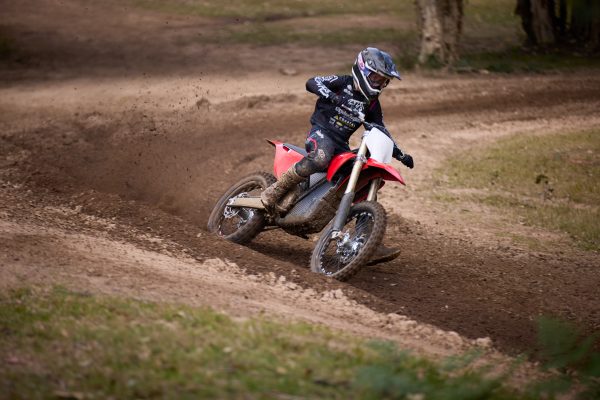
Where the Honda fights back is on corner entry, an area where petrol engines naturally feel comfortable thanks to sound and engine braking. “I probably would prefer the Honda coming into corners. The engine braking helps heaps.”
Engine braking is something riders subconsciously use for control, stability and timing. On the Stark, the silence means she had to adjust her habits. “You can hear the Honda. You can tell where your revs are. On the Stark you can’t hear anything.”
That lack of audio feedback makes judging throttle on the take-off of a jump or entering a rutted corner more difficult: “It’s hard to gauge where your throttle is coming up the ramp. You don’t know how many revs you’re at, so it’s harder to judge.”
But once mid-corner, the Stark claws back an advantage. “Round the corner, the Stark is easier because you don’t have to worry about changing gears. It’s just smooth throttle the whole way.”
Shifting a petrol bike mid-corner can unsettle it: “On the Honda you have to think about gears, and that can make the bike a bit unsettled.” She also explained that even though the Honda can feel better when you nail everything perfectly, “If you get a corner really good on the Honda, it’s hard to beat. But you’re more likely to get it right on the Stark.”
Suspension Feel
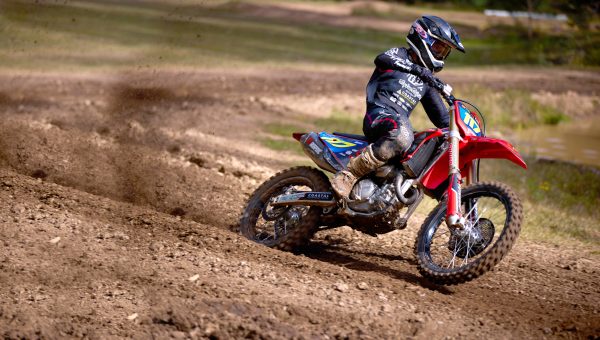
Mia’s take on suspension was clear-cut: the Honda has the better baseline package. “The Honda’s probably got better suspension.” She said the Stark’s suspension felt harsh, particularly over the first part of the stroke. “The Stark is a bit too hard. It’s harsh at the top. It doesn’t soak up all the braking bumps.”
But surprisingly, she didn’t find it a problem when landing jumps, “Landing off a jump it’s fine. It’s just on the little bumps where it feels harder.” That harshness means the rider has to work more with the bike. “You’d have to work more with the Stark’s suspension to get it where you want it.”
Jumping, Scrubbing & Mid-Air Control
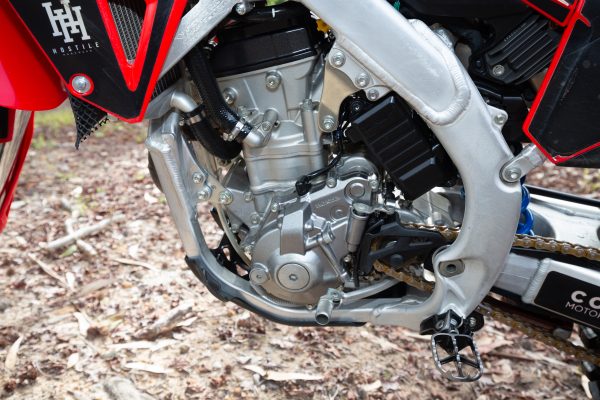
This was where Mia gave the most detailed feedback, because the bikes behave very differently in the air. She’s done plenty of jumping on both and didn’t need long to weigh them up, “The Honda’s better in the air. You can give it a bit of a rev and it settles. On the Stark it’s harder to get it settled.”
Electric bikes don’t have the same engine inertia as petrol engines, and Mia picked up on that immediately. “A throttle twist or a brake tap on the Stark is way more exaggerated.” She said the Stark reacts faster and more dramatically, which takes time to trust and adapt to. On scrubs, “When you try to scrub, the front comes up a bit higher on the Stark. It’s harder to keep the height down.”
Part of that is the sound issue again. “Not being able to hear the motor makes it harder to know where your throttle is. On a ramp you need that.”
Despite that, she’s seen elite European riders throwing insane whips on Vargs. “Yeah, they can get them upside down. But it takes time to get used to it, it’s different to a petrol engine in the air.”
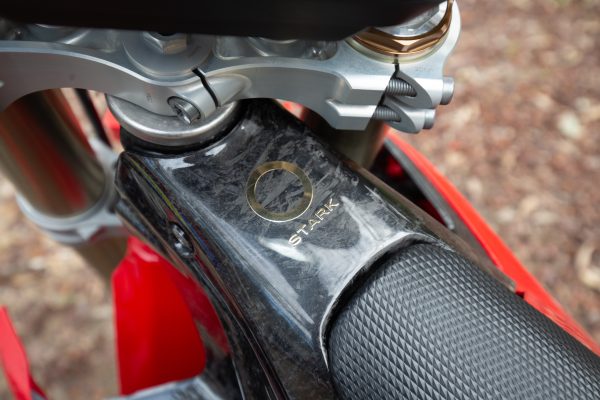
Corner Balance & Chassis Feel
We asked Mia which bike felt more balanced through the full arc of a corner. She said the Stark felt smoother in general because of its uninterrupted drive, “The Stark is easier because you don’t have to worry about gears. Just steady throttle.”
But the Honda’s natural stability and handling reputation are still strong, “The Honda handles really well. If you’re flowing, it’s beautiful through a corner.”
When pressed to choose which one gives her more confidence mid-turn. “If you get the Honda perfect, it’s amazing. But it’s easier to get it right more often on the Stark.”
A 15-Minute Moto
The big question: Which bike would Mia be faster on over a full moto? “Probably the Stark.” She said the smooth power and lack of shifting would help late in the moto when fatigue sets in.
But then we asked why she hasn’t switched to a Varg. “Off the gate, I find it really hard on the Stark because you can’t rev it.”
Starts, in her view, are the biggest barrier. “With the Honda, you can rev it and time it. On the Stark you just have to go when the gate moves.”
A petrol clutch start is still a weapon, “The clutch helps massively. Starts are harder on the Stark without it.”
Which is better?
In the end, the Stark Varg in 250 mode delivers the kind of smooth, instant and deceptively powerful performance that makes a petrol 250F feel almost old-fashioned. It’s easier to ride fast, easier to repeat good laps and far less punishing when the track gets rough or you’re getting tired. But the Honda CRF250R still wins on familiarity and feel, especially on corner entry, where engine braking, sound and inertia give riders the confidence they’ve built their entire riding life around. The Honda is also still the more intuitive bike in the air, thanks to that classic petrol rev-control that helps settle the chassis mid-flight.
For pure speed over a moto, Mia would take the Stark. But for starts, jumps and that natural rhythm only a petrol bike delivers, the Honda remains hard to beat. The Stark isn’t a better or worse 250, it’s a different species entirely.
STARK VARG vs HONDA CRF250R — SPEC BATTLE
ENGINE / MOTOR
| Spec | Stark Varg | Honda CRF250R |
| Type | Electric motor | Liquid-cooled 4-stroke, single-cylinder |
| Displacement | — | 249.4 cc |
| Valves | — | 4 |
| Power | 48 hp to 80 hp (Alpha) | About 40hp |
| Torque | Up to 938 Nm (rear wheel) | — |
| Power Modes | 100+ modes via app | — |
| Engine Braking | Adjustable (app) | Fixed (petrol) |
| Traction Control | Adjustable (app) | N/A |
| Fuel / Energy | 6.5 kWh (MX) or 7.2 kWh (EX) | Fuel Injection |
| Starter | – | Electric |
| Transmission | Single-speed | 5-speed |
| Final Drive | 520 chain | Chain |
CHASSIS
| Spec | Stark Varg | Honda CRF250R |
| Frame | Chromoly steel w/ aluminium subframe | Aluminium |
SUSPENSION
| Spec | Stark Varg | Honda CRF250R |
| Front Suspension | KYB/Technical Touch AOS fork, 12.2 in travel | 49 mm inverted fork, comp/rebound adj., 310 mm travel |
| Rear Suspension | KYB/Technical Touch monoshock, 12.2 in travel | Single shock, preload/comp/rebound adj., 308 mm travel |
BRAKES
| Spec | Stark Varg | Honda CRF250R |
| Front Brake | 2-piston Brembo, 260 mm Galfer disc | Nissin 260 mm disc |
| Rear Brake | 1-piston Brembo, 220 mm Galfer disc | Nissin 240 mm disc |
DIMENSIONS & WEIGHT
| Spec | Stark Varg | Honda CRF250R |
| Weight | 118–120 kg | 107 kg |