WHAT ARE THEY? They are 1988 HUSQVARNA 430AE AUTOMATIC.
Who Grant Andrew Field
WHERE DID YOU BUY IT? Dealer and private.
HOW MUCH? I paid $1,000 in 1997 for the first one (now restored) from Pro Honda and $3,000 for the second one (unrestored) from a private seller in Victoria.
I am an avid collector of vintage Japanese bikes and have 52 bikes in my collection. They are mostly first-year model TM Suzuki, RM, YZ, and CR, as well as some oddity vintage road bikes like the RE5 Suzuki x2, GT750 Suzuki, GSXRs, and the most mental of the lot, an ATC250R. I just picked up a Honda Odyssey to restore. I can send pics if you like.
The restored one I bought from Pro Honda in Brisbane when they were based at Rocklea in about 1997. It was in bad shape and did not run.
The unrestored one I bought from a private seller in Victoria in 2023. It ran great but had not been started for many years and was also rough.
WHY DID YOU BUY IT?
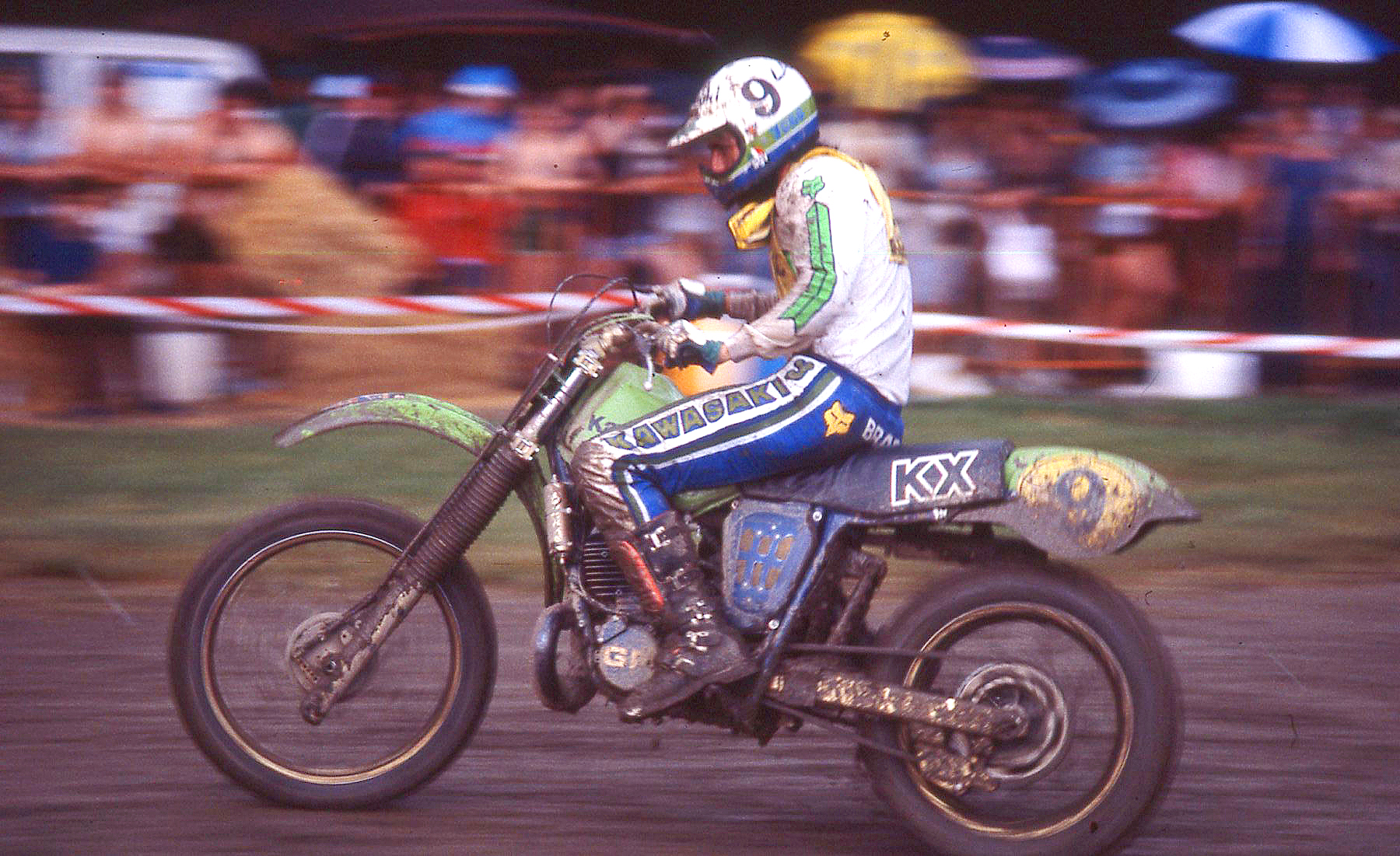
I raced a 1987 and 1988 Husky Auto in the Qld Pony Express series in ’97 and ’98. I also raced the Castrol 12-Hour Pony Express in ’97 and ’98 and did quite well. I sold the bikes after each race season and regretted it, as they are quite rare and unique, so I kept an eye out for one for sale.
The first one came up at Pro Honda in Brisbane in 1997 through a friend, Darren Smart, who worked there. He said it had been traded in, was in rough shape, and did not run. I went to look at it and made a deal that I would pay $1,500 for it if I could not start it and $1,000 if I could. He took me up on the unusual challenge.
I knew from my previous experience with these bikes that the fuel tap leaks when turned off, causing fuel to siphon through the main jet into the engine. I knew the cylinder and exhaust would be full of fuel. I started by removing the spark plug and tipping over a litre of fuel out of the cylinder, then kicked the engine over about 50 times with the plug out. I then fitted the plug and gave it one almighty left-hand kick right-footed, and she fired up first kick!
The only problem was the workshop Hiace van was right behind it, and it sprayed the nice white Pro Honda van with black oily fuel out of the exhaust. The workshop manager was not pleased!
WHAT HAVE YOU DONE TO IT?
The first one I bought from Pro Honda in 1997 was fully restored to as-new condition, as it was very rough. I raced it a few times after restoration at the Moreton District MX Club based at Tivoli in the veteran class (me, not the bike).
In 2018 this bike was stolen from my shed along with a 1986 GSXR1100. I searched for it for a number of years, but it had clearly disappeared. I kept an eye out on Marketplace and saw the second one come up for sale in 2020. I asked for the VIN, but it was not my stolen bike. I bought it anyway and fixed it up as a rider, with the intent of one day restoring it.
Then about six months ago, a local guy who delivers firewood—and knew that the original Husky had been stolen—contacted me and asked if I wanted to buy a 1988 Husky Auto. He brought it around to my place and I immediately recognised it as my stolen bike, although it was in terrible condition from being left outside. I checked the VIN and confirmed it was my stolen bike. He had found it behind a shed on the outskirts of Ipswich.
He gave it back to me!
I then set to work and re-restored it to what it is now, keeping the other Auto as the rider.
HOW DOES IT GO?
They are typically the legendary, mental open-class 2-stroke.
Power everywhere!
Even better is that the 3-speed automatic ensures the engine is always running in the torquiest part of the powerband, so their trench-digging ability is only a minor twist of the throttle away!
The gearbox always seems to be in the correct gear.
They will top out at about 170 kph (I got fined back in 1988 for speeding on the beach at Double Island Point racing two mates on TT600s).
They have no engine braking on trailing throttle, which is a little disconcerting at first, but once you get used to this, they are seriously fast in the tight going as you can’t stall them.
Suspension is good for the era, as you would expect from a high-end Öhlins set-up.
Front disc is strong, rear drum is very progressive.
WOULD YOU RECOMMEND BUYING ONE?
Absolutely! They are torque monsters and very easy to ride fast. Get used to no engine braking and sliding the rear around under brakes, and they are unbeatable in the tight going. They also have an amazing top speed for the fast stuff.
The 1988 models were much easier to start, having a Mikuni carb and Kokusan ignition. Previous models had a Dell’Orto carb and SEM ignition.
The gearbox is cassette-style, so it can be completely removed without taking the engine out of the frame or splitting the cases.
Parts are still readily available, as there are a few companies producing reproduction parts.
4 UNIQUE THINGS ABOUT YOU OR THE BIKE
- Automatic open-class trench digger!
- Always in the powerband.
- Can’t stall it.
- Can lock up the rear, load the auto box with throttle, and bust berms like a 2,000 lb bomb.
These are the last year for the Swedish-made Husqvarna, as Husqvarna was sold to Cagiva in 1988. Cagiva chose to discontinue the automatic.