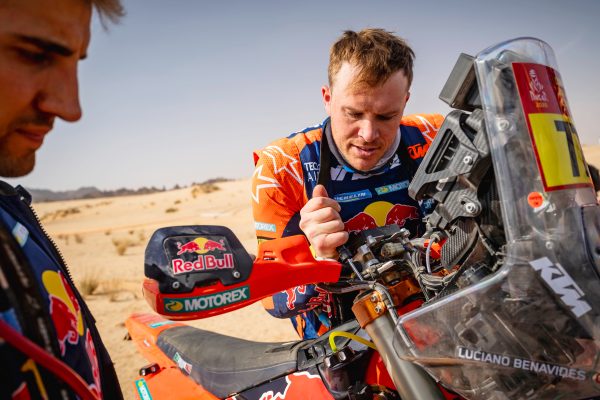
The 2026 Dakar Rally had everything, speed, chaos, heroics, heartbreak, but if you’re reading this from Australia, there’s only one story that really mattered. Daniel Sanders rode half the Dakar with a broken collarbone and a fractured sternum, and somehow turned what should’ve been a DNF into one of the toughest performances the event has ever seen.
Yes, technically, Luciano Benavides won the rally in the tightest finish ever (by 2 seconds). And fair play, Dakar victories are never accidental. But while the stopwatch crowned a winner, the desert chose its own hero. Sanders’ crash should have ended his rally on the spot. Instead, it lit the fuse on a story that had riders, teams, and fans shaking their heads in disbelief.
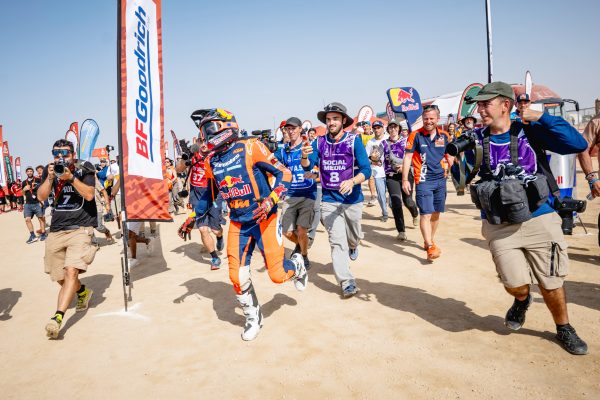
There was an entire Dakar still happening after Sanders hit the deck. Factory battles. Tactical riding. Navigation chess matches played at 150 km/h. And yet somehow, none of it mattered as much as watching an Aussie refuse to quit when every sensible option said he should. This wasn’t just tough. This was “Australian of the Year” tough. The kind of grit that doesn’t show up in highlight reels but lives forever in Dakar folklore.
We sat down with Chucky to unpack it all, the crash, the pain, the decision to keep riding, and the mental battle that followed. Because while 2026 Dakar will always be about winners, sometimes the most important story isn’t who stood on the top step in Riyadh, it’s who proved just how much a human can endure when quitting isn’t part of their vocabulary.
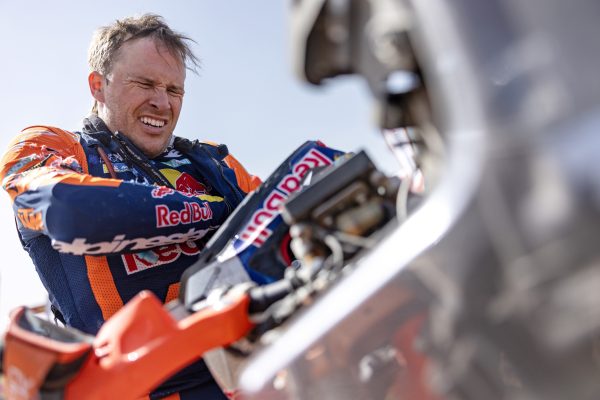
The Dakar that tried to Break Chucky
By the time Daniel Sanders rolled into the bivouac late on Stage 10 of 2026 Dakar, the race had already taken everything it could from him, and then taken more.
A fractured collarbone. A re-injured sternum. A fractured top rib. And, by the time the dust settled, a grade-three torn groin muscle caused not by a single impact, but by days of compensating, gripping a 450 rally bike with one arm.
For most riders, any one of those injuries would have ended a Dakar campaign instantly. For Sanders, it became the beginning of a three-day survival exercise that would define the rally, reshape the World Rally Championship fight, and cement his reputation as one of the toughest riders the event has seen in years.
The Setup Before the Fall
Stage 10 was already a high-risk day. The second part of a marathon stage, deep into the rally, where fatigue clouds judgement and small mistakes get punished brutally. Sanders had started the day second on the road, with a clear strategy.
“I was planning to catch Tosha as quick as we could,” he explains. “In the dunes, everyone was going to lose time. It was one of those days where you didn’t want to open, but you sort of had to do what you had to do.”
But even before the big crash, the warning signs were there.
With only around 40 kilometres to the first refuel, Sanders was running a light fuel load, roughly 10 to 12 litres instead of the usual 20. Somewhere in the dunes, the bike began coughing.
“I sort of shit myself,” he says bluntly. “That’s the worst nightmare. You’re going through the dunes and it starts spluttering and you’re like, no, no…”
The fuel pump tested fine later. The fuel light likely failed. But in that moment, Sanders’ head was already racing ahead, contingency plans, tank swaps, riders behind him who could help if needed.
“At that 40K mark my head was like, ‘What’s going on? What’s the situation?’ I’m already planning everything in my head.”
It was the first crack in concentration on that fateful day. Dakar only needs one.
The First Hit
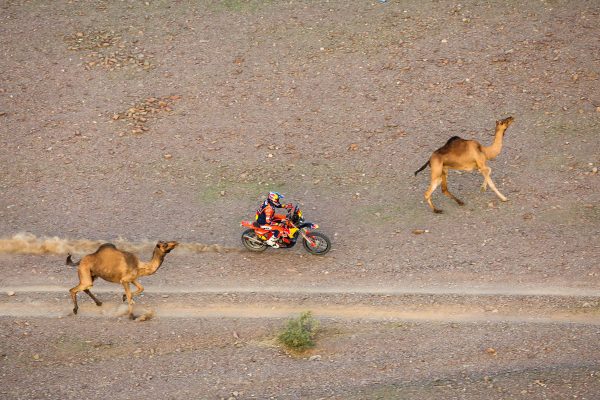
Not long after, Sanders crested a dune and dropped into what looked like nothing, until it wasn’t. “A little sinkhole behind the dune,” he explains. “Only like a metre deep. Everything looks smooth, but it’s just this little booby trap waiting for you.” He hit it hard. “That was like hitting a wall at sixty,” he says. “Just smashing your face on the handlebars and the tower.”
The data confirmed it later: from 60 km/h to zero, instantly. The impact re-injured his sternum, a fracture he’d suffered months earlier, and the helmet strap cut into his chin and throat as the bike stopped dead. “I got really weak in the chest straight away,” he says. “I wouldn’t have been able to do a push-up.”
For many riders, that alone would have been enough. Sanders dragged the bike out of the hole, shook it off, and kept going. “You just have to,” he says. “Shake it off and continue.”
The Dune That Ended the Race
After refuelling and resetting, Sanders found himself riding in a small group, Michael Docherty, Tosha, Ricky Brabec, transitioning from soft, powdery dunes into faster, firmer terrain. The problem was expectation. “Coming off the soft ones, you’re expecting the last couple of metres to be softer,” Sanders explains. “You judge your braking and power for that.”
But the next dune was hard, all the way to the top. “It was like hitting ice.” Sanders hit the crest faster than he should have. Tosha went over first and missed the braking point. Sanders followed, carrying even more speed. “I flew extra a few metres further,” he says. “Which means you drop in another couple of metres further in elevation.”
The landing was catastrophic. “I just collapsed,” Sanders recalls. “I already had no strength. My arms would’ve just blown off the bars.” The bike landed on top of him, pinning him in soft sand, facing downhill. “I was stuck under the bike,” he says. “Pinned. And I’m just thinking, ‘I’ve got no strength right now.’” Tosha sprinted to the top of the dune to warn oncoming riders. Brabec lifted the bike off him. That’s when Sanders knew. “You can see it on the helicopter footage,” he says. “I’m wiggling my arm and going, ‘Something’s not right in the shoulder.’” The diagnosis was instant. “I’m like, ‘Ah, I’ve done my collar.’”
Decision Time in the Desert
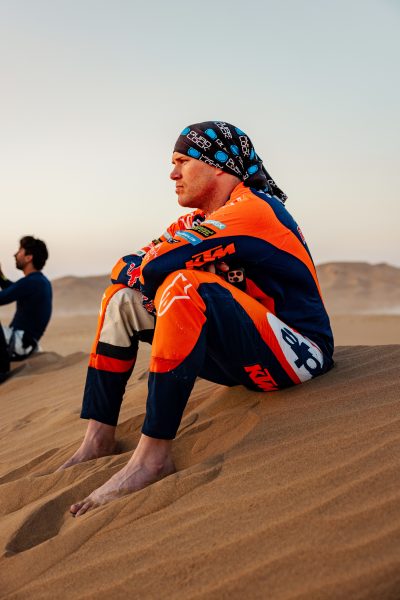
Battered and exhausted, Sanders still believed he could ride. “It wasn’t crunching or floating like a full shattered one,” he explains of the collarbone. “I could move it.” He lifted the bike. Dropped it. Lifted it again. “I grabbed it, lifted it, crashed it again, picked it back up,” he says. “And I was like, ‘Alright, let’s see if I can do it.’” That moment ended his 2026 Dakar win. “That’s where I lost the race,” Sanders says. “From that moment it was survival mode.” The goal changed instantly: manage the damage, finish the stage, and then reassess whether continuing made sense.
Held Together With Tape
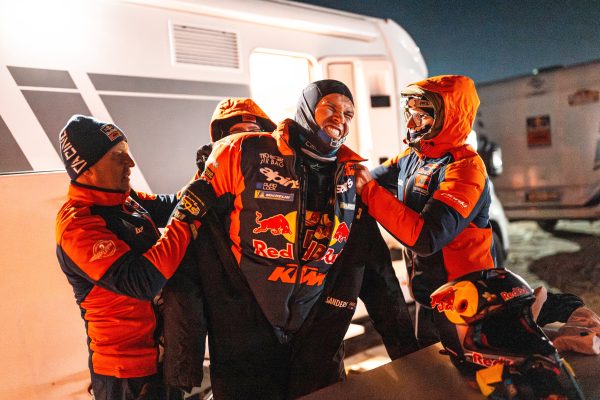
At the next refuel, the medical team confirmed what Sanders already knew. “I said, ‘I broke my collar,’” he recalls. “They’re like, ‘Right, what do you want to do?’” The answer was immediate. “Get whatever tape you’ve got and let’s go.” When they pulled his gear off and saw the swelling and displaced bone, the mood shifted. “They’re like, ‘Oh yeah… he’s done it.’” The medics could have stopped him if the injury was life-threatening. This wasn’t. “They weren’t going to stop me,” Sanders says. “They saw me get through that day.” From that point on, every medical checkpoint became a small show of respect. “I got applause every stop,” he says. “The medics knew what I was going through.”
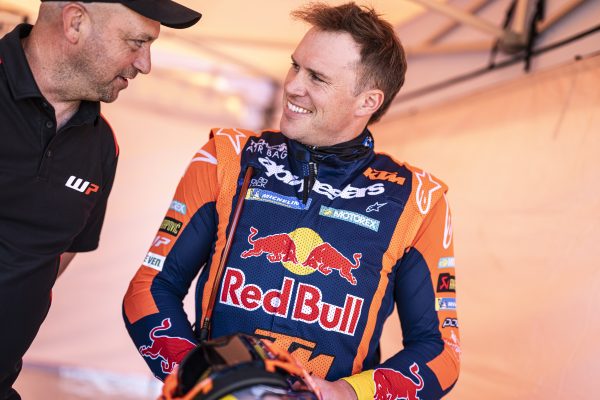
Riding With One Arm
The physical compromise was brutal. Clutch control was still possible, fingers worked, but the left arm was reduced to a single function. “It was literally just gripping the bike,” Sanders explains. “That’s it. Five per cent work.” Everything else shifted to his body. “All the work went through my left leg and right arm,” he says. “Like a diagonal cross.”
Standing was mandatory. “If I sat down, any bump would jolt through everything,” he says. “So I had to stand.” That decision destroyed his groin. “A grade-three tear,” Sanders says. “From gripping the bike too much, compensating for the arm.” By the finish line, the pain was overwhelming. “I couldn’t kick my sidestand up,” he admits. “That’s how bad it was.”
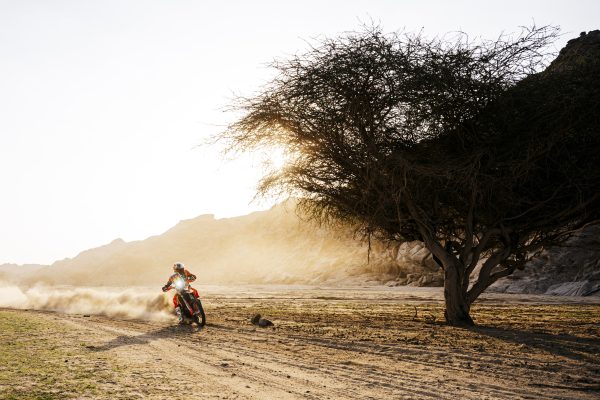
Why He Didn’t Stop
Back at the team truck, the conversation wasn’t emotional, it was mathematical. Grabbo asked the only question that mattered. “Is it worth it?” Sanders recalls. The answer came quickly. “If you drop Dakar, you lose a heap of points,” Sanders says. “If I can sit top five or top ten, it’s worth it.” The numbers backed it up. Even injured, Sanders was losing surprisingly little time. “I only lost three-thirty to the fastest guy over the last hundred kilometres,” he says. “That’s top ten. Pulling out would have ended his World Rally Championship defence. Continuing kept it alive.
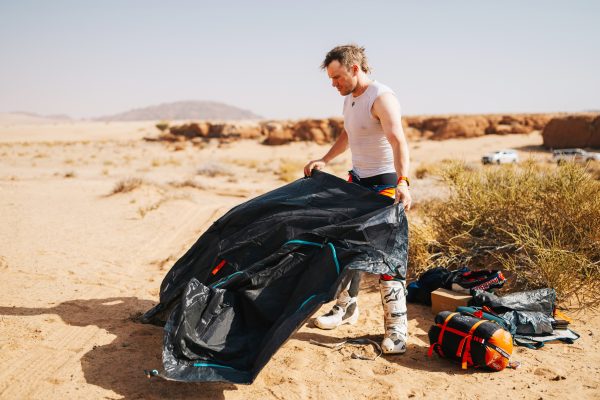
Pain vs Losing
Sanders doesn’t romanticise the suffering. He explains it simply. “I hate losing,” he says. “I was so pissed that I crashed and broke my collarbone and was out of winning it.” Going home early wasn’t an option. “I’d still be dirty when I got home,” he says. “I’d rather burn some of the pain out there.” The mindset was ingrained long before 2026 Dakar. “My dad always said: start any race, finish it,” Sanders explains. “Unless it’s mechanical.” That rule hasn’t changed. “If my body’s still working and can ride a bike, I’ll sit on that thing until my body says you can’t do this no more.”
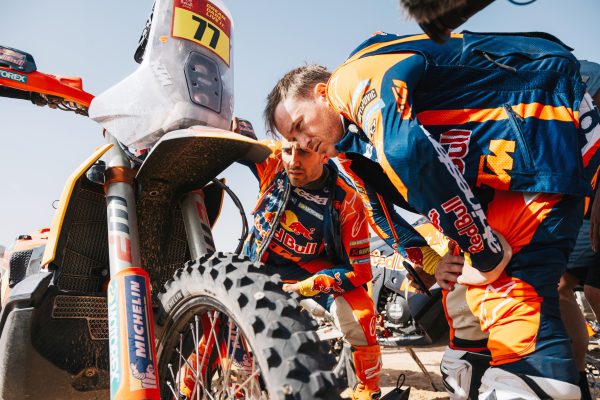
The Toll
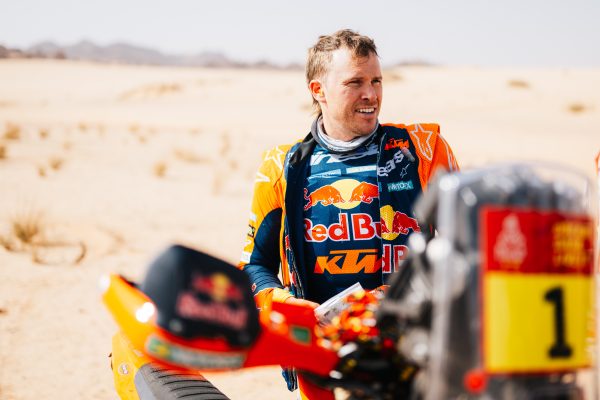
By Stage 12, the body was failing fast. “My right tricep was cooked,” Sanders says. “I already had tennis elbow in that arm before the race.” The technical stages were torture. “First gear, rocks everywhere,” he explains. “You actually have to use muscle to keep the bike straight.” The groin finally gave up, “Lying in bed, my foot would flop outwards,” he says. “I couldn’t pull it back in.” Running to congratulate his teammate at the finish, the limp we saw was unmistakable. “I don’t think I could’ve done one more day,” Sanders admits.
Aftermath
Surgery came quickly. A plate in the collarbone. Time needed for ribs, sternum, and muscle to heal. But the decision to continue might pay off. “If I win the championship by less than 17 points,” Sanders says, “you’ll know why I pushed on.” 2026 Dakar will be remembered for many things, close finishes, tactical gambles, and heartbreak. But for Daniel Sanders, it will be remembered as the year he refused to quit. Not because he was unbreakable. But because he was already broken, and rode on anyway.
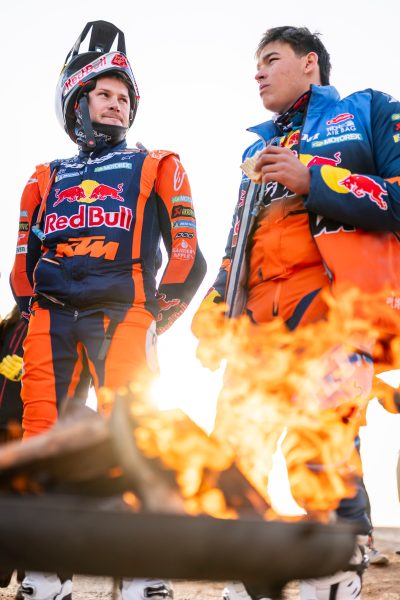
Chucky’s Dakar: Broken, Beaten, Finished
From the moment the 2026 Dakar Rally rolled out of Yanbu, it was obvious Daniel “Chucky” Sanders was in the mood to fight. The prologue and opening stages weren’t about fireworks, they were about positioning. By Stage 2, he did exactly that, punching in his first stage win of the rally and putting himself on top of the overall standings. Classic Sanders stuff: fast when it mattered, smart when it counted.
The first week became a high-speed chess match. Sand, rocks, dunes, bonus seconds, penalties, the margins were brutal. Sanders rode some of his best 2026 Dakar stages through the deep sand, opening routes, managing tyres, and still finding speed where others bled time. Even when a speeding penalty clipped his buffer, he stayed calm, recalculated, and kept himself in the hunt. At the rest day, he was still very much in the title fight, even if he admitted the rally hadn’t been as clean as he wanted.
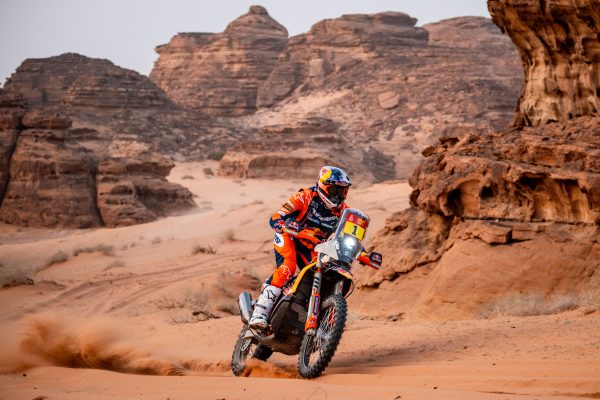
Then Dakar did what Dakar always does. Stage 10 changed everything. Charging through the dunes and right back in the mix, Sanders launched off a big dune, landed hard, and crashed heavily. Broken collarbone. Broken sternum. For most riders, that’s the end of the rally. For Chucky, it was just the start of a different kind of race. He got back on the bike, rode it to the finish, passed medical checks, and fronted up again the next morning: bruised, taped, and very clearly hurting.
What followed wasn’t about results anymore. It was about grit. When the final stage wrapped up in Yanbu, he crossed the line fifth overall. Not a win, not a podium, but one of the toughest Dakar finishes you’ll see.
Play-by-play
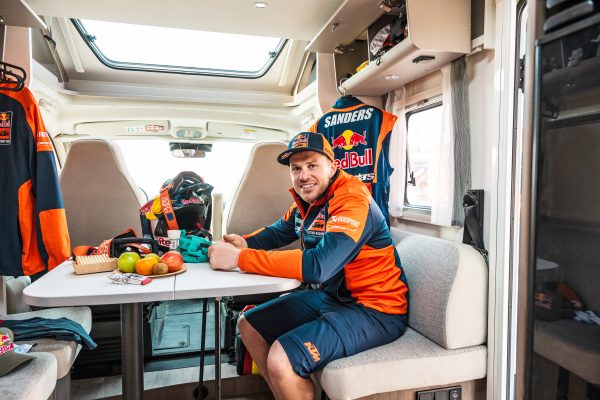
Stage 1 (Yanbu loop): “fast, dusty, sandstorm-ish… but we’re rolling”
- Stage 1 is brutal from the opening kilometre: narrow passes, jagged rock gardens, then opening into sand and small dunes near the finish.
- Canet goes P1, Sanders follows him home P2 (+1:02), with Brabec third.
- Sanders’ own take: it was fast and straightforward but made tricky by wind, dust and even sandstorm conditions. Most importantly: no issues, no “Dakar tax” paid early.
Overall after Stage 1
- Canet leads, Sanders is P2 overall (+1:05).
Stage 2 (Yanbu → AlUla): Chucky strikes back, first win, takes the lead
- Stage 2 is 400km selective, starts slow/technical through mountains and rocky passes, then turns into faster terrain with riverbeds, sandy plateaus and canyons.
- Sanders starts second and basically announces, “Yep, I’m here for this.”
- By km 70, Sanders moves into the lead. He catches Canet, the KTM pair run together, and they manage the navigation late where mistakes are costly.
- Bonus time becomes the difference-maker: Sanders wins Stage 2, Canet P2, and Chucky grabs his first stage win of 2026 and 10th Dakar stage win.
Overall after Stage 2
- Sanders leads the Dakar by 30 seconds over Canet.
Stage 3: longest special so far, Sanders opens and banks bonus time
- Stage 3 delivers the longest timed special of Dakar so far (421km) within a brutal 736km loop around AlUla, with sandy canyons, plateaus, narrow tracks and heavy emphasis on navigation.
- Sanders opens the stage from start to finish, earning over six minutes in bonus time and delivering a controlledP3 (+3:28) — his fourth consecutive top-three result.
- Despite the difficulty of opening on a high-risk navigation day, Sanders rides cleanly, keeps rhythm, and avoids major mistakes where others falter.
- It’s not about outright pace — it’s Dakar-smart execution. The bonus time and consistency are enough for Sanders toextend his overall rally lead.
Overall after Stage 3
- Sanders leads overall; Brabec P2 (+1:07); Schareina P3 (+1:13).
Stage 4-5 (marathon stage ends): management mode, protects the tyres, regains lead
- Stage 5 closes the marathon stage: riders leave the spartan camp, no outside assistance, and it’s all about reliability, endurance and smart decisions.
- Benavides wins Stage 5.
- Sanders rides a controlled P3 (+5:50) while explicitly managing worsening tyre damage. He checks tyres after refuel, realises it’s trending bad, and backs off through the middle to avoid ending his rally.
- It’s not sexy… but it’s Dakar-smart. That conservative call is enough for Sanders to regain the overall rally lead.
Overall after Stage 5
- Sanders leads overall; Brabec P2 (+2:02); Benavides P3 (+5:55).
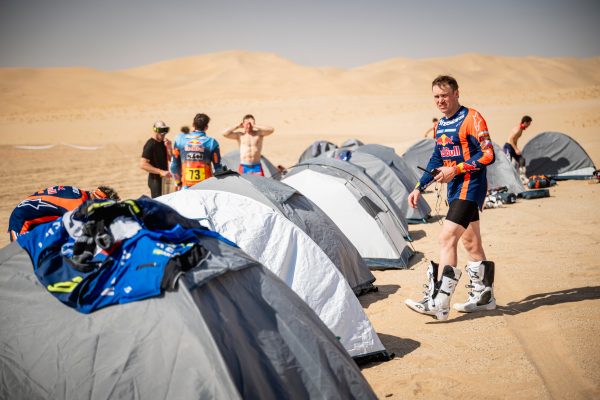
Stage 6 (Ha’il → Riyadh): dunes masterclass… then the penalty gut-punch
- Stage 6 is the longest day so far: 920km total, 331km special, and the entire timed section is sand in the Qassim region, navigation + endurance + dune skill.
- Sanders is on it. He catches Benavides by km 78, opens a gap, and rides “masterclass” pace, he’s 4:43 faster than the next best on raw speed.
- Then Dakar does Dakar things: a six-minute speeding penalty drops him to P3 on the stage and slashes his overall buffer.
Overall after Stage 6
- Sanders still leads, but now only by 45 seconds over Brabec.
- Benavides sits P3, just over 10 minutes back.
Stage 7 (Riyadh → Wadi Ad-Dawasir): early mistake, then “bonus-time warfare”
- Week two starts with a monster: 877km, 459km special, mix of fast valleys, high-speed tracks, dunes, then tighter technical late.
- Sanders makes a small error early, drops 2–3 minutes, and it’s hard to claw back on a stage that’s so fast.
- Then the chess starts: after the second refuel, the leaders slow to calculate bonus time. Sanders puts the hammer down, breaks away to ensure they don’t collect it, and from km 375 onwards he earns the available bonus himself.
- Result: P4 on the stage, but importantly he extends his overall lead.
Overall after Stage 7
- Sanders leads Brabec by 4:25.
- Benavides is P3, only 4:40 back.
Stage 8 (Wadi loop): tightens to 10 seconds, and Sanders loses the lead (barely)
- Stage 8 is a massive loop: 483km special, dunes/sand tracks/canyons, rhythm changes all day, navigation critical.
- Benavides opens, rides a blinder, and hoovers up 7:28 bonus time to win again.
- Sanders starts fourth, rides hard, stays ahead of Brabec by 12 seconds, finishes P2 on the stage… but Benavides’ bonus time flips the rally.
Overall after Stage 8
- Benavides leads Sanders by 10 seconds.
- Brabec is still in touch (+4:47).
- The Dakar is now basically a three-man knife fight.
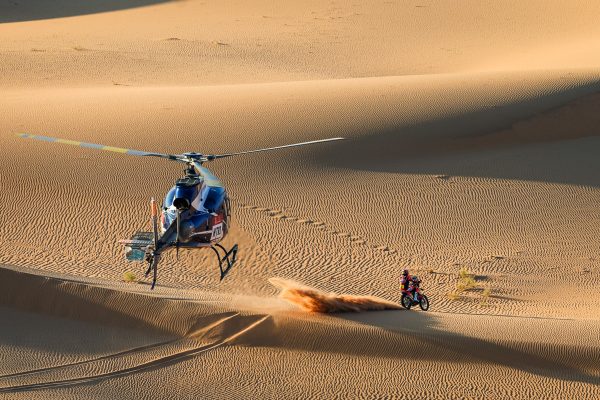
Stage 9-10 (marathon stage second half): the crash, and everything changes
- Stage 10 is the back half of marathon: 368km special, opens with vast soft dunes then faster sand tracks.
- Sanders catches the leader by km 123 and starts accumulating bonus time, he’s riding like a bloke who still thinks this Dakar is his.
- Then the big one: a large jump off a dune, heavy landing, big crash.
- He gets up, remounts, and drags himself home P16.
- Medical checks clear him to continue, but the script flips from “win it” to “survive it.
Overall after Stage 10
- Brabec leads.
- Benavides is P2 overall (+0:56).
- Sanders drops to P4 overall (+17:37), and now he’s injured.
This is the pivot point of the whole Sanders narrative.
Stage 11 (Bisha → Al Henakiyah): rides injured, just keeps showing up
- Long day: 883km total, huge liaison, 346km special, navigation-heavy.
- Sanders rides hurt, manages risk, finishes P13 and stays P4 overall.
- His line says it all: he felt every bump, especially in rocks and sand; anything that required “holding on and fighting” lit up the collarbone.
Overall after Stage 11
- Benavides retakes the overall lead by 23 seconds over Brabec.
- Sanders remains P4, now +23:32.
Stage 12 (Al Henakiyah → Yanbu): a tougher day, a small crash, still refuses to stop
- 720km total, 311km special, mixed terrain: dunes, sandy tracks, rocky riverbeds, fast flowing sections.
- Sanders calls it more demanding than Stage 11, and admits it would’ve been a “nice stage if you had two arms”.
- He has a small crash, bike takes a hit, but he rides it home P15.
- The mission is no longer podiums, it’s getting to the finish, for himself and for the team.
Overall after Stage 12
- Brabec leads, Benavides is +3:20 back.
- Sanders is P5 overall, about +58:31.
Stage 13 (final sprint): finishes the thing, battered, but standing
- Final stage is short: 108km special.
- Canet wins the stage, Benavides finishes P2 and seals overall victory by 2 seconds over Brabec, one of the tightest finishes ever.
- Sanders brings it home (stage time shown as 57:13, P23 among KTMs listed), and finishes fifth overall.
- The quote that matters: he only finds out the result at the finish, he’s in serious pain and just wants to lie down… but still goes to congratulate Benavides. That’s pure team guy stuff.