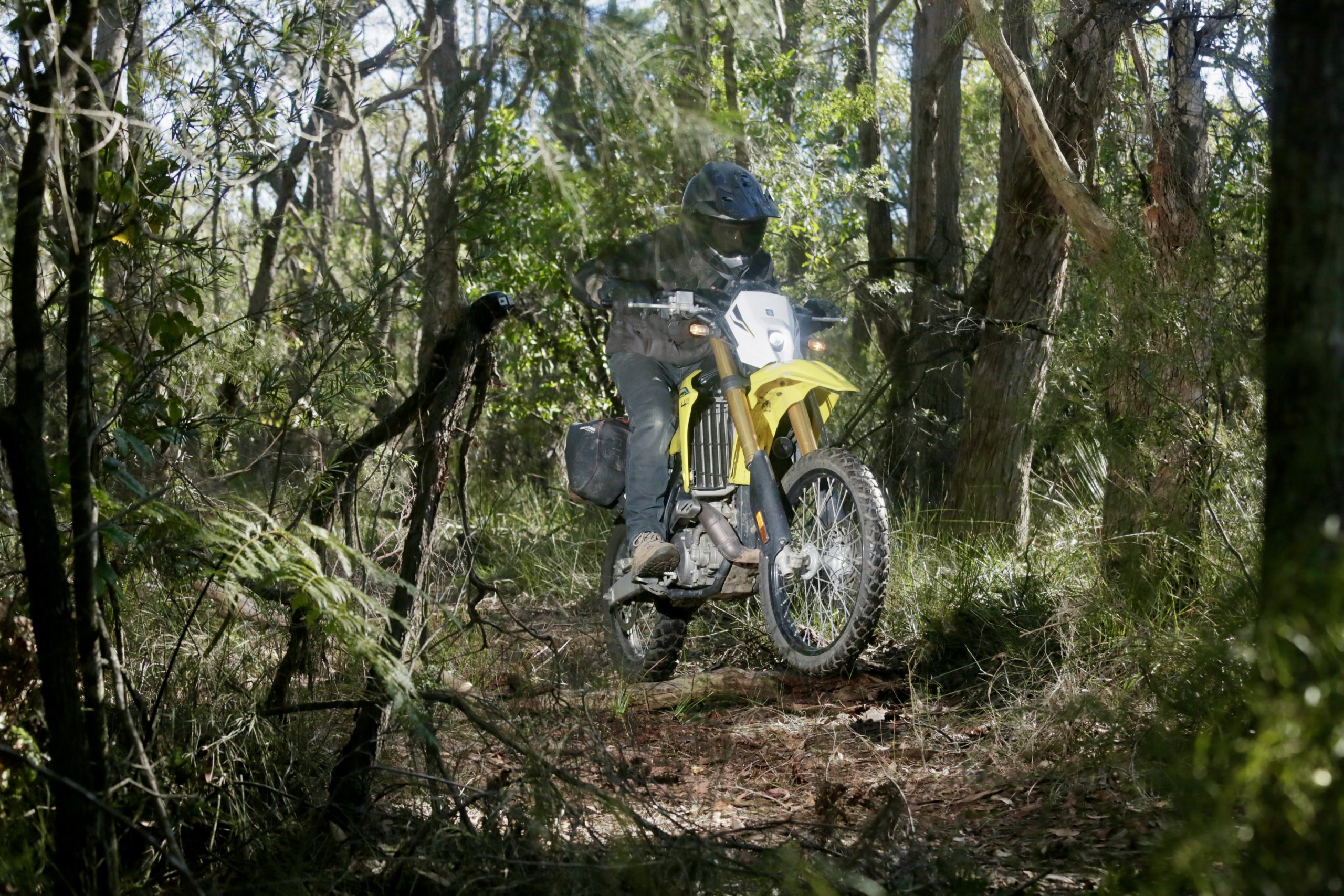
We very rarely test anything that doesn’t have two wheels and a handlebar. But when we do, it’s usually quite brief and revolves mostly around how manyy bikes it can fit. Those vehicle tests are easy. You pick the keys up, drive around town for a few days, head into the bush for a quick weekend and then hand the thing back. You get a decent feel for the vehicle, write your notes and move on to the next one.
This wasn’t one of those tests. When we picked up the RAM 1500 Rebel Hurricane, we had a much bigger challenge ahead of us. The plan was to drive from Sydney to Adelaide, collect the Offline Campers Ryder, load it with bikes and camping gear and then make our way through the Flinders Ranges and up the Oodnadatta Track before eventually arriving in Alice Springs for the 50th anniversary of the Tatts Finke Desert Race. By the time we rolled into Alice, we’d travelled roughly 4000 kilometres and spent nearly two weeks living out of the RAM.
We simply needed a vehicle capable of carrying a family, towing a serious camper and surviving the outback without rearranging our spines along the way.
THE STRAIGHT SIX QUESTION
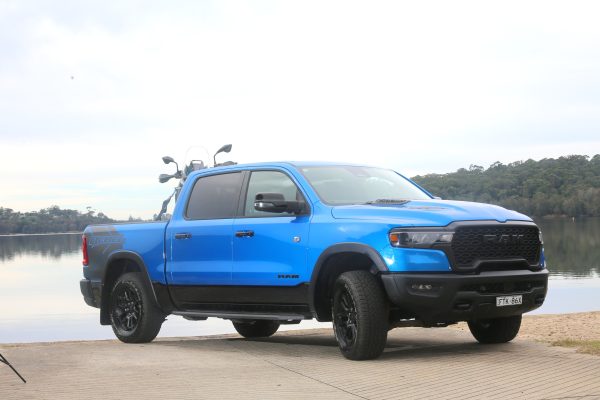
The biggest talking point surrounding the Rebel Hurricane is the engine. For years RAM buyers have been accustomed to V8 power. We’ve tested the V8 petrols and the V8 diesels over the years and they’ve always had a loyal following. This new twin-turbocharged Hurricane straight-six, however, represents a different approach.
We’d been asking for something like this for years. Not everyone needs a giant V8 and not everyone spends every day towing horse floats, race cars or excavators. Plenty of people want the size, comfort and practicality of a full-size American pickup without the thirst traditionally associated with a big-capacity V8.
The Hurricane feels like RAM’s answer to that question. And for the majority of our trip, it made a lot of sense.
COMFORT CHANGES EVERYTHING
Before we even talk about performance, towing or fuel economy, we need to talk about comfort. Because after spending three weeks behind the wheel, comfort was probably the thing we appreciated most.
The seats are outstanding. In fact, they’re probably the most comfortable seats we’ve ever sat in during a long-distance vehicle test. Day after day we’d climb in, knock over hundreds of kilometres and climb out feeling remarkably fresh.
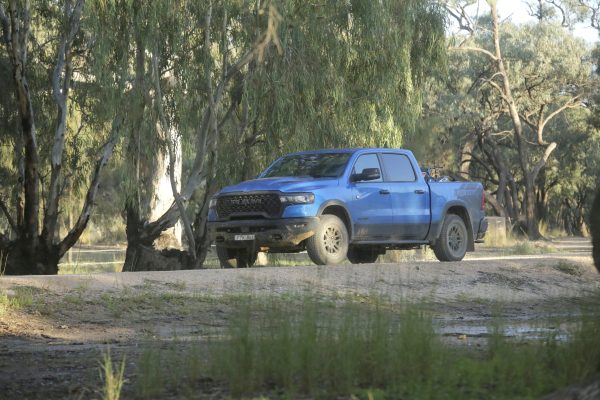
The suspension deserves a lot of credit as well. Unlike many traditional work-focused utes that rely on rear leaf springs, the Rebel uses a Bilstein coil-sprung setup. The result is a ride quality that feels much more refined, particularly on corrugated roads and rough dirt roads. Instead of rattling your spine loose every time the road deteriorates, the Ram simply absorbs the punishment.
That comfort became increasingly noticeable the further we travelled. Broken Hill. Flinders Ranges. Oodnadatta Track. Alice Springs. Every section of road reinforced just how comfortable this thing is to live with.

A FAMILY OF FOUR TEST
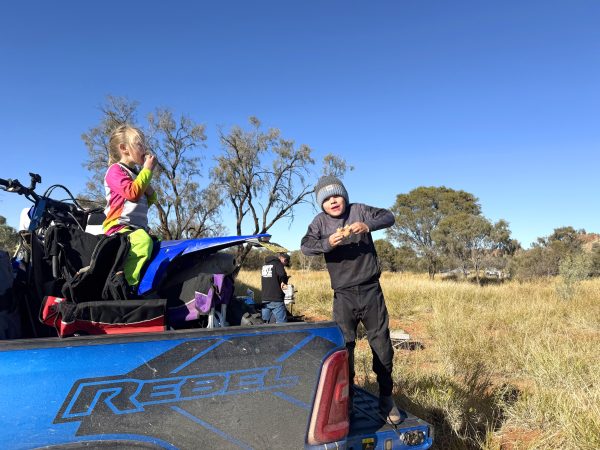
One of the most impressive aspects of the Rebel was simply how much room it offered. We had two young kids in the back seat, along with sleeping bags, heated blankets and a mountain of travel gear. Despite all that, neither child could even touch the front seats with their feet. The rear cabin is enormous and feels more like the back seat of a luxury SUV than a traditional ute.
Even as adults, climbing into the rear wasn’t an issue. At various stages of the trip the back seat was loaded with cameras, backpacks, jackets and all sorts of random equipment, yet there was still enough space for people to sit comfortably.
The charging options were another unexpected highlight. Modern content creation means everything needs charging all the time. Cameras, microphones, phones, batteries, drones and laptops constantly need power. The RAM’s combination of USB, USB-C and wireless charging meant we could effectively run our entire media operation from the vehicle while travelling between destinations.
HOW GOOD IS THE HURRICANE?
Without a trailer attached, the Hurricane engine genuinely impressed us. The throttle response is sharp, the power delivery is smooth and the eight-speed automatic gearbox works brilliantly. Around town it feels effortless and on the highway it cruises comfortably while barely feeling stressed. Gear changes are almost imperceptible and the entire drivetrain feels refined.
Fuel economy was the biggest surprise. With three dirt bikes, camping equipment and roughly half a tonne of gear in the tray, we consistently saw figures around 12 to 13 litres per 100 kilometres. That’s remarkable for something this large. In lighter-duty situations, with very little weight onboard, we even saw figures closer to 10 litres per 100 kilometres.
It’s exactly the sort of economy we’d hoped the straight-six would deliver and it makes the Rebel a far more practical proposition for everyday use than many people probably expect.
THEN WE STARTED TOWING
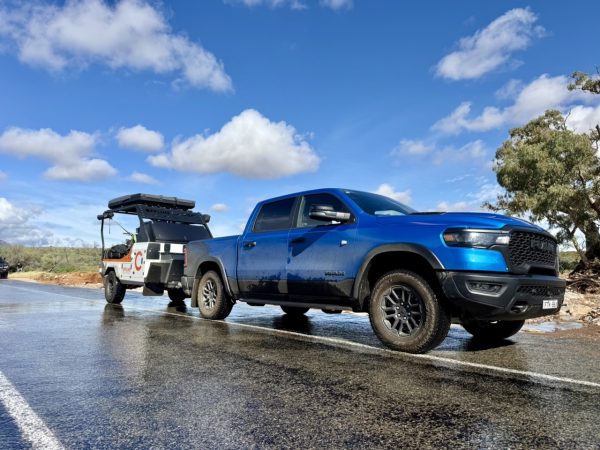
Of course, our trip wasn’t just about carrying gear. We were also dragging the Offline Campers Ryder behind us, and that’s where things became more interesting.
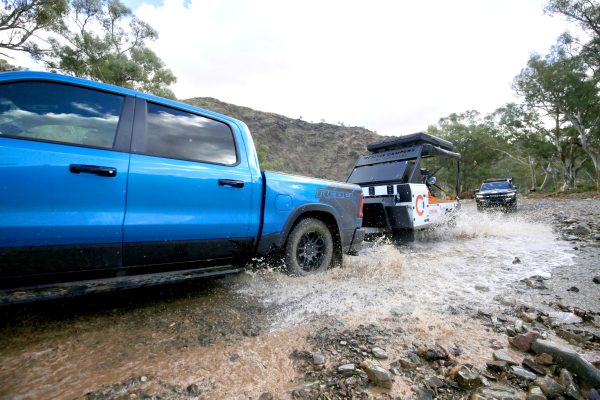
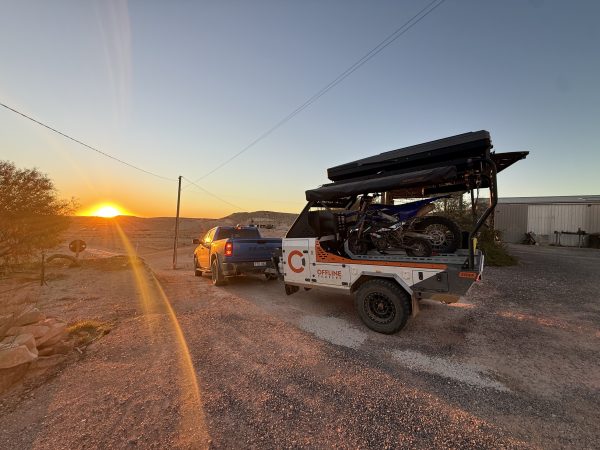
The Ryder isn’t a lightweight camper. It’s built incredibly tough and designed to survive some seriously nasty terrain (see feature on page 64). By the time it was loaded with bikes, camping equipment and supplies, we were towing somewhere between 1.7 and 2.0 tonnes.
The RAM handled the weight without complaint. Stability remained excellent and the vehicle always felt composed. There was never any sense that the trailer was pushing the vehicle around or overwhelming the chassis. The towing performance itself was very impressive.
Fuel consumption, however, told a different story.
THE REALITY OF TOWING
At highway speeds, while towing close to two tonnes, the Hurricane definitely worked harder than its V8 petrol or diesel siblings.
Holding 110km/h across long stretches of highway saw fuel consumption climb to around 25 litres per 100 kilometres. That’s a significant increase over the unloaded figures and something potential buyers should be aware of.
The good news is that speed made a huge difference. Once we backed things down to around 90-95km/h, fuel consumption dropped dramatically to around 17 litres per 100 kilometres. That’s a substantial improvement and highlights how much aerodynamic drag comes into play when towing a large camper.
If your life revolves around towing heavy loads every single day, particularly loads above two tonnes, you’d probably be better served by stepping into one of Ram’s larger models. The 2500 exists for a reason and it’s designed specifically for that kind of work.
The Rebel can absolutely tow. Just be ready to spend a bit more on fuel to do so.
RANGE ANXIETY IN THE OUTBACK
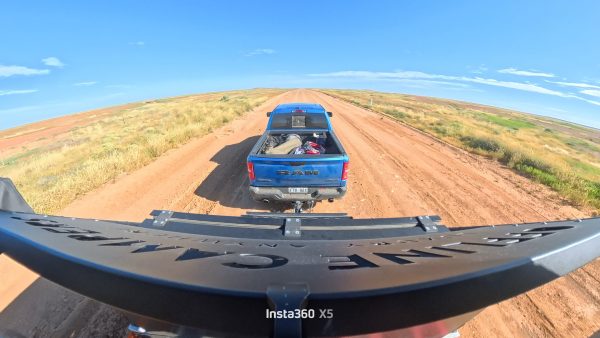
The other factor worth considering is fuel capacity. The Rebel’s 98-litre tank is more than adequate for everyday use and weekend adventures. Running around town, heading away for a ride or spending a week exploring regional Australia isn’t going to be a problem. With the fuel economy we experienced unloaded, range was excellent.
When towing heavy loads through remote Australia, however, things become more challenging. At 25 litres per 100 kilometres, fuel stops arrive much sooner than you’d like. There were sections of our trip where the fuel light would appear at roughly 400 kilometres and we’d immediately start looking for the next servo. In heavily populated areas that’s no big deal. In remote Australia it requires a little more planning.
That’s simply the reality of towing large loads long distances without second fuel tanks. If crossing Australia with a heavy trailer is your regular routine, an auxiliary tank or a larger towing-focused model would be worth considering.
WHY IT WORKED SO WELL
What impressed us most wasn’t any single specification or feature. It was how well the entire package worked together. The giant cabin meant the family stayed comfortable. The tray swallowed gear without complaint. The suspension remained composed across rough roads. The Hurricane engine delivered strong performance and surprisingly good economy when unloaded. The technology was easy to use and genuinely useful.
Most importantly, nobody was exhausted at the end of each day. That’s the true test of a touring vehicle. If you arrive at camp tired, sore and grumpy after a day’s driving, something isn’t right. The RAM consistently left us feeling fresh enough to unload bikes, go riding and actually enjoy the destinations we’d travelled so far to reach.
When we compared that experience to making the same trip in our well-used 2016 Mitsubishi Triton, the difference wasn’t even close.
Would I buy one?
The RAM 1500 Rebel Hurricane proved exactly what we hoped it would. It’s a brilliant long-distance touring vehicle for riders, campers and families who need space, comfort and genuine capability without stepping into a heavy-duty truck. The Hurricane engine delivers impressive fuel economy when unloaded, the ride quality is exceptional and the cabin is one of the most comfortable places we’ve spent time during any vehicle test.
Yes, fuel consumption climbs when towing nearly two tonnes at highway speeds. That’s simply physics. But for the sort of work most riders actually do, the Rebel feels incredibly well suited to the job. And it will be far more comfortable when cruising around town and when crawling from the mall to school pickup.
By the time we rolled back into Ram HQ after thousands of kilometres, nasty dirt roads and one epic journey to the 50th anniversary of Finke, we weren’t looking forward to handing the keys back. That’s usually a pretty good sign you’ve tested something special.
ENGINE & DRIVETRAIN
Engine Type: 3.0L twin-turbocharged Hurricane inline six-cylinder petrol
Displacement: 2993cc
Maximum Power: 313kW @ 5200rpm
Maximum Torque: 635Nm @ 3500rpm
Transmission: 8-speed automatic
Drive System: On-demand 4WD with dual-range transfer case and Auto 4WD mode
CHASSIS & SUSPENSION
Construction: Ladder-frame chassis
Front Suspension: Independent front suspension with A-arms and coil springs
Rear Suspension: Multi-link live axle with coil springs