For most professional motocross riders, retirement isn’t marked by a farewell lap or a standing ovation. More often than not, it arrives quietly. An injury that won’t heal. Sponsorship that dries up. One day you’re known as a racer, the next you’re trying to work out who you are now you’re not racing.
It’s a transition the sport rarely talks about, but one almost every rider eventually faces. Some find another path inside the industry, while others walk away altogether, unsure where to point the same drive and determination that got them to the top. Kale Makeham knows exactly what that feels like because he’s lived every part of it.
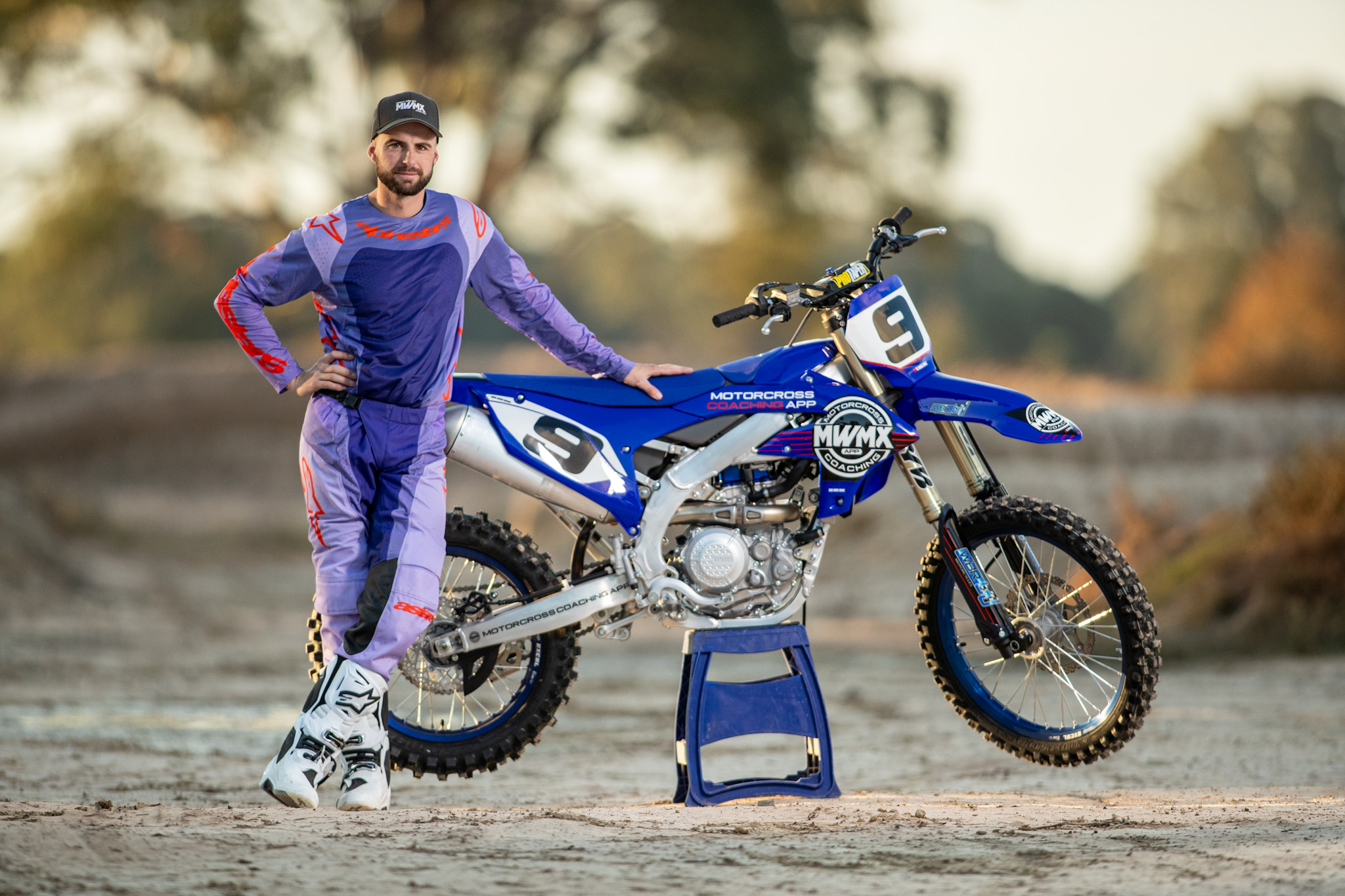
Today, Makeham is one of the biggest personalities in Australian motocross. His coaching business, MWMX, has grown into an international operation, his social media reaches hundreds of thousands of riders every month. Ironically, he’s arguably more recognisable today than he was when he was lining up behind a starting gate.
It wasn’t always like that. For several years after walking away from professional racing, Makeham admits he was “a grumpy, miserable prick”. He watched the riders he’d grown up battling continue winning championships while he tried to work out where he belonged.
The start
Like so many Australian racers, Makeham’s story started in a small country town where motorcycles were simply part of everyday life. His grandfather ran a dealership in Koondrook, Victoria, his father built bikes, and before long young Kale was spending more weekends at motocross tracks than he was doing much else. “I’d ride before school, ride after school, not go to school and ride,” he laughs. “I just loved it.”
Makeham says he never received any meaningful support throughout his junior career. Looking back now, he believes that may have been the best thing that ever happened to him “I never got discounts on bikes or sponsorships or anything like that,” he says. “I always had that underdog mentality. I always felt like I had something to prove.”
At 15 years old, after deciding school wasn’t for him, his parents made a deal that would shape the rest of his life. If he wanted to leave school, he could, but he’d be starting work the very next day. “So I got my ABN when I was 15,” he recalls. “From that point on it was like, well, if you want to race too, it’s on you.”
By day he was splitting red gum firewood, driving machinery and earning enough money to keep chasing the dream. On weekends he became a “professional” motocross racer.
AN UNLIKELY CHAMPION
Hard work eventually started to outweigh circumstance. After years of hovering around the fringes as a junior, Makeham’s results suddenly began to snowball. He qualified fastest, led laps, won races and, in 2012, completed one of the most unlikely championship campaigns in Australian motocross by claiming the Australian Under-19 Supercross title.
“The switch was purely mental,” he explains. “I’d always had the ability and I’d always had the work ethic. I just didn’t believe in myself as a kid. Then I got obsessed with the work. I worked so hard that eventually I started believing I belonged there.”
“I was as hardcore a privateer as you could get,” he says. “The night I won the championship I just turned up in a ute with a second-hand bike in the back.”
Even the gear on his back told the story. He raced in Matt Moss’s old riding gear, used second-hand motorcycles with plenty of hours on them.
Despite becoming a national champion, there were no big bonuses waiting, no prize money that suddenly changed his life and no financial security attached to the title he’d worked so hard to earn. “When I won my Supercross championship I got zero dollars,” he says matter-of-factly. “There were no bonuses, no prize money, no manufacturer contingencies. I remember looking around thinking, ‘That’s cool… but I’m poorer and I’ve got to go back to work.'”
KTM eventually stepped in with a goodwill bonus and manufacturer support, giving him the opportunity to continue racing professionally. It wasn’t a lavish factory contract, but for Makeham it represented recognition that someone had finally noticed what he’d achieved. The following two seasons produced podiums, strong championship results and eventually an opportunity with Suzuki’s factory team aboard the RM-Z450.
Shoulder injuries had already interrupted his momentum several times, and while he adapted quickly to the 450, another heavy crash, followed by concussion and then a torn Achilles during Supercross, robbed him of the consistency he’d fought so hard to build. Every time he felt like he was taking a step forward, something dragged him backwards again.
In the end, the numbers simply stopped adding up. At just 24 years old, Makeham made the decision every professional rider dreads. He walked away from the sport he’d devoted his life to. It wasn’t because he no longer loved riding. It wasn’t because he thought he’d reached his ceiling. It was because, for the first time, he had to think about surviving beyond the next race meeting.
Without racing, Makeham suddenly found himself asking questions he’d never had to answer before. Who was he if he wasn’t lining up behind a starting gate? What job was he qualified to do? What direction was he supposed to take after spending his entire life chasing one dream? “I was just a lost puppy,” he admits. “I don’t say this lightly, but I was dumb as a potato. I had no idea what I wanted to do.”
He fell back on the only thing he knew. He bought an old tip truck, headed back into the bush cutting firewood by hand and drove loads into Melbourne for a few hundred dollars at a time.
STARTING AGAIN
For the first time since he was a kid, there was no training program, no race calendar and no clear goal to chase. Instead, there were bills to pay, a future to build and the uncomfortable reality that he had no real idea how the outside world worked.
Even buying a house became a lesson in how little he knew about life outside motocross. After saving enough money for a deposit, Makeham walked into a display home convinced that was all it took. The sales staff asked for payslips to support a loan application, but after years of being self-employed and racing, he had no idea what they were talking about.
“I went down to the newsagent, bought one of those old paper books and literally wrote my own payslips,” he laughs. “I made up the tax rate, made up the holiday pay and sent them in. They obviously laughed me out of the building. I still keep a photo of those payslips because every now and then I look at them and think, ‘How bloody clueless was I?'”
“I figured out pretty quickly that if I wanted the house, I had to get employed,” he says. “So I went into civil construction and just started learning how the real world worked.”
THE BIKES NEVER LEFT
Although racing was over, motorcycles never completely disappeared from Makeham’s life. During the week he worked whatever job was paying the bills, but on weekends he’d still find himself at motocross tracks helping local riders. There was no grand business plan and certainly no vision of building one of Australia’s biggest coaching companies. At that point, coaching simply kept him connected to the sport he loved.
“I wasn’t doing it as a business,” he explains. “I’d just coach local kids on weekends because I still loved bikes. It was my way of staying involved.”
The coaching slowly became more regular as word spread. Riders started recommending him to friends, parents told other parents, and before long weekends were filling with coaching schools. “I never really let go of bikes,” he says. “Every chance I got I’d coach”.
BETTING ON HIMSELF
Most people would wait until their side business comfortably replaced their full-time income before taking the leap. Makeham didn’t.
By the time he’d secured approval for his home loan, he’d already made his mind up. In one of the biggest gambles of his career, he quit almost immediately after receiving confirmation from the bank.
“The day I got my loan approved was the day I quit my job,” he laughs. “I rang the broker and said, ‘If I leave my job, do I keep the loan?’ He said yes. I said, ‘Beauty, I’m out of here.'”
It sounds reckless, but Makeham says that’s simply how he’s always approached life. Racing had already taught him that opportunities rarely arrive wrapped in certainty. Sometimes you’ve simply got to back yourself and figure the rest out later. “I’m probably wired for risk,” he says. “I weigh it up, but it doesn’t really scare me.”
ROCK BOTTOM
Money was so tight that while working away in Melbourne he couldn’t justify paying for accommodation.
“I was sleeping in my van outside the Craigieburn Police Station because I didn’t have any money,” he recalls. “Everything I earned was going towards the house. Saving seventy bucks a night meant everything.”
Makeham recalls another experience that still sticks with him years later. Having virtually no money to his name and being forced to walk more than 12 kilometres home after he lost his wallet disappeared one night, Makeham began wondering what he was doing with his life.
THE PERFECT STORM
If there was one moment that transformed Makeham’s coaching from a weekend side hustle into a genuine business, it was COVID. While most industries ground to a halt, motocross found itself in a unique position. Team sports were cancelled, but small coaching groups were still permitted under the restrictions, and suddenly there were hundreds of riders looking for something to do.
“It just went gangbusters,” Makeham says. “Because footy was cancelled, everyone wanted to ride. I could sell coaching schools out over and over again because there was nothing else happening.”
As demand continued growing, Makeham realised there was only one problem. There was only one of him. No matter how many weekends he worked, he could only coach so many riders before running out of days in the year.
That was when MWMX began evolving from coaching schools into an online platform.
BUILDING A BRAND
Rather than relying solely on face-to-face coaching, Makeham embraced social media. He started producing riding tips, analysing technique, filming coaching drills and sharing honest insights into both racing and business with his business MWMX. The content was educational, but it also felt genuine.
Today, MWMX has expanded well beyond coaching schools into online memberships, riding programs, business mentoring and digital education.
MORE THAN A RACER
Listening to Makeham talk, it’s obvious his greatest achievement isn’t the Under-19 Supercross Championship. It’s the perspective he gained after losing the identity he’d built around racing.
It’s a refreshing perspective in a sport where success is often measured only by championships and trophies. Makeham doesn’t dismiss his racing career—far from it—but he no longer defines himself by it. Racing gave him discipline, resilience and work ethic. Business simply gave him another arena to apply those same skills.
That lesson might be the most valuable takeaway from his entire story.
Motocross has always celebrated the riders who make it to factory teams, win championships and lift trophies. Those stories deserve to be told. But the reality is only a tiny percentage of riders will make a lifelong living from racing. Eventually, every single one of them will have to step away from the start gate.
Makeham’s story proves that retirement doesn’t have to be the end of ambition. The same determination that carried him from an overlooked junior to an Australian champion eventually carried him through financial hardship, uncertainty and self-doubt before helping him build one of the biggest coaching businesses in Australian motocross.