In the motorcycle and automotive industry, the term ‘submarine’ is often used for projects that start rolling far from the official radar screen of management and do not yet have a stamped business plan, but instead arise from the pure motorbike passion of technicians. In the past, many such machines later became milestones because they opened up new segments and went on to be success stories for their companies.
The BMW R 80 G/S was born that way: as a ‘mushroom seeker’ by BMW Motorrad employees. In the 1970s, they needed a motorbike that could take them quickly and comfortably from Munich in southern Germany across the motorway to the gravel roads of the Alps, where a cool beer — or mushrooms — awaited them at the mountain pastures.
At BMW Motorrad, vehicle development has been in the hands of passionate off-road rider Christof Lischka for several years, and the last official two-cylinder Dakar bike from the Munich-based company, built in 2001 for Nani Roma, is displayed in his office. With such an object in front of him every day, it’s hard not to think constantly about how to conjure something from the current BMW portfolio to make off-road racing happen again. Perhaps that factory racer was already the inspiration for the new F 900 GS, presented in spring 2024, which suddenly revived the off-road character of the mid-range series that had somehow been lost over time. Despite being a little overweight, the engineers succeeded in creating a well-balanced adventure bike with a lively, responsive engine. But Lischka wanted more…
Almost simultaneously, a young man with a big name in the city of Wangen, around 160 kilometres west of Munich, was thinking about the same topic, creating a narrative that echoed events from nearly 50 years ago. Towards the end of the 1970s, BMW Motorrad had persuaded the German Motorcycle Sport Federation (OMK) to announce a new displacement class above 750 cc in off-road racing. The Bavarian company wanted to compete in this class to promote the new R 80 G/S and underline its versatility and off-road capability.
BMW took a two-pronged approach to the construction of its ‘factory bikes’. The team around chassis specialist Laszlo Peres worked internally, while multiple-time German champion and off-road legend Herbert Schek was also commissioned to prepare motorcycles. In 1980, BMW’s factory riders won the German and European championships on the GS 870, laying the foundations for a success story that continues to this day — including four Paris-Dakar Rally victories and the BMW GS’s untouchable dominance in the touring enduro/adventure bike segment.
Herbert Schek’s grandson, Maxi, has inherited the rally DNA from his family. His mother, Cornelia, competed in several rallies in Africa, and his aunt Patrizia even finished the Dakar Rally (sometimes alongside Herbert). On a slightly modified F 850 GS, Maxi won the first German Cross Country Championship in 2023 in the big-bike class. Shortly after the launch of the F 900 GS in February 2024, a bike was already on the bench in his workshop, being prepared for the 2024 season.
Meanwhile, back in Munich, the press feedback after the Málaga launch of the F 900 GS was encouraging, especially around its off-road performance. That gave Lischka reason enough to push forward with building a racing version, providing a toy for extreme enduro specialist and BMW instructor Gerhard Forster.
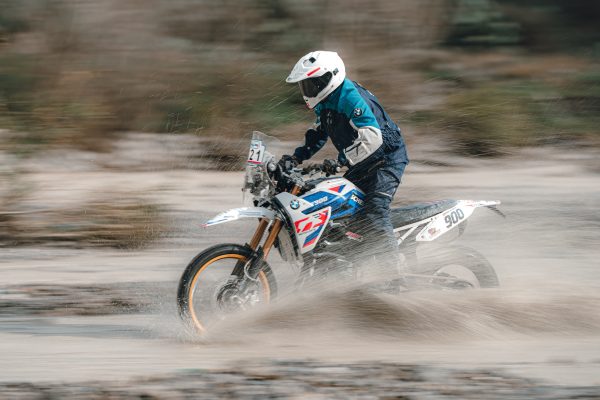
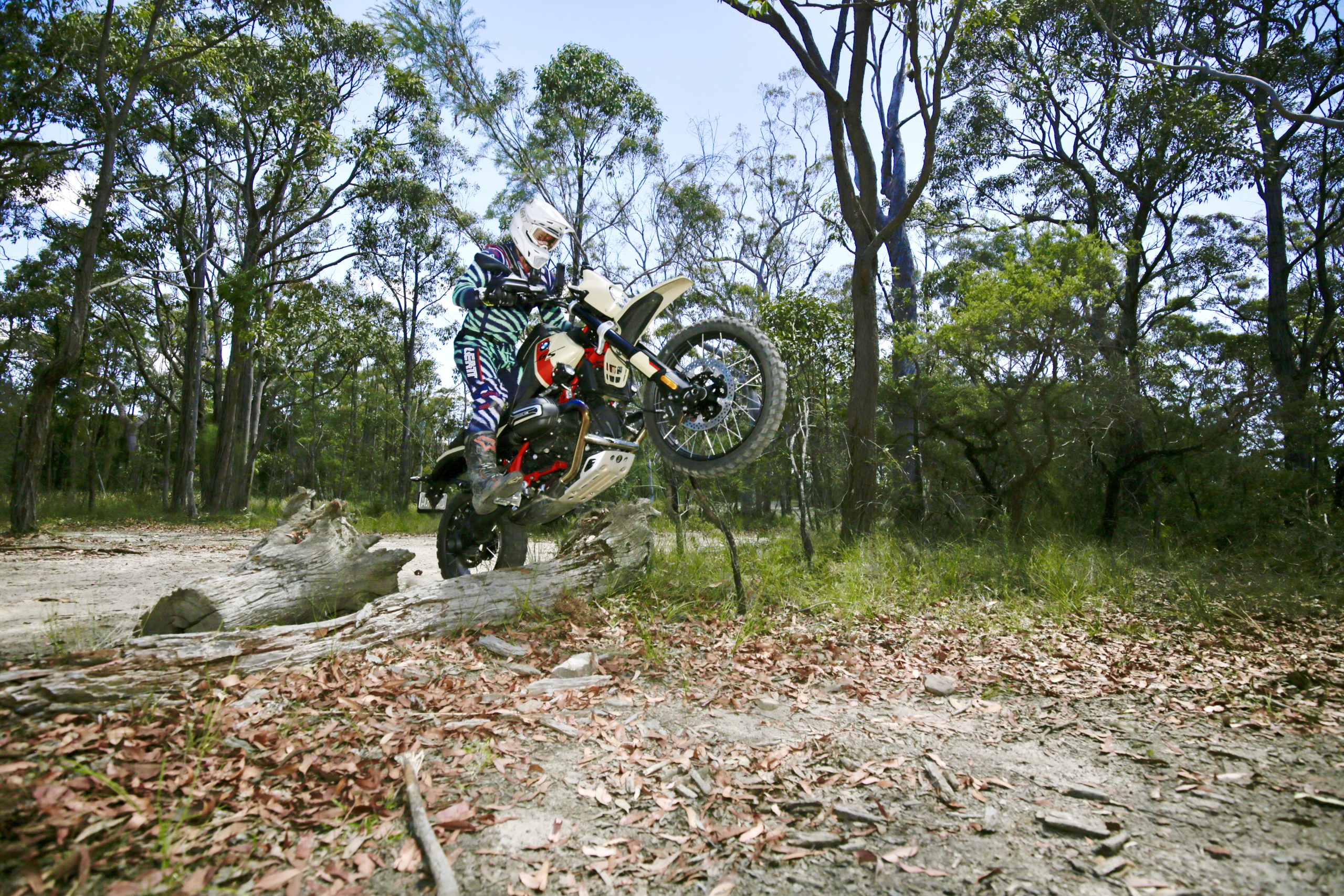
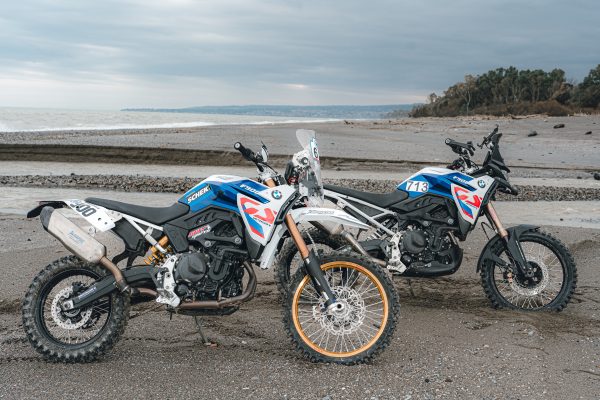
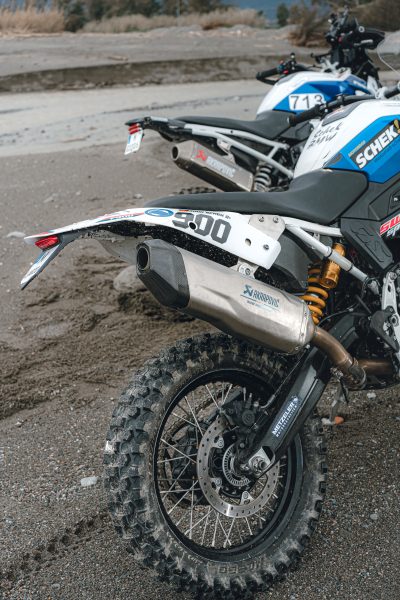
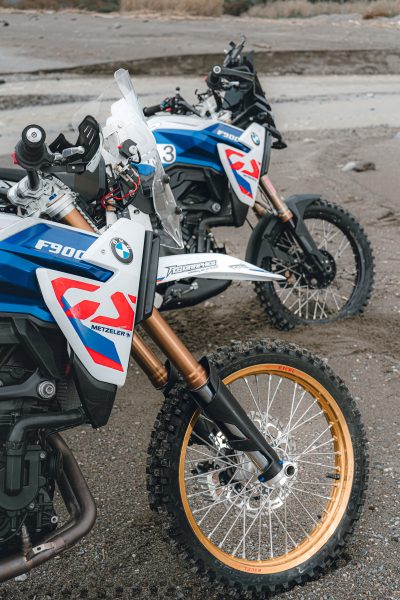
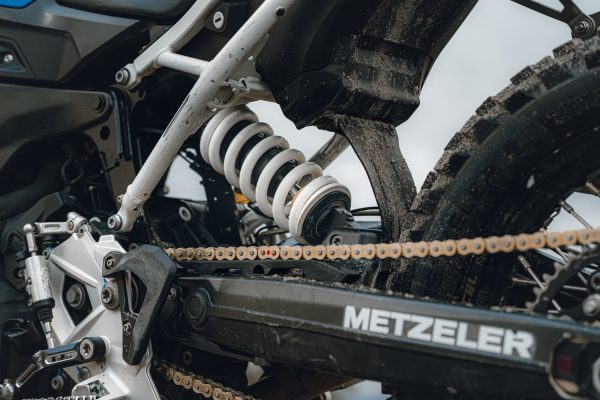
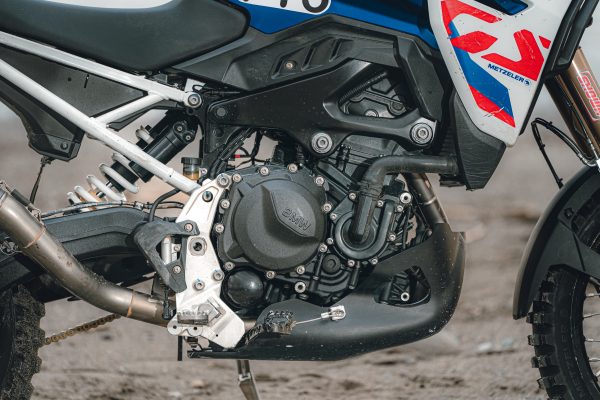
The first job was cutting weight, bringing the machine down to around 210 kg. To do this, the ABS, carbon filter, passenger footpegs and other non-essential parts were removed. A titanium Akrapovič exhaust was installed, and the current LED headlight was swapped out for the halogen unit from the previous model (which had the same shape). The original hubs were retained but laced to narrow Excel rims (21/18-inch), and the front end ran a single-disc brake system. Suspension was handled by German company Zonenstern, who installed a closed cartridge into the stock Showa USD fork, keeping 230 mm of travel. A new rear shock from the same supplier delivered 245 mm of travel (30 mm more than standard). Because the instrument carrier is a known weak point on adventure bikes, especially when rally nav gear is mounted, the stock unit was replaced by a 3D-printed aluminium rally tower. Footpegs, handlebars and levers were adjusted to Forster’s liking, and a one-piece aluminium skid plate was fitted. With stock plastics and white-and-blue motorsport graphics, the bike looks almost standard from a distance, belying its rally spec.
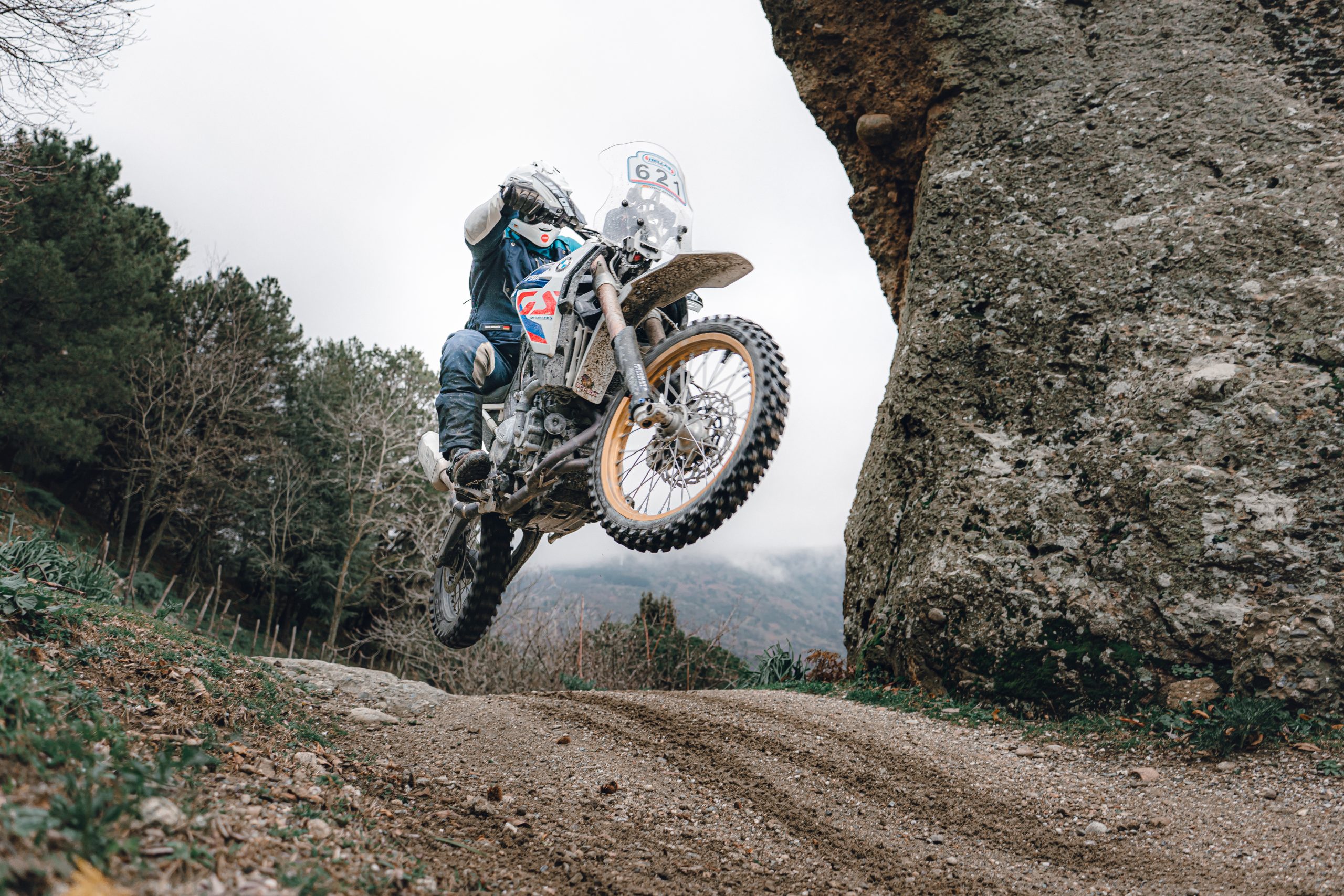
Maxi Schek’s machine, though, took a more radical approach. It was built primarily for the German Cross Country Championship and only secondarily for rally use. The most striking change is at the front: the Showa fork is swapped for a WP unit with 48 mm tubes, a closed cartridge and 270 mm travel. The KTM-sourced front wheel and single-disc brake system were also adopted. His rally tower is a modular, home-built aluminium plate design, holding two vertically stacked ellipsoid headlights, topped by a Dakar-style windscreen. At the rear, an Öhlins shock (borrowed from a BMW HP2) provides 240 mm travel. To cut weight, a lithium battery was installed, the central silencer was removed, and the rear subframe was simplified. A KTM rear guard unit was added to leave space for race numbers. Ergonomics were tuned with higher pegs, a taller seat and a flatter handlebar. The ABS modulator is present but deactivated, and both traction control and quickshifter are disabled.
The two bikes met for their first duel on a Sicilian beach. With a seat height around 90 cm and stiff suspension, Maxi’s bike requires effort just to mount, and it barely sags. A throaty exhaust note accompanies its first metres in the sand, and the powerful twin easily pulls its 200 kg bulk clear of soft patches. For a 175 cm rider, the flat bar works well for aggressive enduro-style riding. Without a steering damper, hard braking after high-speed runs can be a shock, but on the flip side, the engine’s responsiveness and the bike’s controllable power delivery make drifting an exhilarating experience.
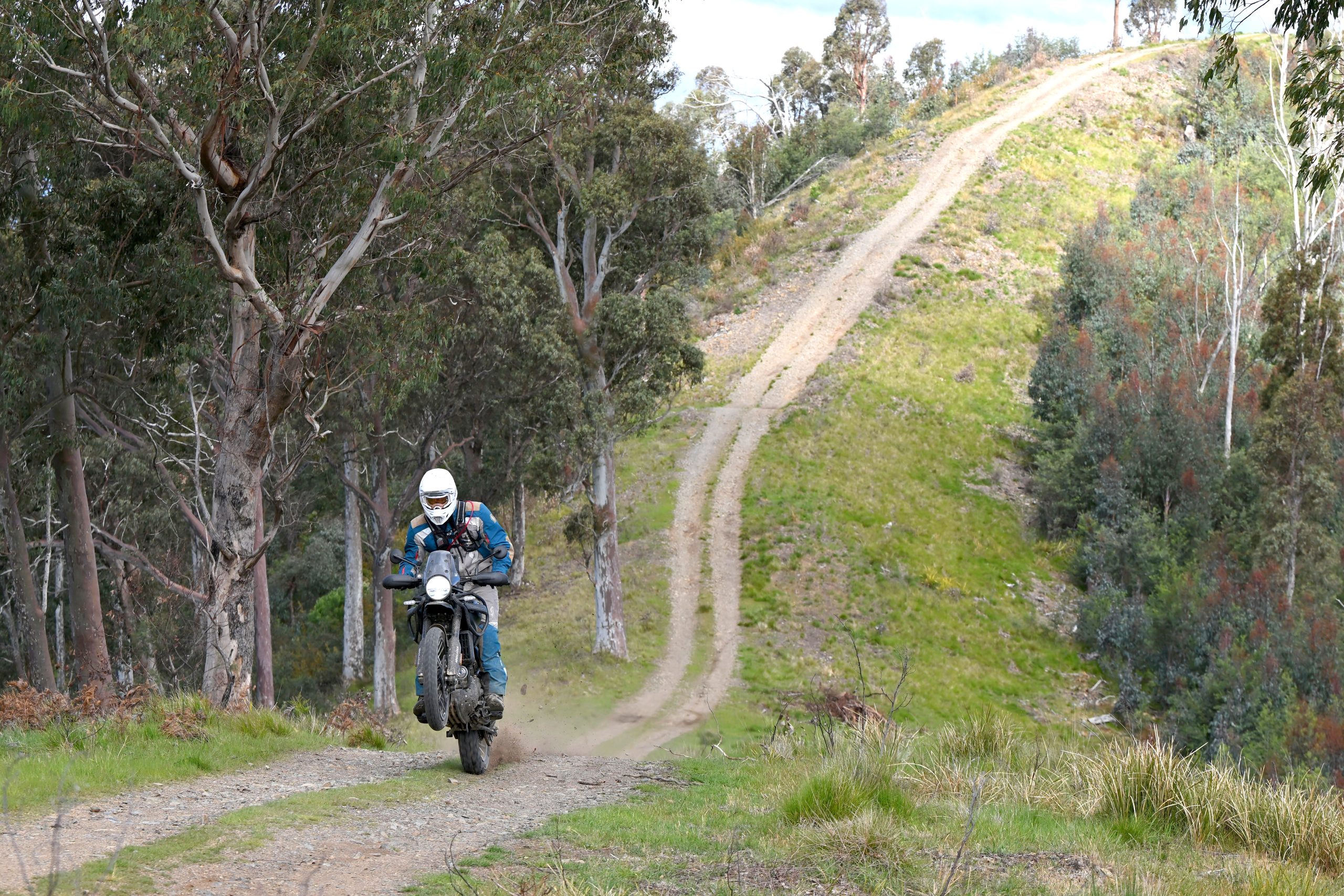
On rocky jeep tracks, the F 900 GS reveals its true strength. It bombs through ruts, stones and berms with suspension that refuses to bottom out, giving riders the confidence to push harder than expected on an adventure bike. The only drawback comes when standing: the bulges on the fuel tank prevent the knees from gripping tightly, which can make full-throttle acceleration a little unnerving.
By contrast, Forster’s rally build is set up for long, comfortable days. Lower pegs and a stock seat ease the knee angle, higher bars with thick grips reduce fatigue, and the softer suspension is tuned for stability and comfort. The steering damper provides security at speed, making it safer on long gravel stretches, though it makes the bike feel heavier in technical terrain. Compared directly, Maxi’s machine feels like a motocross bike, Forster’s like a rally raid. Both are brilliantly effective for their intended purpose.
The scales confirmed the impressions: Forster’s full-fuel bike weighed 211 kg, with balanced 105.5 kg front/rear loads. Schek’s racer came in lighter at 202 kg, but with just 90 kg on the front wheel (rear: 102 kg), explaining its razor-sharp steering. (Stock F 900 GS: 225 kg total, 114 kg front, 111 kg rear).
Even so, compared with Aprilia’s Tuareg — winner of the Africa Eco Race for the second year running — the Schek machine is still about 20 kg heavier. That could hinder outright rally competitiveness. But as the saying goes, there’s magic in every beginning. The commitment of privateer Maxi Schek and R&D boss Christof Lischka may well be the start of something much bigger.