I know what you’re thinking. Why the hell has ADB sent its Enduro Editor to Italy to test what is probably one of the most anticipated 250cc motocross bikes of 2027? I’m the bloke who’s supposed to be good at ruts, logs, roots and going fast between trees, not throwing whips over jumps and scrubbing everything in sight.
I don’t think I can whip and I definitely don’t think I can scrub. Or at least I didn’t think I could scrub until Mitch saw one of my attempts at the Ducati launch and reckoned maybe I should have chased the motocross dream after all. I’m still not sure whether that was a compliment or whether he was taking the piss, but I’m choosing to take it as a compliment.
Jokes aside, I do actually ride motocross. I’ve got a 2026 Kawasaki KX250 as my ADB long-termer, I’ve been testing dirt bikes for this magazine for about 20 years and I’ve ridden enough motocross and enduro bikes in that time to know exactly what makes one work. In fact, I reckon I know more about motocross and enduro bikes than just about anyone – so there, Mitch. Now we’ve got that out of the way, let’s talk about the Ducati.
ANOTHER ONE ALREADY?
Last year we were wrapping our heads around the fact the Italian company famous for superbikes, MotoGP and making motorcycles that look like they belong in art galleries had decided it wanted a slice of the dirt bike pie with the Desmo450 MX. Then, only last month, ADB was back in Italy riding the Desmo450 EDS enduro bike and now Ducati has gone and built a 250F.
My first impression from being around Ducati’s off-road program for the second time is just how seriously these guys are taking it. The speed at which the company is developing motorcycles and expanding the range is impressive, but it’s the people behind the bikes that stand out. There is genuine passion throughout the whole project.
FIFTEEN BLOODY THOUSAND
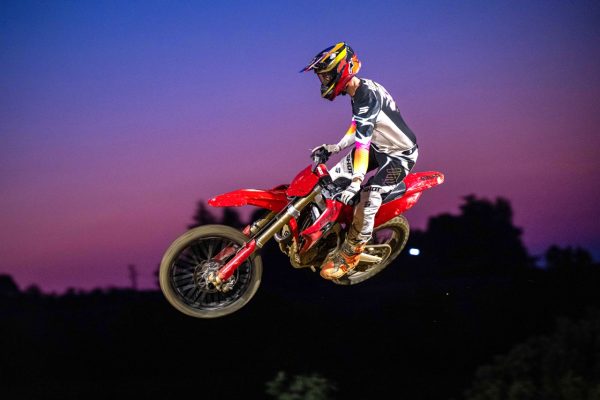
The headline number on the Desmo250 MX isn’t actually its claimed 44.5hp, it’s the 15,000rpm rev ceiling. Fifteen. Thousand. RPM. That’s what this thing will rev to and it completely defines how the engine feels on the track.
You get on the throttle expecting to have to grab another gear and it just keeps pulling. It has this huge amount of over-rev that gives you options everywhere, so if you’re approaching a jump and wondering whether to grab another gear just before the face, you can often leave the Ducati where it is, keep it pinned and let the engine rev.
Second and third gears were basically the sweet spot around the circuit we rode. At 85kg I’m not exactly a featherweight 250F pilot, but I never felt like I was strangling the thing or desperately searching for more power.
MORE THAN A SCREAMER
I’ve got that 2026 KX250 at home, so that’s my most immediate point of reference. The Ducati feels stronger off the bottom than my Kawasaki and then really comes alive through the mid-range. That’s probably what impressed me most about the engine because you look at 15,000rpm and assume Ducati has built a screaming little thing that needs its neck wrung everywhere, but there’s actually decent response before you get anywhere near the top.
The Desmo system obviously plays a massive role in what Ducati is trying to achieve. Rather than conventional valve springs, the Desmodromic system mechanically controls both the opening and closing of the valves, a principle Ducati has been using forever on its road and race bikes. Bringing it into motocross allows the engineers to chase high rpm while maintaining precise valve control. The 249.7cc single uses an 81mm bore and an incredibly short 48.4mm stroke, with a 14.5:1 compression ratio.
FIVE IS ENOUGH
Ducati has gone with a five-speed gearbox, which makes perfect sense for a dedicated motocross bike. The ratios felt well-matched to the engine and, like I said, I spent a lot of time moving between second and third. There’s also an up-only Quick Shift system as standard, which is another interesting bit of tech to find on a motocrosser.
Quickshifters on dirt bikes are still one of those things that sound slightly weird until you use a good one. When you’re accelerating hard and don’t want to interrupt drive, being able to bang the next gear without chopping the throttle can be useful, especially with an engine designed to live at this sort of rpm. The clutch is hydraulically operated and, overall, the controls felt natural almost immediately.
THE 450 DNA
Ducati hasn’t reinvented the entire motorcycle for the 250. A lot of the chassis philosophy comes from the Desmo450 MX, and that’s no bad thing. The aluminium frame uses cast, forged and extruded components welded together, while suspension is handled by Showa at both ends.
Up front is a fully adjustable 49mm USD fork with Kashima-coated outer tubes and 310mm of travel, while the fully adjustable Showa shock controls 301mm at the rear. The bike weighs a claimed 103kg wet without fuel and you can feel it immediately on the track. The Ducati is ridiculously easy to tip into a corner and there’s very little inertia compared with a 450, so you can move it from side to side without feeling like the bike is dictating where it wants to go.
POINT AND SHOOT
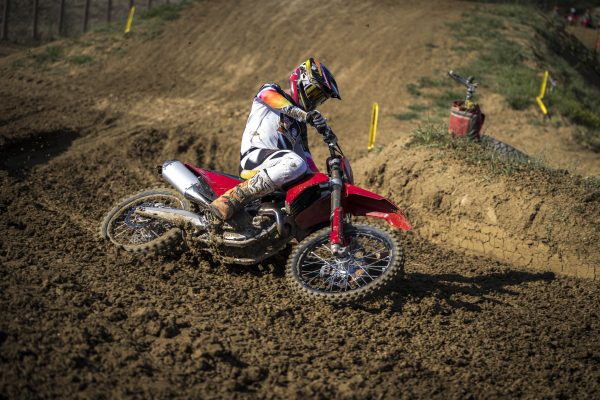
I really liked the front of this bike. There was good stability but it didn’t come at the expense of turning, and I could tip it into ruts and trust the front tyre without feeling like I had to push the bike onto line.
The overall chassis balance was very good too. Nothing stood out as doing something strange and, once I was comfortable with the track, I could concentrate on carrying speed rather than thinking about what the bike underneath me was doing. That’s usually a very good sign, although the one area I wanted to work on was the rear shock.
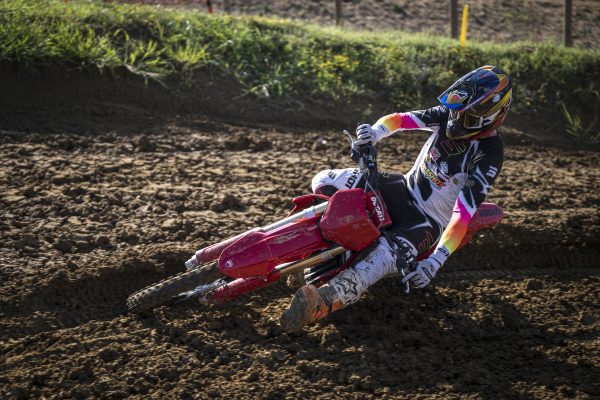
SOFT IN THE REAR
I bottomed the rear a couple of times and initially thought we’d probably need to go up a spring rate for my weight. We started playing with the clickers and high-speed compression, though, and made a decent improvement without having to start pulling springs out. That’s exactly why launches can be difficult for making definitive suspension calls because you’re riding a new bike on a new track in unfamiliar conditions and you’ve only got so much time to find the window.
The fork, on the other hand, impressed me pretty much immediately. It held itself up well, had good stability and matched the chassis nicely. With more time, I’d like to properly set the sag, make sure the spring rate is correct for my 85kg and then work through the shock settings systematically, because I reckon there is plenty there and what I felt wasn’t a fundamental problem, just a setup that wasn’t quite perfect for me.
PRICED RIGHT
The Desmo250 MX is listed at $14,925 ride away in Australia. ADB has been inundated with people guessing the price of the Ducati bikes every since they got announced and most people expected a hefty price tag. But $14,295 is actually less than the price of the defending Champ of our 250cc Motocross Shootout the Yamaha YZ250F ($15,049), so the Ducati isn’t as expensive as everyone thought it would be.
And don’t forget, you’re getting the Desmo engine, Showa suspension, Brembo brakes, Excel rims, hydraulic clutch, quickshifter, lithium-ion battery and an electronics package that includes traction control, engine-brake control, Riding Modes and Power Launch.
THE ITALIANS ARE COMING
I’m tired as hell writing this. It’s about 10:30 at night in Italy, we’ve spent the day riding motocross in ridiculous heat and I’m a very long way from home, but I’d do it again tomorrow.
We had the Desmo450 MX, then the 450 EDS and now this. In an incredibly short amount of time, Ducati has gone from being the new kid in motocross to having the foundations of a legitimate off-road range, and these don’t feel like half-hearted first attempts. The 250 has a genuinely strong motor, especially off the bottom and through the mid-range, then it just keeps revving.
The chassis is light and easy to place, the Showa fork works extremely well and my only real setup complaint was wanting more support from the shock. Most importantly, I had a bloody good time riding it. Ducati has thrown itself into the dirt bike world with an amount of passion and speed that deserves respect, and the engineers and everyone involved in this project clearly care about what they’re building.
So, yes, ADB sent the Enduro Editor to Italy to test a motocross bike and it turns out I didn’t completely embarrass myself. After Mitch saw that scrub, I might even start taking bookings for motocross coaching. Just don’t ask me to demonstrate it twice.
DUCATI TECH
The Desmo250 MX comes with Riding Modes, Ducati Traction Control, Engine Brake Control and Ducati Fall Detection. It also gets Power Launch, the up-only Quick Shift and is ready for Ducati’s Wi-Fi module and X-Link App.
Ducati’s experience in electronics is obviously enormous and the company is bringing that knowledge into its dirt bike program rather than pretending the technology doesn’t exist. The interesting part will be spending more time with the bike back home and digging into those systems properly. There’s a lot in there to play with.
WHAT ELSE?
Brakes are another area where Ducati hasn’t mucked around. There’s a 260mm Galfer disc and two-piston Brembo floating caliper at the front, with a 240mm Galfer disc and single-piston Brembo caliper at the rear.
Excel rims are standard, with a 21-inch front and 19-inch rear wrapped in Pirelli rubber. Fuel capacity is 7.2 litres, seat height is 970mm and wheelbase is 1499mm. None of those numbers are particularly radical for the class.
LIGHTS ON
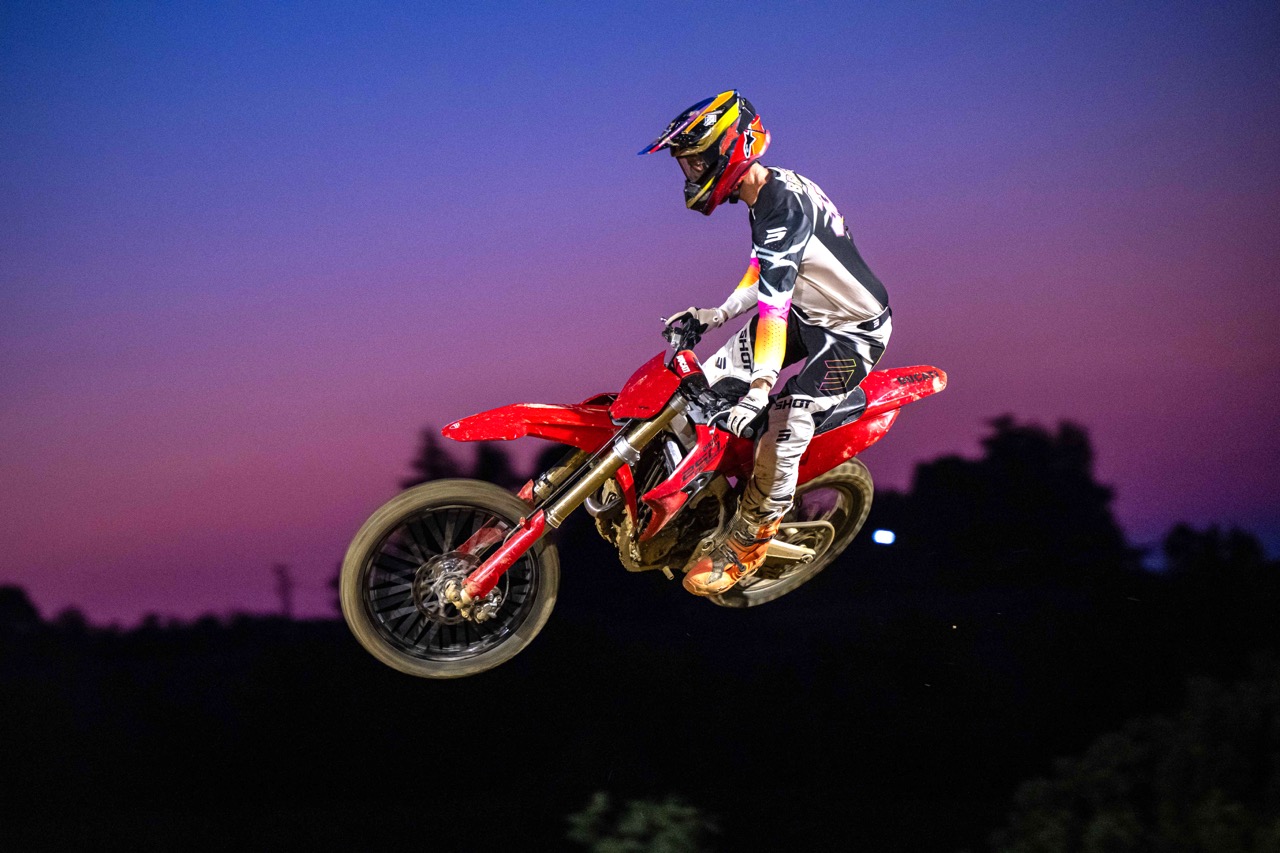
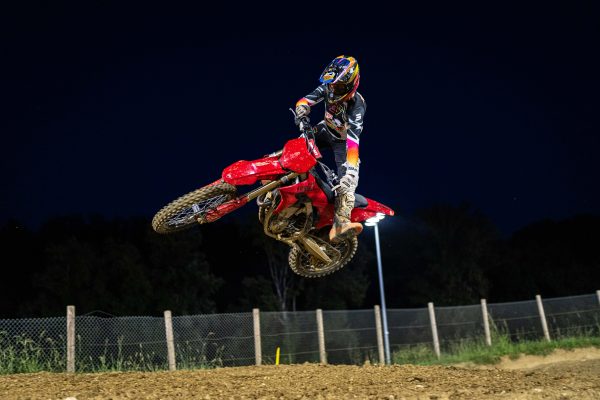
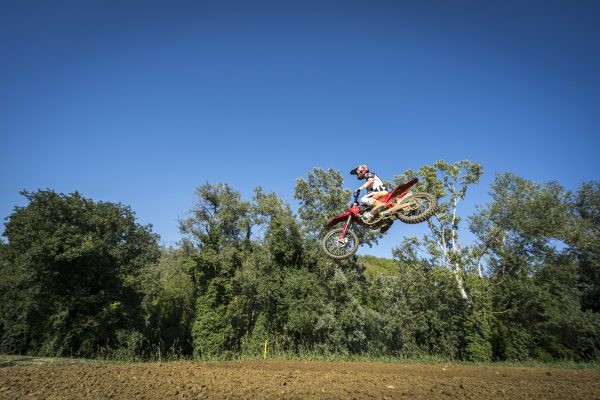
My favourite part of the entire launch came late in the day. The temperature finally dropped, Ducati switched on the track lights. I did two motos of roughly half an hour, one around 9pm and another getting close to 9:45pm, and motocross under lights in Italy on a 2027 Ducati 250F isn’t something you get to do every Tuesday night.
WHAT ABOUT MAINTENANCE?
Whenever Ducati and Desmodromic valves get mentioned in the same sentence, somebody will inevitably ask how often you’re going to have to pull the thing apart. The published schedule isn’t outrageous for a modern race 250F, with Ducati specifying oil and filter changes every 15 hours, a valve-clearance inspection at 45 hours and piston replacement between 45 and 60 hours. The main engine service interval is listed at 90 to 120 hours.
Obviously, race conditions, rider level and how hard you’re bouncing the thing off 15,000rpm will have an impact.
2027 DUCATI DESMO250 MX
ENGINE
Type: Single-cylinder, liquid-cooled, DOHC 4-stroke with four-valve Desmodromic timing
Displacement: 249.7cc
Bore x Stroke: 81.0 x 48.4mm
Compression Ratio: 14.5:1
Fuel Injection: Keihin injector, Mikuni 44mm throttle body
Starter: Electric
Clutch: Hydraulic
Transmission: Five-speed
CHASSIS & DIMENSIONS
Frame: Welded aluminium with cast, forged and extruded components
Wheelbase: 1499mm
Seat Height: 970mm
Weight: 103kg (Dry)
Fuel Capacity: 7.2L
SUSPENSION & BRAKES
Front Suspension: Showa 49mm fully adjustable USD fork with Kashima-coated outer tubes, 310mm travel
Rear Suspension: Fully adjustable Showa monoshock, 301mm travel
Front Brake: 260mm Galfer disc with Brembo two-piston floating caliper
Rear Brake: 240mm Galfer disc with Brembo single-piston floating caliper
TYRES
Front Tyre: Pirelli Scorpion XC Mid Soft 80/100-21
Rear Tyre: Pirelli Scorpion MX32 Mid Soft 100/90-19
RRP & WARRANTY
RRP: $14,925 Ride Away
Browser: www.ducati.com/au
Warranty: 3 months or 20 hours