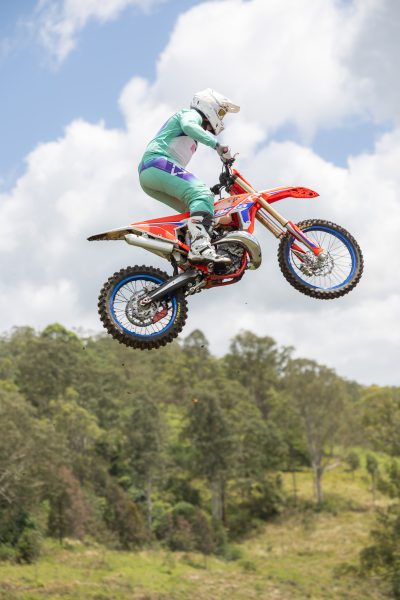
The Beta RX 250 was the first model Beta added to its motocross range. Having started life building trials bikes, Beta gradually moved into enduro, where it didn’t just grow, it thrived. In both trials and enduro, Beta pushed rivals to work overtime in their R&D departments just to keep pace. With more than a dozen enduro models now in the range, the RX 250 marked Beta’s first serious step into motocross. Initially, it was essentially a heavily modified enduro machine, but in reality it represented the beginning of Beta’s genuine investment in motocross. Fast forward a few short years and the RX lineup has expanded to include the RX 450 four-stroke and RX 350 two-stroke and 2026 Beta RX250 all now completely separate from the enduro range and designed, built and tuned specifically for the demands of motocross.
That first RX 250 was a real arm-tearer. Since then, Beta has done an excellent job of retaining the strong low-end power while adding a much smoother and stronger mid-range, along with a clean, revving top end.
First Ride Anticipation
We’ve always been big fans of the RX 250 at ADB and have used it in several tests and comparisons over the years. It’s always been a fun bike to ride, so it was only natural that excitement was high ahead of the 2026 model. Before anyone could suggest scissors, paper, rock, I grabbed a plane ticket and headed to Queensland to be the first to throw a leg over it.
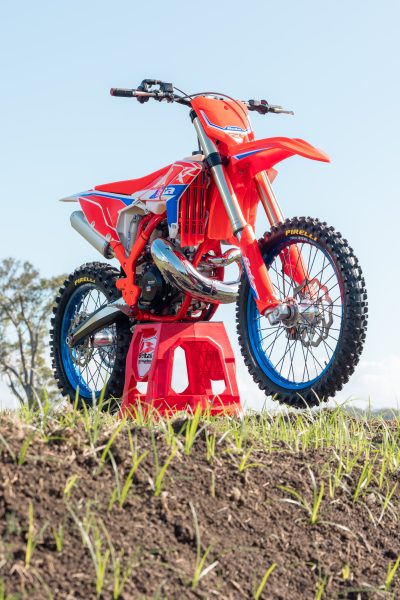
Conditions couldn’t have been better. The track looked like something straight out of a poster, green grass hills, deep loam, fast jumps up and down elevation changes, and loads of traction. It was the perfect place to let rip on a 250 two-banger and relive my youth for a day.
Tech Analysis
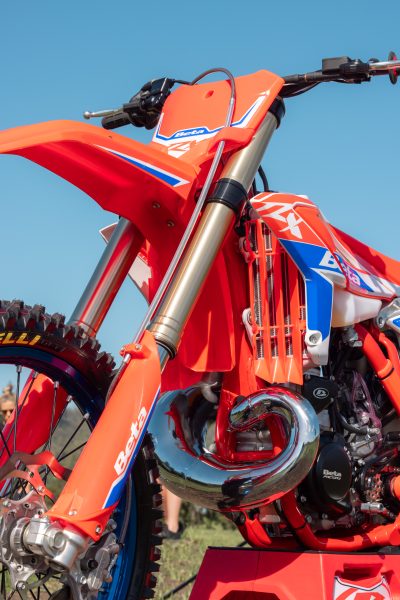
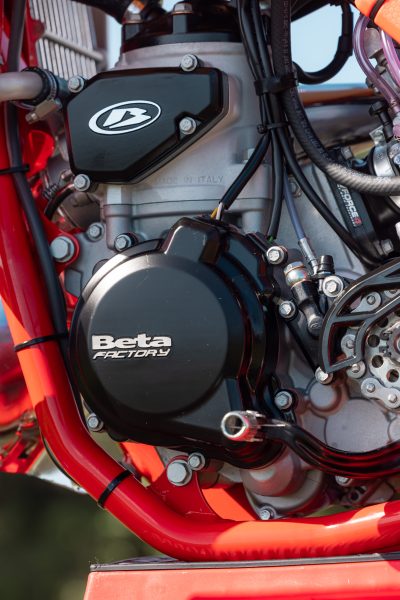
The 2026 Beta RX 250 two-stroke debuts with a completely new engine platform, designed to give riders a lightweight, high-revving option within the RX lineup. At the core of the redesign is a new cylinder head engineered to optimise combustion speed and airflow efficiency, key factors in achieving the high-rpm performance expected of a competitive 250 two-stroke.
Supporting this is a newly developed cylinder and piston assembly tailored specifically to this displacement. Beta has also recalibrated the power valve using different springs across models, allowing the RX 250 to fully exploit its rev-focused character. A new bore and stroke configuration of 66.4 mm x 72 mm results in a 249.3 cc capacity, supported by a 14.6:1 compression ratio to promote strong cylinder filling across the rev range.
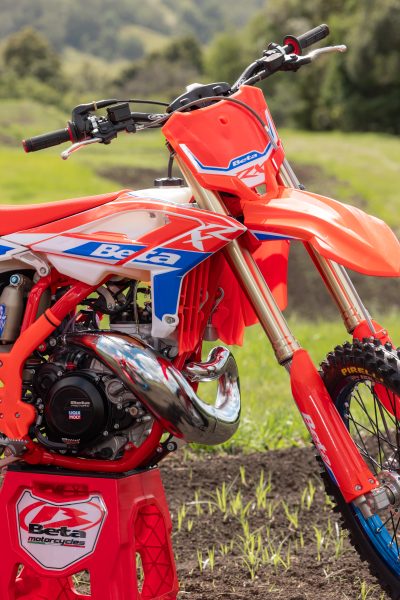
Further updates include new crankcases with revised internals to suit the updated crankshaft and manage the higher rotational speeds associated with the RX 250’s performance goals. Fueling remains via a Keihin PWK 38 carburettor with reed-valve induction, chosen for consistent throttle response and tuning flexibility. Oil delivery is pre-mix only, maintaining simplicity for competition use.
Electrical components include Kokusan digital CDI ignition and an electric starter powered by a lithium battery, now a common and welcome feature on modern two-strokes. Combined, these changes create a compact, high-efficiency engine package focused on improving volumetric efficiency and rev potential without sacrificing durability.
Chassis and Components
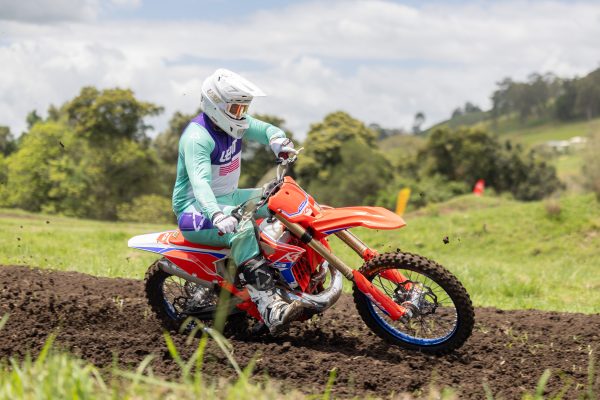
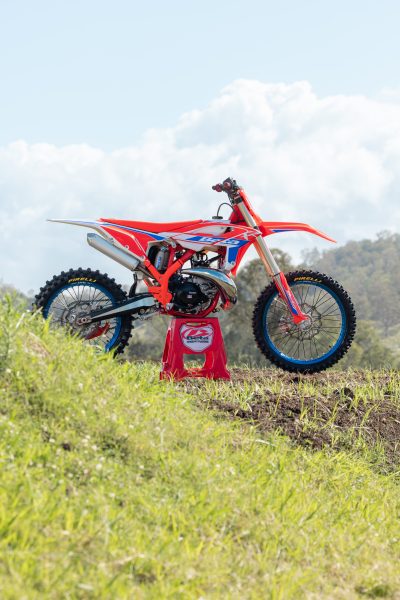
Across the chassis, the RX 250 shares the same 2026-generation upgrades introduced across the RX range. The molybdenum-steel double cradle frame now features cast-in reinforcement around the steering head, improving torsional rigidity under motocross loads. An aluminium subframe keeps weight down while maintaining rigidity, contributing to a claimed dry weight of 100 kg.
Radiators have been strengthened to better resist deformation, while air filter access remains quick and tool-free, an important consideration for motocross maintenance. Suspension is supplied by KYB, with a 48 mm AOS closed-cartridge fork up front offering 305 mm of travel, and a 50 mm rear shock delivering 300 mm, both specifically calibrated for motocross impacts.
Braking duties are handled by Nissin calipers paired with Galfer wave discs measuring 260 mm at the front and 240 mm at the rear.

Ergonomics and Dimensions
Dimensionally, the RX 250 maintains a familiar motocross footprint with a 1482 mm wheelbase, 945 mm seat height and 340 mm of ground clearance. Ergonomics are enhanced through Xtrig Flexfit handlebar mounts, which help isolate vibration, particularly important on a two-stroke.
A non-O-ring chain is fitted to reduce rotational mass and improve drivetrain feel, reinforcing the RX 250’s race-focused intent. Riders can also choose between two selectable engine maps (wet and dry), offering electronic adjustment to power delivery while retaining the mechanical advantages of the new engine platform.
Ride Review
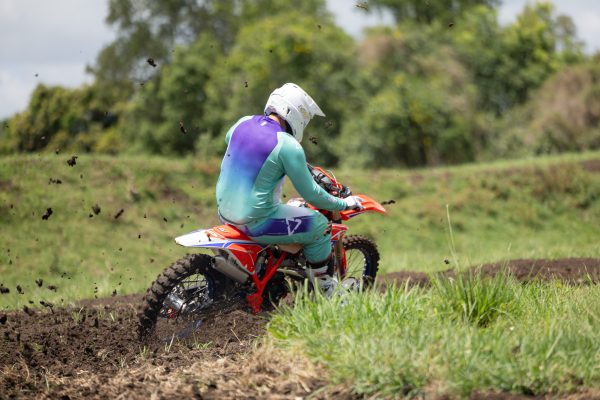
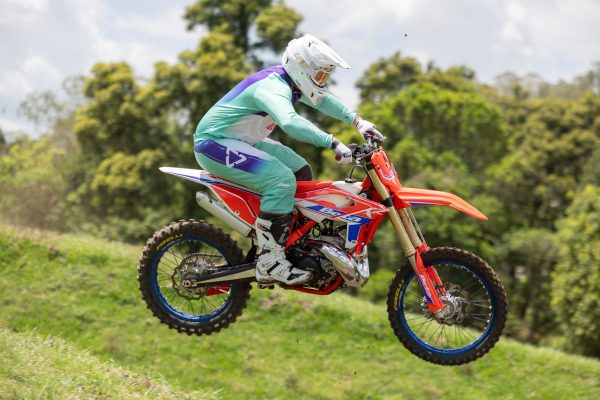
The RX 250 is the smallest capacity motocross machine Beta currently offers, and it is an absolute blast to ride. The first thing that struck me while cutting laps was just how much 125-style feel the RX 250 delivers. It’s incredibly nimble and easy to move around on. While it has far more power than a 125, the handling, mass and overall control feel remarkably similar.
The engine delivers a solid body of power, with a strong punch and enough low-end torque to pull cleanly out of ruts and up hills. Throttle response off the bottom is snappy and immediate. Thanks to the low rotating mass, the bike is also easy to manoeuvre in the air, without the engine’s inertia pulling it off line.
Interestingly, the snap off the bottom end is actually stronger and more abrupt than the RX 350 two-stroke, although the two bikes differ significantly in gearing. While I felt the need to make major gearing changes on the 350, Beta has nailed the gearing on the 250. Gear spacing and power valve timing work exceptionally well together.
The only issue encountered was a lean hesitation between quarter and half throttle when feathering the throttle through slower, tighter turns. A quick adjustment, moving the needle up one clip to richen the mixture, completely cleaned up the mid-rpm response. This highlights one of the advantages of carburetion. While similar issues can occur on fuel-injected two-strokes, resolving them typically requires a tuner or aftermarket ECU. With a carb, it can be fixed trackside in minutes.

Suspension Performance
Suspension is handled by the widely respected KYB components front and rear. Even though I’m heavier than the standard spring rates are designed for, the quality of the valving is immediately apparent. The suspension is smooth, predictable and confidence-inspiring across a wide range of conditions.
There’s nothing worse than suspension that unloads unexpectedly or only works when ridden flat out. The RX 250 avoids both pitfalls, performing consistently whether pushing hard or backing it off. The KYB suspension complements the new frame exceptionally well.
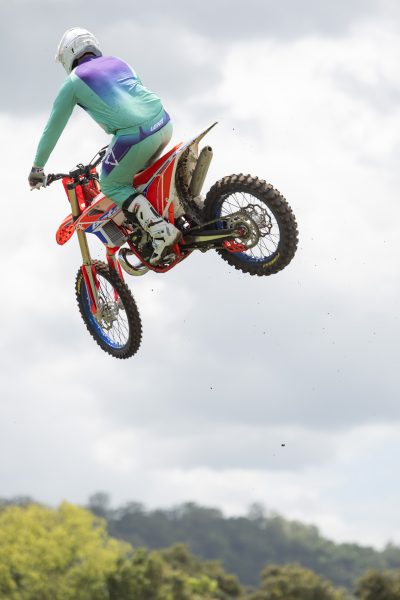
In deep ruts, the RX 250 is outstanding. Rut entry stability and ease of use really need to be felt to be fully appreciated. My favourite attribute, however, is how effortlessly the bike tips into turns while maintaining traction and stability. The chassis is exceptionally well balanced, a clear sign of the development time Beta has invested in a highly competitive motocross market.
Clutch and Brakes
The clutch does exactly what it should. It doesn’t stand out as exceptional, but it does nothing wrong either. Lever action is smooth, engagement is predictable, and there was no fade or sign of overheating.
The brakes provide good stopping power, although I would like to see Beta upgrade to a more modern Nissin front master cylinder rather than continuing with the older Honda-style unit.
Where Does It Fit?
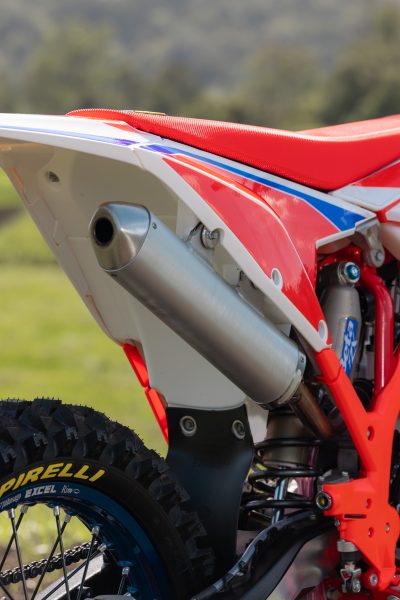
The Beta RX 250 is one of the most enjoyable bikes I’ve ever ridden. It’s impossible to step off it without a huge smile on your face, especially if you grew up riding 250 two-strokes. Whether it’s nostalgia or simply the way this bike delivers its performance, it’s pure fun.
If riding purely for enjoyment with no intention of racing, the RX 250 would be an outstanding choice, a bike you could ride for years without getting bored. For racing, if I had to line up in MX1, I’d still choose the RX 450 because I’m personally faster on the bigger bike. That won’t be the case for everyone, but it is for me.
However, many clubs, states and series still allow 250 two-strokes to compete in MX2. In that scenario, the RX 250 would be right at the top of my list.
2026 Beta RX 250
Engine
- Engine Type: Single-cylinder, two-stroke, liquid-cooled
- Bore x Stroke: 66.4 mm x 72 mm
- Displacement: 249.3 cc
- Compression Ratio: 14.6:1
- Exhaust Valve: BPV system
- Starter: Electric
- Ignition: Kokusan AC digital CDI
- Induction System: Reed valve
- Carburettor: Keihin PWK 38
- Clutch: Wet multi-disc
- Transmission: 5-speed
Chassis
- Frame: Molybdenum steel double cradle with quick air filter access
- Wheelbase: 1482 mm
- Seat Height: 945 mm
- Dry Weight: 100.0 kg (Front: 48 kg / Rear: 52 kg)
- Fuel Tank Capacity: 7.0 L
Suspension
- Front: 48 mm KYB AOS closed-cartridge fork with adjustable compression and rebound, 305mm travel
- Rear: KYB shock with 50 mm body, adjustable rebound and high/low-speed compression, 300mm travel
Brakes & Wheels
- Front: Nissin 260 mm wave disc with double-piston floating caliper
- Rear: Nissin 240 mm wave disc with single-piston floating caliper
- Front Tyre: 90/90 – 21, Pirelli MX32
- Rear Tyre: 120/80 – 19, Pirelli MX32
RRP & Warranty
RRP: $14,495 Ride Away
Warranty: None
Browser: betamotor.com.au