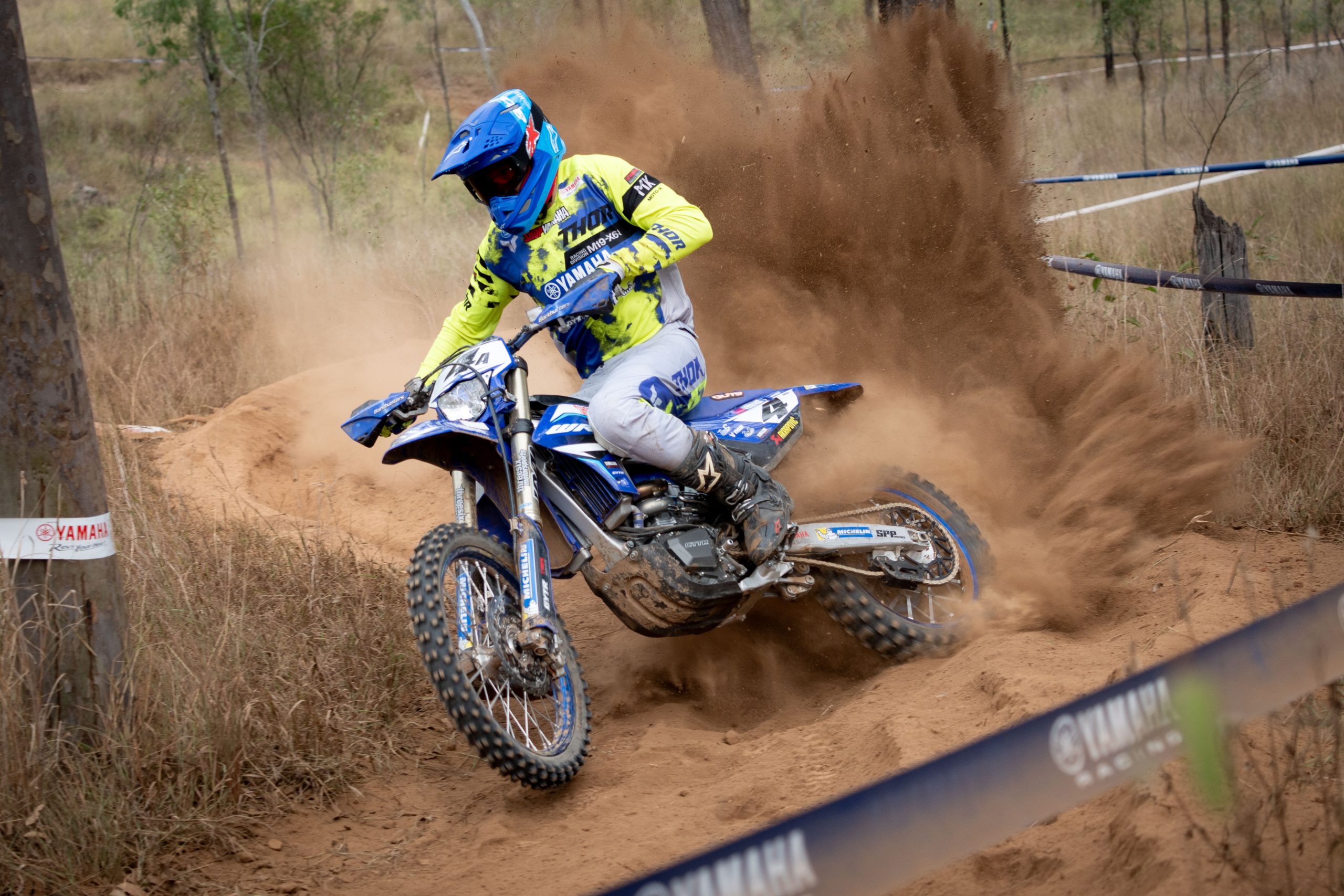
There are championship-winning seasons and then there are seasons like the one Jed Beaton just put together. After finishing runner-up in the MX1 championship twice in three years and having his 2025 campaign destroyed by a broken leg, Beaton came back in 2026 with a point to prove. What followed aboard the Monster Energy CDR Yamaha YZ450F was one of the most dominant premier-class campaigns we’ve seen in Australian motocross for a long time.
He opened the season at Wonthaggi by smashing both motos, winning them by 49 and 25 seconds respectively, then went to Canberra and swept Superpole and both races again. By the end of Appin, Beaton had won eight of the first 10 motos and four of the opening five overalls. One round later at Traralgon, another 1-1 performance took his championship lead to a whopping 64 points.
By the time the circus rolled into Conondale, Beaton had won 11 of the first 12 motos. A calculated 3-3 was enough to seal the championship with a round still remaining, finally giving one of Australia’s most respected racers the MX1 crown that had eluded him through injuries and near misses.
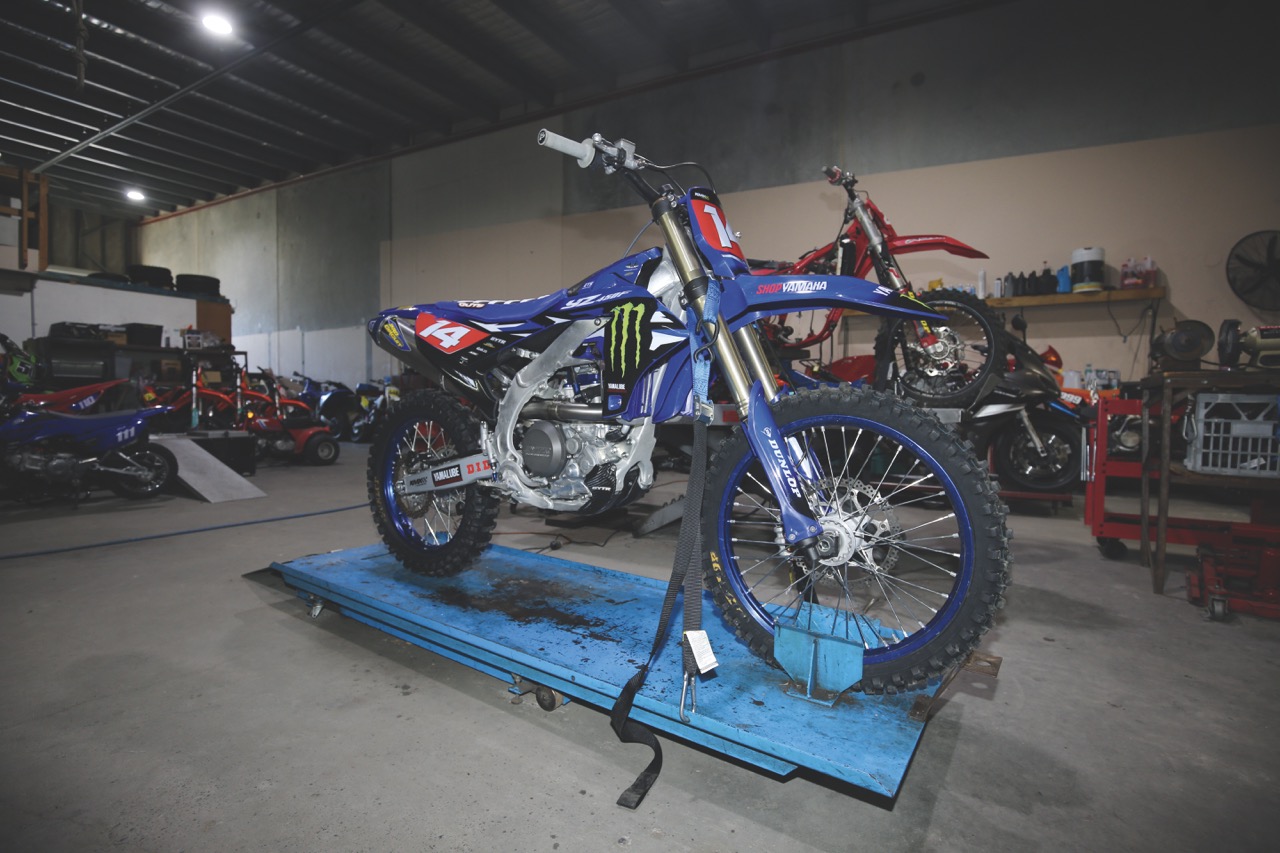
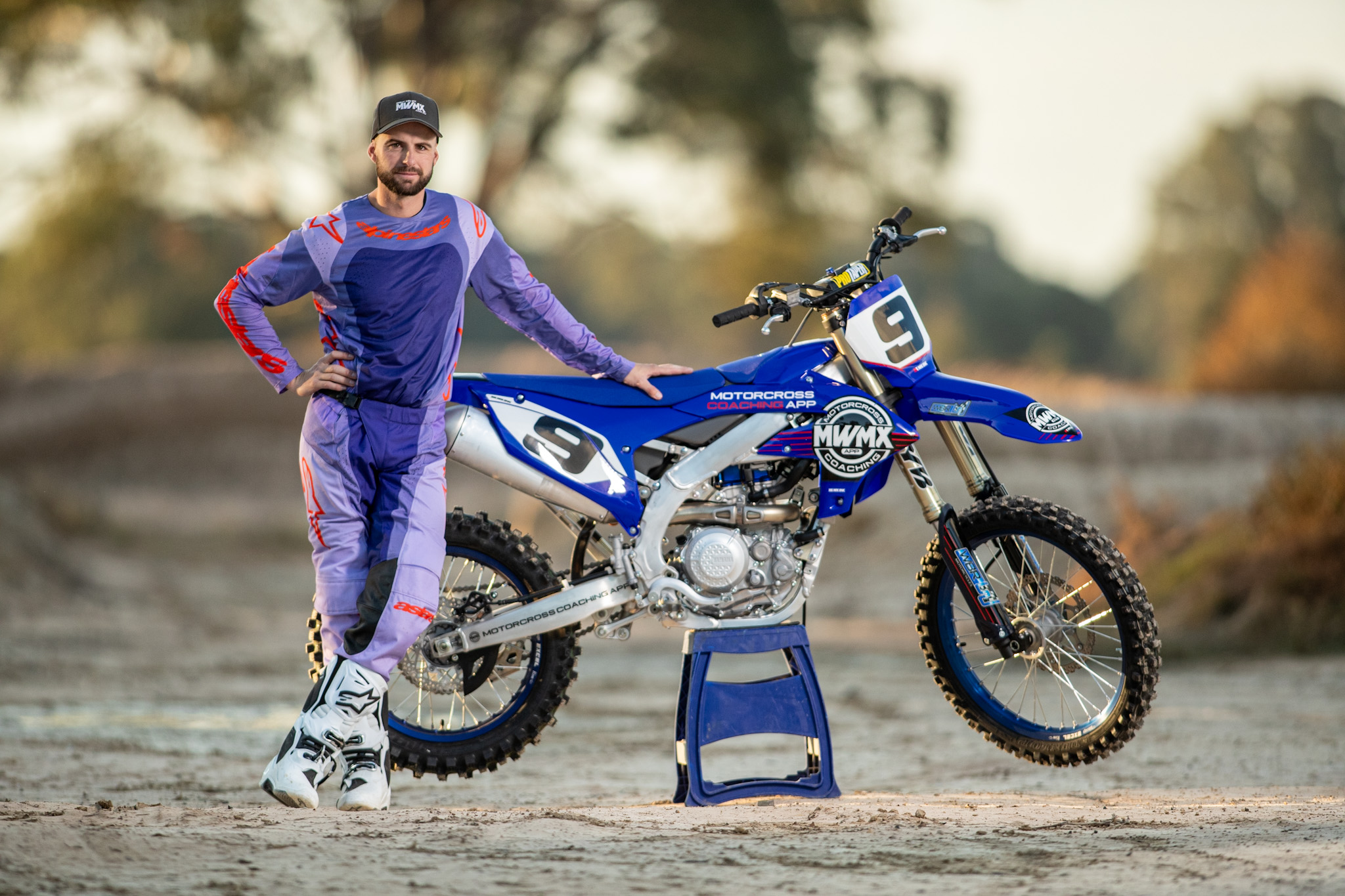
And that made our next long-term YZ450F project fairly bloody obvious. We were going to build a Jed Beaton replica.
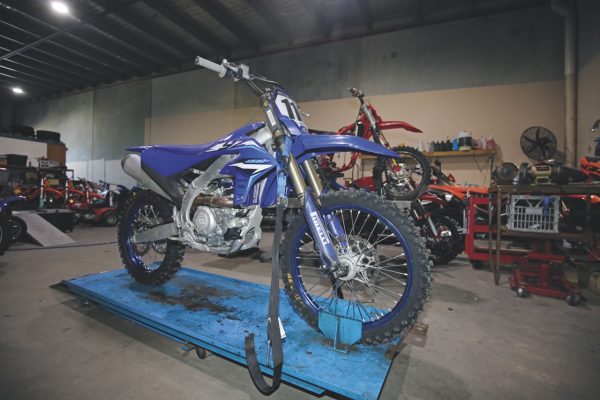
HOW FACTORY CAN WE GO?
Now, there’s replica and there’s replica. We weren’t about to ring CDR Yamaha and expect them to hand over Jed’s factory ECU, suspension, cylinder head, engine settings and every little trade secret that helped turn his race bike into the thing that demolished the ProMX field. That phone call probably wouldn’t have lasted long.
The first question was simple: how close could we actually get? Closer than you might think. After speaking with the CDR crew, the impression was that there is obviously some small internal engine work happening on Jed’s bike, along with ECU settings nobody is giving away, but the base motorcycle isn’t some completely alien factory prototype. All the other GYTR products, the Pro Circuit pipe and everything else, you can buy.
That gave us a plan. We’d use the genuine GYTR parts available to the public, hunt down the correct Pro Circuit exhaust, copy the aesthetics as closely as possible and build the kind of Beaton-inspired YZ450F that an enthusiastic punter could realistically put together at home.
Well, assuming said enthusiastic punter has nearly six grand burning a hole in his pocket.
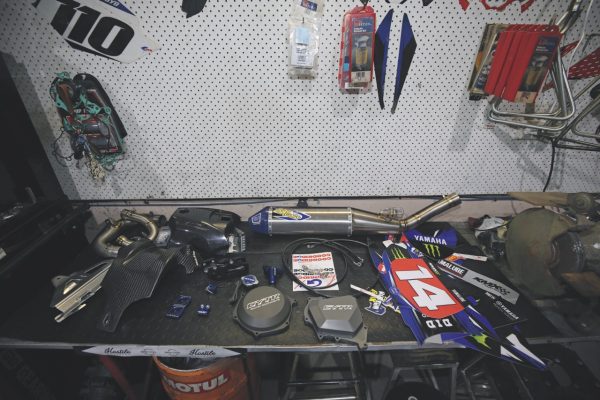
THE SHOPPING SPREE
Our parts bill eventually came to $5,839.28, and the biggest chunk of that was the Pro Circuit full exhaust system at $2,299.99 through Monza Imports.
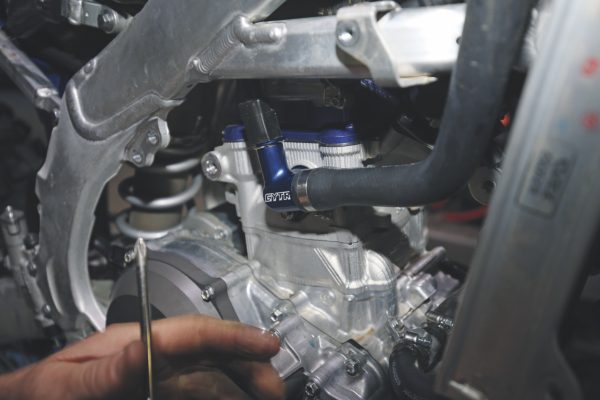
Around it went a serious collection of GYTR gear: a high-flow water fitting, rear-brake clevis, brake-line pinch clamp, axle blocks, carbon skidplate, chain guide, airbox cover, front-sprocket chain guard, clutch cover, 2.0-bar radiator cap, ignition cover and radiator braces.
Then came the finishing touches. A GUTS seat cover added another $139.94, KustomMX supplied the $329.95 replica graphics kit and Goodridge front and rear braided brake lines added another $250.
A lot of those bits aren’t going to suddenly give us Jed Beaton’s lap times. Unfortunately, there’s still no GYTR catalogue part number for talent.
What they do give us is durability, protection and a motorcycle that looks significantly more factory than the bike Yamaha rolled out of the crate.
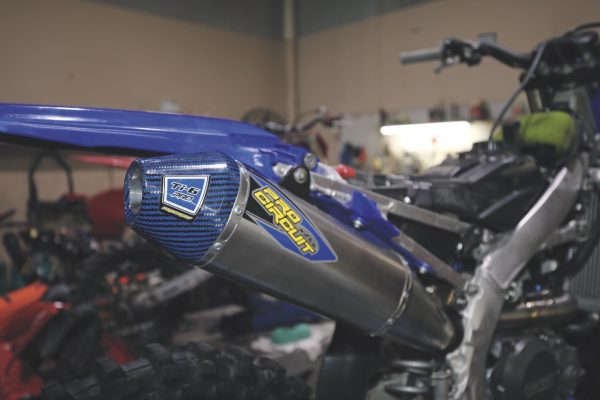
THE PIPE DREAM
The Pro Circuit system was one of the hardest parts of the entire build to get right. Not so much the muffler itself, but the exact configuration. Jed’s bike runs a very distinctive carbon-blue end cap and tracking the correct setup down meant going directly through Pro Circuit channels.
Then there was the header. Removing the stock YZ450F header reminded me why nobody enjoys doing it. Anybody that’s ever taken a header pipe off a Yamaha knows how many fingers and toes you’ve got to cross to get that thing out. There’s one exact way it’ll come out and it feels like it changes every single time you do one.
The replacement went on considerably easier, but there was something interesting stamped into it: CDR. That immediately raised questions about whether the CDR team is playing with header dimensions or length to alter the engine characteristics of its race bikes. We’re still confirming exactly what can and can’t be bought publicly, but either way it was a pretty cool detail to have on our replica.
The system currently runs without its removable baffle, although we have that as well. We’ve already dyno’d the bike and it hauls with the pipe on. Check out the sidebar.
MORE AIR, MORE GO?
The other genuine performance modification is the GYTR airbox cover. At first glance, it doesn’t sound as exciting as bolting on a full exhaust system, but there’s more going on here than swapping one lump of plastic for another. The GYTR setup provides more internal volume and adds intake flutes at the front.
The rear air openings are then blocked with foam, forcing the engine to draw from those forward-facing intakes. It works somewhat like a ram-air system, with air being directed into the airbox as the motorcycle moves forward.
Between the airbox and exhaust, we were able to increase power by????? (Dyno run will tell)
FACTORY ARMOUR
Most of the remaining GYTR catalogue is about making the bike tougher and considerably more schmick. The carbon skidplate offers protection underneath while keeping the proper race-bike look. GYTR radiator braces provide some insurance for those expensive radiators, while the chain guide, sprocket guard and axle blocks replace vulnerable standard items with CNC-machined pieces designed to take more abuse.
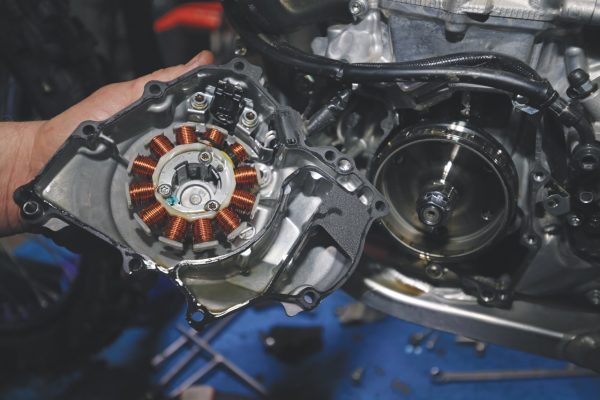
Then there are the bits you absolutely don’t need but absolutely want. The GYTR clutch and ignition covers are beautiful pieces of gear. They’re tougher, more resistant to scuffing and impacts than the stock covers and, most importantly for a replica build, they make the engine look straight out of a race-team workshop.
The high-flow water fitting and 2.0-bar radiator cap add some functional cooling-system upgrades, while the rear-brake clevis and brake-line pinch clamp finish off the details.
TAKING THE SPONGE OUT
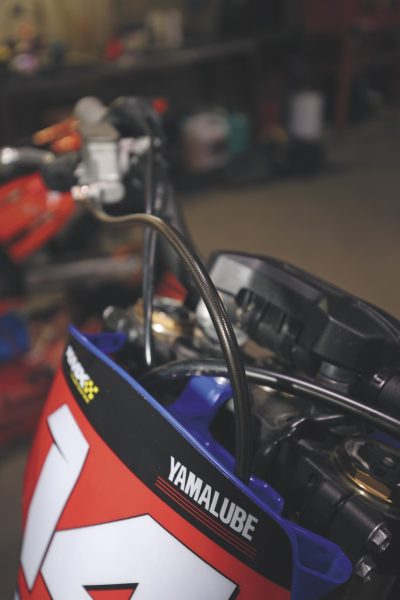
Goodridge supplied braided brake lines for the front and rear, and this is one of those upgrades that makes more sense the harder you ride. Standard rubber lines can expand slightly under pressure. A braided line helps resist that swelling, creating a more direct connection between what your fingers are doing at the lever and what’s happening at the caliper.
The idea is trying to get that spongy feeling out because the line is shrouded in braided material, it can’t swell as much when you pull the lever.
THE LOOK
You could fit every trick performance part on Earth, but a Jed Beaton replica without the right graphics would still just look like an average YZ450F with a pile of expensive parts attached.
That’s where KustomMX came in. The goal was to recreate the Monster Energy CDR Yamaha look as closely as we reasonably could, and they absolutely nailed it. Better still, the kit actually fitted properly.
This kit lined up around bolt holes, complicated panel shapes and all the ugly little grooves without requiring trimming or creative surgery.
Up top, a GUTS seat cover finished the factory vibe. Our resident seat-cover installer Bryce got the job of stretching it over the YZ foam, and despite Yamaha’s slightly fiddly front section, it pulled up tight without wrinkles, loose sections or tearing.
NOT JUST A SHOW PONY
Standing back and looking at the finished product, the first temptation is to park it in the ADB office and never let anyone get dirt on it. That would completely miss the point.
Is it Jed’s actual championship bike? Of course not. We don’t have his engine, suspension, ECU or CDR’s accumulated years of setup knowledge.
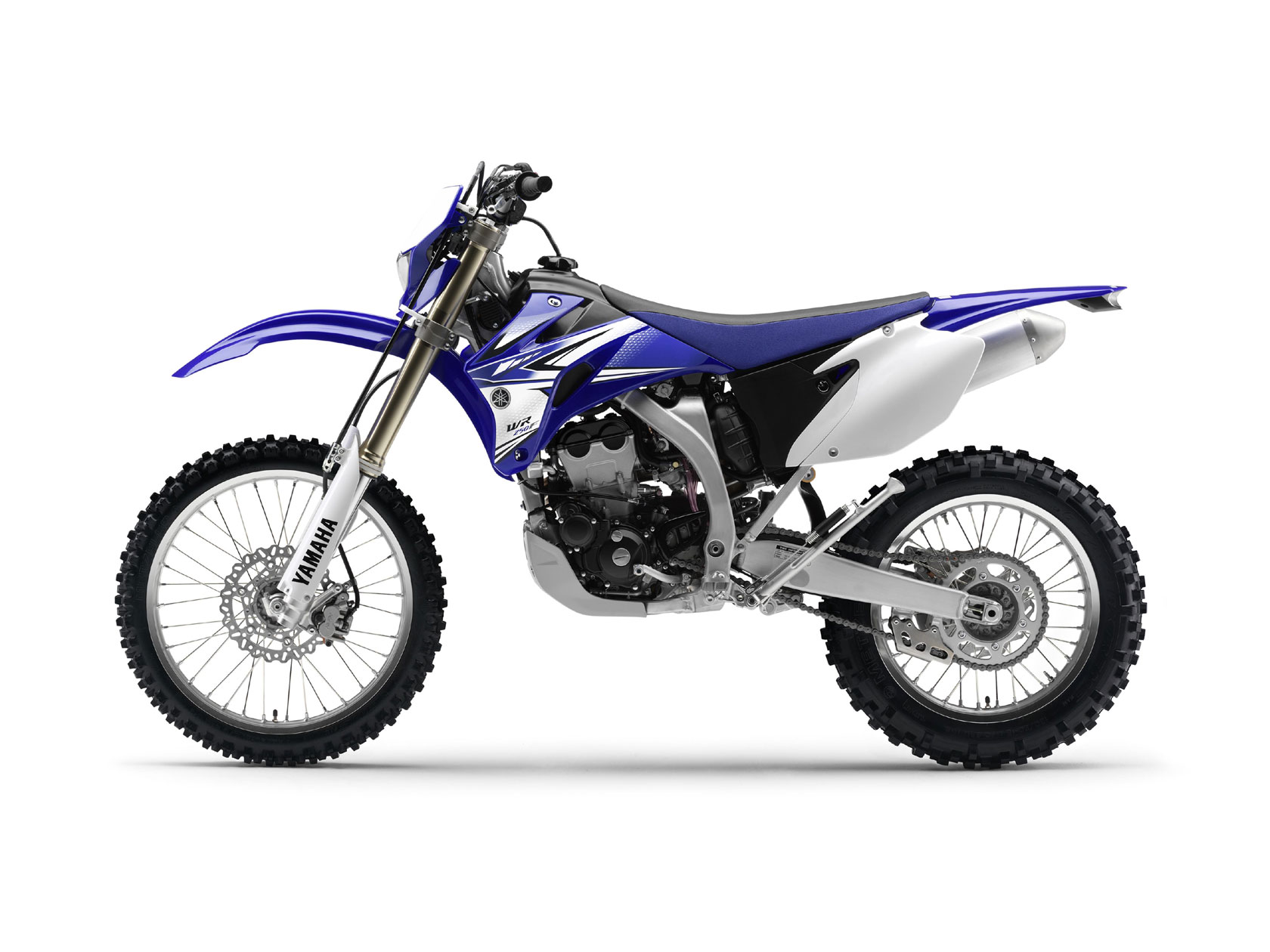
We wanted to take our standard 2026 YZ450F long-termer and show how close you can get using parts that riders can actually buy. With the Pro Circuit exhaust, GYTR catalogue thrown at it, braided brake lines, KustomMX replica graphics and GUTS seat, we reckon we’ve ended up with one bloody special YZ450F.
PC for the Win!
Other than increasing the noise, because the vacuum noise and the exhaust noise are quite a lot louder using this Pro Circuit pipe than the standard pipe, the PC pipe increased horsepower by nearly 4hp. The ramp up is a lot quicker, a lot more aggressive off the throttle and there’s a lot more bark from the bottom-end. The power actually ramps up quite fast and aggressive compared to stock.
It broadens out the top end a lot too. It gives it more RPM up higher, and the power curve is a lot stronger but still linear up high.
Okay.
THE BUILD
GUTS Seat Cover – $139.94
serco.com.au
Pro Circuit Full System – $2299.99
monzaimports.com.au
GYTR High-Flow Water Fitting – $171.95
GYTR Rear Brake Clevis – $99.95
GYTR Brake Line Pinch Clamp – $81.95
GYTR Axle Blocks – $99.95
GYTR Carbon Skidplate – $413.95
GYTR Chain Guide – $276.95
GYTR Airbox Cover – $206.95
GYTR Front Sprocket Chain Guard – $100.95
GYTR Clutch Cover – $428.95
GYTR High-Pressure 2.0-Bar Radiator Cap – $78.95
GYTR Ignition Cover – $643.95
GYTR Radiator Braces – $214.95
KustomMX Graphics Kit – $329.95
kustommx.com
Goodridge Front & Rear Brake Lines – $250
johnstamnas.com
TOTAL PARTS VALUE – $5839.28