What: 1977 Husqvarna 250CR Special
When:- December 1977 Trail & Track No. 51
Purpose:- Enduro
How Much:- $1,499
There were superseded CR250 Husqvarnas sitting around unsold, and A Grade motocrosser and salesman at Triple C, Steve Cramer, came up with an idea to help move them off the showroom floor by converting them for enduro use. There wasn’t a lot that needed to be done, and many private owners were doing it themselves already, but a shop like Triple C could do it with economy of scale, making an overall cheaper package. At its most basic, a conversion only needed lights and a quieter exhaust to pass road registration requirements, which is all this bike seemed to have, but a larger tank than the standard 7.8-litre steel unit and a bash plate were handy additions as well.
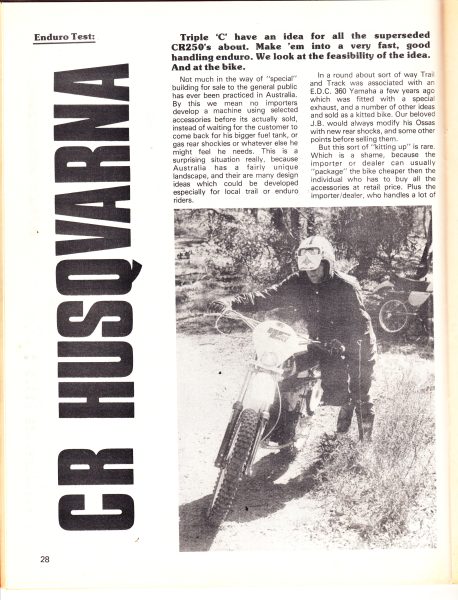
The 250 Husky started life as a five-speed that was not noted for being lightweight. It went on a diet in 1975 with the change to magnesium cases, then it got a radial finned head and six speeds in 1976. Other changes, inspired by world champ Heikki Mikkola, included the frame, various shock positions and exhausts until Husqvarna produced the model we have here. The use of magnesium saved a lot of weight, useful on a motocrosser but a liability on an enduro bike, which needs strength and reliability, and strangely this conversion did not include any engine protection.
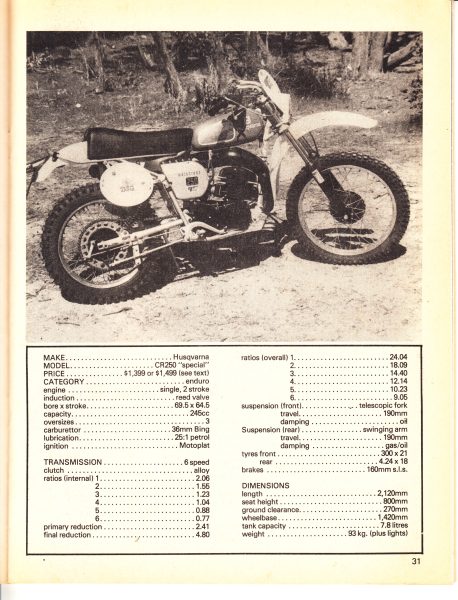
The fuel was fed by a 36mm Bing carburettor with no choke, just a tickler, which covered the cases with 25:1 premix and leaked as soon as the fuel was turned on, only stopping when the motor was started, and it breathed through a double reed valve with eight petals. The airbox was not well sealed for enduro use and copped a lot of splash from the rear wheel. The gearbox internals were interchangeable with the 360WR, making it possible to fine-tune the ratios to your own requirements, and it was suggested the top two ratios from the WR would be the way to go. The Super Trapp muffler allowed owners to experiment with the noise-to-power balance by adding or removing baffles. Suspension travel was 190mm front and rear, brakes were 160mm SLS drums, and weight was 93kg (plus lights).
Riding it required a certain technique to light it up, as it was easily flooded due to the short left-side kickstart swing, which clashed with the footpeg, and the testers admitted to clutch starts being preferable if on a slope. It was said to pull well from low down due to the reed valve but still performed when in the powerband. It was reported to have been ridden continuously below the powerband with enough usable power to negotiate tricky terrain slowly, but still came onto the powerband with a wheel-spinning surge and revved out cleanly after 15 or 20 minutes of slow riding.
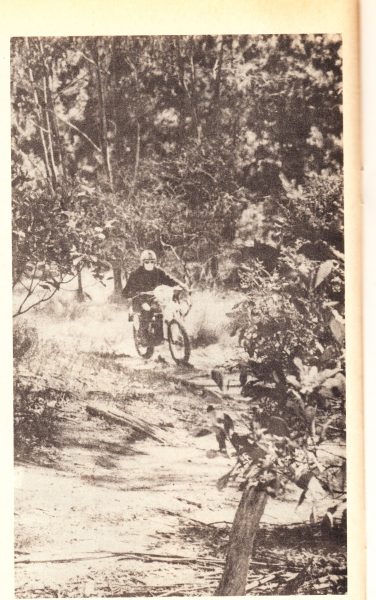
Suspension was judged to be too hard for enduro work, with most test riders remarking it could be softer. The rear springs on the Girling shocks could be changed easily enough, but the factory didn’t offer softer springs for the front fork, although it could easily be converted to air. It handled well in fast going and was easy to slide, and it was remarked that sometimes it was a little too easy, with the back end coming out often, although this suited the Husky more than squaring off a corner. The front brake impressed with its performance but not the full-floating rear brake, which showed a tendency to hop and lock much like the Japanese bikes of the era. Ultimately, it was decided that, with the right fittings added, the Husqvarna 250CR could be converted into an economical and super competitive enduro mount.