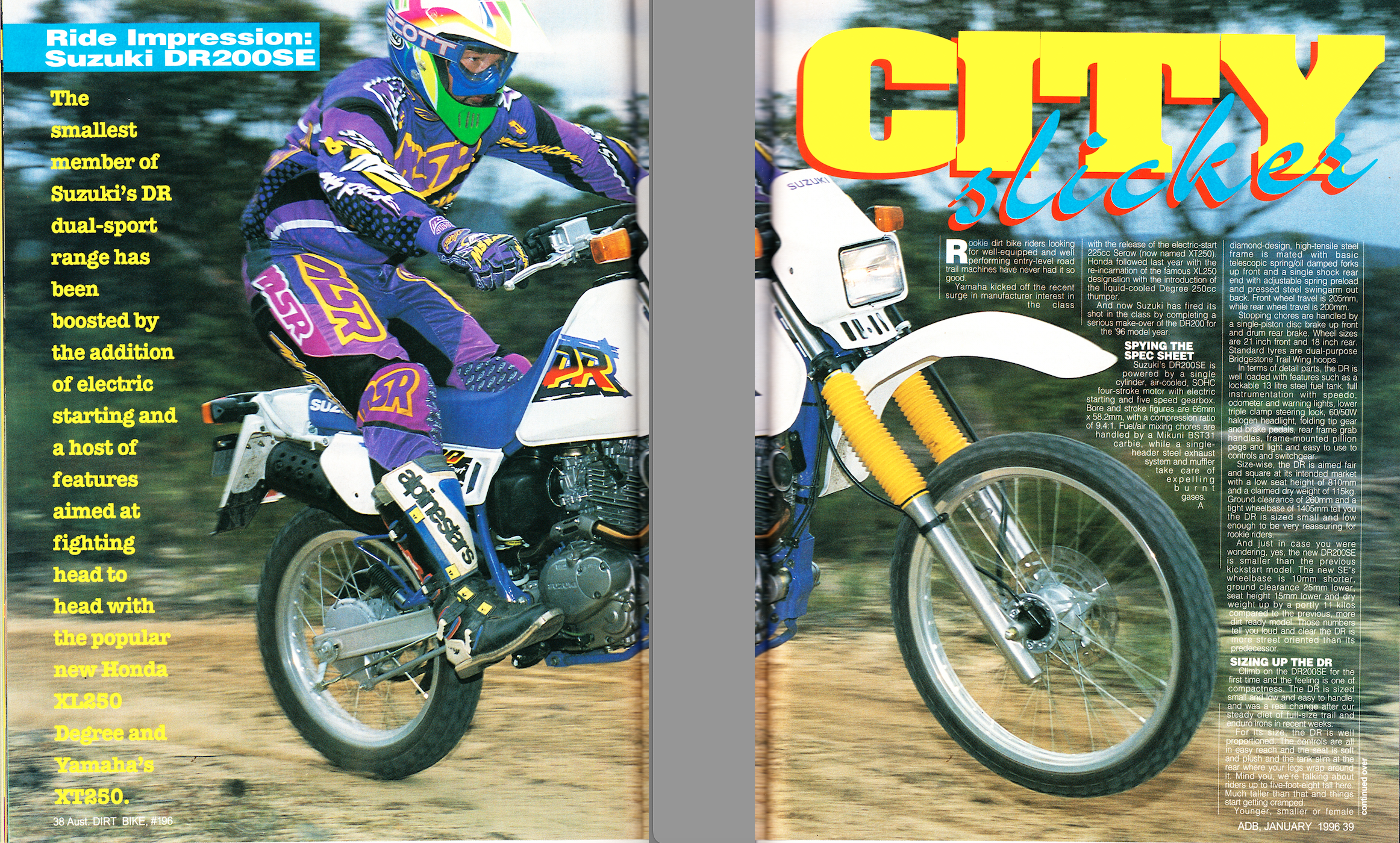
THE BASICS
What: Suzuki DR200SE
When: January 1996, Issue 196
Purpose: Trail Bike
How Much: $5,100
When it came to entry-level road/trail machines for the beginner rider or the weekday commuter who wanted some gentle playtime in the bush, then the Suzuki DR200SE was possibly not the best choice of the three available offerings, but it was the best value for money, which for many is just as important. The little Suzuki gained electric start and 11kg over the previous model and had a $358 advantage over the Yamaha XT250 (previously called the 225 Serow) and the Honda Degree XL250, which cost a whopping $1,756 more. Combine that with a seat height of 810mm and a dry weight of 113kg and it’s clear that Suzuki was aiming fair and square at smaller riders or those who were just starting out on two wheels.
The SOHC, air-cooled, single-cylinder motor fired up with the touch of a button, sported a five-speed gearbox, a steel exhaust system, Mikuni BST31 carb and CDI ignition, as well as a conventional fork with 205mm of travel and a single shock with adjustable preload that offered 200mm travel. A single-piston disc brake up front and a drum rear handled the stopping duties. Wheel sizes were 21-inch and 18-inch, fitted with Bridgestone Trail Wing rubber, the swingarm was pressed steel, and the frame was a diamond-design, high-tensile steel construction mounted by a lockable steel 13L tank. The whole bike was sized small, compact, low and was easy to handle, an ideal combination for first-timers.
As a commuter, the DR200SE slid easily through traffic. The engine was free-revving but no powerhouse and required plenty of revs as it made most of its power up high, but had no trouble running with the traffic and, on open roads, could reach 110km/h with smaller riders or larger ones prepared to tuck in as much as they could. The brakes washed off speed reasonably well, but the fork would dive under heavy braking as, even for street use, the suspension was a bit soft in standard form, both front and rear. But as a cheap and economical transport runabout, it worked OK.
In the dirt, the little Suzy could reach its limits without trying too hard, although it did make it around the rock- and ledge-infested enduro loop near ADB’s office-by-the-sea, a course usually used to test pukka enduro iron. To be fair, this was asking a lot of the bike. The suspension bottomed out everywhere, the front brake went spongy, the rear drum couldn’t hack the pace and the clutch copped a lot of abuse on the hills, resulting in the clutch action going away as well. It didn’t do it with style, but it did make it all the way around despite this sort of use being well outside the design parameters.
On gentler fire trails and dirt roads, the intended home of the Suzuki, it was much more at home but still needed to be kept working if wanting to keep pace with the offerings from Yamaha and Honda, both of which enjoyed an engine capacity advantage. In this market niche, though, price is very often a large, if not major, consideration and on that score the Suzuki DR200SE was the definite winner.
ce and improve over time, and I really enjoy coaching them. We live in the Southern Highlands, so there is plenty of opportunity for riding with my sons. Plus, I have a Ducati Monster and I used to have a YZ450 Super Motard for a bit of fun on track days, and I sometimes ride the Transmoto series with my sons.