There’s a big difference between being fast and being a championship rider. For years, nobody questioned Hunter Lawrence’s speed. The Aussie had already proven himself across the 250 class, won outdoor titles and shown flashes of brilliance whenever he lined up in the premier category. But Supercross is ruthless. It doesn’t care about hype, reputation or raw talent. It exposes every weakness a rider has and rewards the riders who can survive the chaos week after week.
That’s why heading into the 2026 AMA Supercross Championship, Hunter still felt like something of an unknown quantity in the title conversation. Most people believed he could win races, but fewer believed he could survive an entire 17-round season against riders like Eli Tomac, Cooper Webb and Ken Roczen. Supercross championships are built on consistency and composure, and until this season, Hunter hadn’t yet had the chance to prove he could manage both over the course of an entire premier-class campaign.
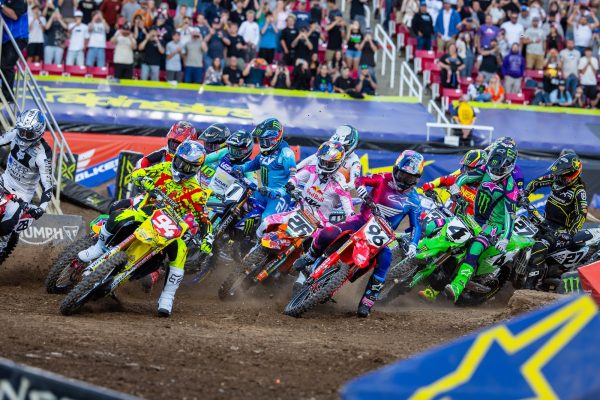
As the gates dropped at Anaheim 1, the spotlight wasn’t fully on Hunter either. Eli Tomac’s return dominated headlines, Cooper Webb was expected to grind his way into contention as always, and there was enormous curiosity around whether Ken Roczen could somehow produce one final championship push after years of horrific injuries and setbacks. Hunter quietly went about his business, and in hindsight, that was probably the first sign this season was going to be different.
Fourth place at Anaheim 1 wasn’t spectacular, but it was smart. While other riders rode with aggression and emotion, Hunter looked controlled and patient. He stayed out of trouble, banked points and left the opener sitting fourth in the standings. It wasn’t the type of result that immediately dominates social media, but it was the type of ride that championship contenders build seasons around.
SAN DIEGO SENDS A MESSAGE
San Diego was where the championship really started to feel different. Hunter grabbed the holeshot and immediately looked comfortable leading the best riders in the world. He traded laps with Eli Tomac and Ken Roczen and never looked overwhelmed by the pace or pressure. Even when the intensity ramped up late in the race, Hunter stayed composed and continued hitting his marks lap after lap.
He eventually finished second, but that ride mattered more than many realised at the time. Everybody already knew Hunter had speed. What they didn’t know was whether he could sustain it under championship pressure against riders who had spent years fighting for titles. San Diego showed he could. More importantly, it showed he could do it without riding over his head or making emotional mistakes.
That became one of the defining traits of his season. While other riders often faded late in races or made mistakes trying to force the issue, Hunter frequently looked stronger as the mains wore on. His late-race pace became one of his biggest weapons and gave him a level of consistency that suddenly made him look like a genuine title threat rather than just another podium guy.
Anaheim 2 reinforced the point. Another second place. Another race where Hunter looked composed and mature. Another reminder that his first 450SX victory was getting closer and closer. Even then though, the championship still felt incredibly open. Tomac looked dangerous, Roczen was rebuilding momentum, Webb was quietly lurking in the background and Sexton still had terrifying outright speed whenever everything clicked.
HOUSTON: THE FIRST BIG TEST
Houston’s Triple Crown became one of the first major turning points of the season. Triple Crowns have a way of exposing riders because there’s no time to mentally reset between races. One mistake can completely derail an entire night, and riders who panic usually get swallowed up quickly. Hunter made an early mistake in the opening race and dropped back to seventh, which immediately put him on the back foot.
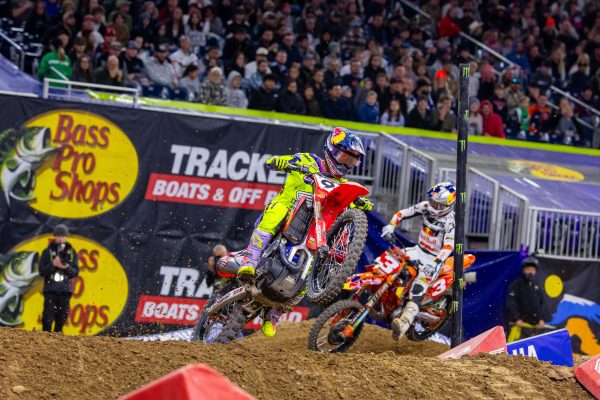
Previous versions of Hunter Lawrence may have spiralled after something like that. The 2026 version didn’t. Instead, he responded exactly like a championship rider should. He came back swinging in Race 2, took the win and then backed it up with another strong ride in Race 3 to salvage second overall for the night.
That response was arguably more important than the result itself. Championships are rarely won on the nights where everything goes perfectly. They’re won on the nights where riders manage damage and stop bad situations becoming catastrophic. Hunter leaving Houston only four points behind Eli Tomac suddenly made people in the paddock start paying real attention to him.
More importantly, he looked mentally strong. He wasn’t panicking when things went wrong, and he wasn’t letting one poor start or one mistake destroy his night. That ability to emotionally reset quickly became one of the biggest reasons he stayed in championship contention all season long.
THE RED PLATE ARRIVES
By Indianapolis, the transformation was complete. Hunter no longer looked like a rider trying to prove he belonged at the front. He won the Triple Crown overall with a 2-4-1 scorecard and suddenly found himself carrying the momentum of the championship.
What stood out wasn’t necessarily the speed. It was the maturity in how he approached races. Hunter wasn’t riding desperate or trying to make highlight-reel passes every lap. He simply kept putting himself in smart positions, avoiding major mistakes and capitalising whenever opportunities presented themselves. That’s exactly what elite championship riders do.
By the time Birmingham rolled around, the pressure had shifted completely. Roczen was finding form, Tomac still looked dangerous and Webb remained the master of quietly hanging around title fights. Yet Hunter looked calmer than all of them. He got out front early at Birmingham and completely controlled the race without ever looking flustered.
The win extended his points lead and completely changed the championship narrative. Hunter Lawrence wasn’t chasing a title anymore, he was leading one! That’s a completely different mental challenge. Suddenly, everyone else was chasing him, and every race weekend carried a different kind of pressure.
DETROIT DISASTER
And then came Detroit.
Up until that point, Hunter had been almost flawless. He’d stayed healthy, avoided chaos and consistently scored strong points. Detroit was the moment Supercross reminded everyone how quickly things can unravel. Hunter looked untouchable all day, qualifying fastest and winning his heat race comfortably. Everything pointed toward another dominant night.
Then the main event happened. While chasing Chase Sexton through the whoops, Hunter crashed heavily and immediately found himself in survival mode. The crash bent the handlebars and jammed the front brake, forcing him into the mechanics area while the rest of the field disappeared down the track. He eventually limped home in 18th place, and in one race his comfortable championship lead was gone.
That was the moment the championship exploded open again. For the first time all season, Hunter looked vulnerable, and mentally that’s where a lot of championships disappear.
The scary thing for Hunter’s rivals though was how he responded afterwards. Plenty of riders would’ve mentally collapsed after a night like Detroit. Instead, Hunter turned up the following rounds looking more determined than ever.
THE BEST RESPONSE
Nashville became one of the defining rides of Hunter’s entire career. The conditions were brutal, with the track becoming slick, rough and deeply technical as the night wore on. Roczen looked strong early and Cooper Webb hovered in the background waiting for mistakes. Hunter stayed patient through all of it.
Rather than forcing the issue, he slowly built into the race, picking riders off methodically before finally attacking Roczen after halfway. Once he got to the lead, he disappeared. Hunter won by over seven seconds and immediately re-established himself as the man to beat in the championship.
That ride mattered because it proved Detroit hadn’t broken him mentally. In fact, he almost looked stronger afterwards. Nashville also highlighted how complete Hunter had become as a rider. He wasn’t just winning one style of race or succeeding on one type of track. Slick tracks, rough tracks, Triple Crowns or technical layouts — he adapted to all of them.
At this point, it became obvious the title fight was turning into a genuine heavyweight battle between Hunter and Roczen as Tomac had mentally left the building. The rest of the field still influenced the championship, but emotionally and momentum-wise, those two riders had separated themselves from everyone else.
DENVER SETS UP THE FINALE
Denver delivered one of the biggest rides of Hunter Lawrence’s career. Heading into the round, he sat four points behind Roczen and knew he needed to win. Under that kind of pressure, most riders tighten up. Hunter did the opposite.
At altitude, starts become even more critical because passing is harder and riders fatigue quicker. Hunter nailed the launch, controlled the race from the front and completely dominated the field. He didn’t just win, he destroyed them, crossing the line more than 12 seconds clear of the pack.
That result cut Roczen’s lead to a single point heading into Salt Lake City and created one of the most dramatic finales the sport has seen in years. Seventeen rounds. One point. One final race to decide everything.
The pressure heading into Salt Lake City was enormous. Hunter had spent huge portions of the season leading the championship and now found himself needing one final perfect ride to complete the story.
HEARTBREAK IN SALT LAKE CITY
For the opening laps of the finale, it genuinely looked like Hunter was about to pull it off. He grabbed the holeshot and immediately went head-to-head with Roczen while the crowd erupted around them. Every lap felt tense because both riders knew the championship was effectively changing corner by corner.
Then the mistakes crept in. A small off-track moment. Another mistake. Then a crash. Suddenly Hunter dropped back to seventh and watched the championship begin slipping away in real time. Meanwhile, Roczen rode exactly the race he needed to.
When the chequered flag fell, Roczen secured the championship by three points. For Hunter, the heartbreak was obvious immediately afterwards. You could see the emotion all over his face. The frustration of being so close. The pain of knowing one or two moments across an entire season had ultimately made the difference.
But despite the heartbreak, the 2026 AMA Supercross Championship completely changed the way the sport views Hunter Lawrence. He entered the season as a very good rider with potential. He left it looking every bit like a future Supercross champion.
This wasn’t a “nearly” season. It was a breakout season. Hunter proved he can handle pressure, manage a championship and win the biggest races against the best riders in the world. Most importantly, he proved he belongs in the sport’s elite tier.
But what defined Hunter’s entire season actually came once the season had officially ended. As Hunter sat there, clearly overcome with emotion and trying to work out how he lost the Championship by 3 points, the live broadcast team asked him how he felt. His response won the hearts of all supercross fans and showed aspiring athletes all around the world how to conduct yourself in the face of defeat: “Congrats to Kenny—well earned” Hunter said. “He was the better man tonight in the main. Congrats to him and the team, it was fun battling with him. We’ll get ready for outdoors.”
450SX Championship Points (after 17 of 17 rounds)
- Ken Roczen: 349
- Hunter Lawrence: 346
- Cooper Webb: 315
- Eli Tomac: 275
- Justin Cooper: 273
WHAT HAPPENED TO ELI TOMAC IN 2026?
For the first half of the 2026 AMA Supercross Championship, it honestly looked like Eli Tomac might finally grab one more title before the curtain closed on his incredible career. The veteran came out swinging early, winning Anaheim 1 and stacking up multiple victories throughout the opening rounds, including another dominant Daytona win — his eighth at the famous speedway.
Tomac spent large portions of the season either leading the championship or sitting right in the thick of the fight with Hunter Lawrence and Ken Roczen. Even when Hunter grabbed momentum through the middle rounds, Tomac never really went away. But, fans and pundits started noticing that Tomac didn’t quite look like himself physically, particularly during the second half of races.
The defining moment came at Cleveland during Round 14 when Tomac crashed heavily in practice and injured his hip. The injury ruled him out of the round and effectively ended his championship hopes. He eventually returned late in the season and even scored a podium in Denver, but by then the championship battle had shifted entirely toward Hunter Lawrence and Ken Roczen.
GAVE up the Chase
Heading into the year, there was massive hype surrounding Chase Sexton’s move to Kawasaki after leaving KTM, with many expecting the former champion to immediately become a title contender again. Early on, there were flashes that suggested exactly that. Sexton won Anaheim 2 in convincing fashion and looked blisteringly fast whenever the track suited him.
The problem was consistency. While the raw speed was obvious, Sexton never quite looked fully comfortable on the Kawasaki package. Some weekends he qualified near the front and looked capable of winning, while other rounds he struggled to settle into races and often found himself hovering around the top five rather than dominating.
Then came the injury blow. Before Daytona, Sexton crashed during preparation and suffered hip and lower back injuries that forced him out of multiple rounds, effectively ending any realistic championship hopes. The timing couldn’t have been worse because the title fight was just starting to intensify between Hunter Lawrence, Eli Tomac and Ken Roczen.
To Sexton’s credit, he fought back later in the year and still showed the kind of speed that reminds everyone why he’s one of the most naturally talented riders in the sport. He capped off the season by winning the Salt Lake City finale.
KIWI KID CONQUERS AMERICA
There’s something about New Zealand motocross riders that always seems to translate overseas. Maybe it’s the rough tracks, the work ethic or the fact most of them grow up riding sketchy paddocks and muddy circuits before they ever see a groomed Supercross track. Whatever it is, the tiny island of New Zealand keeps producing epic riders.
Ben Townley did it. Josh Coppins did it. Darryll King did it. Courtney Duncan did it. Now another Kiwi has added his name to the list, with Cole Davies delivering New Zealand its biggest Supercross moment in nearly two decades.
Heading into the 2026 AMA Supercross season, Davies was already regarded as one of the sport’s hottest young prospects. The teenager had dominated as a junior back home, blitzing whoops 24/7 with Townley watching over before relocating to America.
The raw speed was obvious, but Supercross championships are usually won by riders with experience. The 250 class was stacked with proven names, and there were still questions around Davies.
Right from the opening rounds, Davies looked completely comfortable. More importantly, he didn’t ride like a teenager trying to prove himself. He rode like somebody who genuinely expected to beat everyone around him. His whoop speed immediately became one of the biggest talking points in the paddock, with riders and fans constantly commenting on how smooth and effortless he looked through technical sections.
What made the season so impressive wasn’t just the speed though — it was the maturity. Young riders often rely purely on aggression and emotion, but Davies looked calm under pressure. He avoided major mistakes, adapted to different track conditions quickly and consistently put himself in smart positions during races.
As the season progressed, it became obvious this wasn’t just a hot streak. Davies kept stacking podiums and race wins while the riders around him struggled with inconsistency. The East Coast title fight remained tight for most of the year, but Davies continually found ways to stay at the front of the championship.
The defining moment came in Philadelphia. Heavy rain turned the circuit into an absolute mud pit and transformed the night into a survival race. Experienced riders crashed everywhere while conditions deteriorated lap after lap. Davies handled it like a veteran. Instead of panicking or forcing the issue, he rode smart, picked good lines and stayed patient while others unravelled around him.
When the chequered flag dropped, Davies secured his fifth win of the season and officially clinched the 2026 AMA Supercross 250 East Championship. The emotion afterwards said everything. You could see how much the title meant to him and his family after years of sacrifice to chase the American dream.
One of the coolest parts of the season was watching Davies develop a rivalry with Haiden Deegan. The pair traded blows throughout the year and instantly became one of the sport’s most exciting young matchups. We’ll have to wait a few years for Cole to jump into th e450 class to see them battel again now.
The Deegan Show
Haiden Deegan’s 2026 AMA Supercross season was exactly what everyone expected from the outspoken American. While Cole Davies grabbed the 250 East title, Deegan dominated much of the West Coast series with raw speed and intensity that often made him look untouchable. The Monster Energy Yamaha rider continued building his reputation as the sport’s biggest young personality, combining brutal starts, huge whoop speed and that trademark aggression that either wins fans over or drives them insane. There were still moments of inconsistency and controversy throughout the season, but when Deegan was on, he looked like the benchmark of the class.
ROCZEN’S FAIRYTALE
Unfortunately for Hunter, Roczen was quietly building one of the greatest comeback stories the sport has seen in years. At 32 years old, after endless injuries and surgeries, Roczen somehow found himself back in championship contention. For years, the question had never been about his talent. The question was always whether his body could survive an entire season.
In 2026, it finally did. That’s what made the title fight so emotional. Roczen wasn’t just another rival. He was a battered veteran, a friend of Hunters’ who was trying to finally achieve something that had escaped him for over a decade. Watching him slowly claw back points every week created an incredible atmosphere around the championship.
The most insane part of Roczen’s run was that he overturned a 31-point deficit over the final seven rounds. That’s almost unheard of in modern Supercross, especially against a rider as consistent as Hunter had become. Every weekend suddenly felt enormous because the momentum swings between the two riders became so dramatic.
Meanwhile, Eli Tomac’s season slowly drifted away despite looking dangerous early in the championship. Injuries and inconsistency prevented him from sustaining a title run, but his speed still influenced the outcome massively because he constantly stole points away from both Hunter and Roczen. Cooper Webb, meanwhile, continued doing Cooper Webb things, maybe not the outright fastest rider every week, but always there collecting points and capitalising on mistakes.