I’ll get this out of the way early: if you’re looking for a radical, all-new 2026 Kawasaki KX250, you’re not going to find it. The big changes happened last year. The 2025 model was the one that got the serious overhaul, and for 2026 Kawasaki have stuck with that package. Same bones, same engine concept, same chassis direction. And honestly? That’s not a bad thing.
I’m 170cm and about 80 kilos in gear. I spend most of my time on 125s and 250s, so a bike like this is right in my wheelhouse. I’m not a big 450 guy. I like revvy engines, light chassis, and bikes that reward corner speed and technique. So if Kawasaki were going to sharpen up their KX250, I was exactly the sort of rider who’d feel it.
Last year’s changes were all about making the KX250 stronger where it needed it most, low-to-mid power and front-end feel, without taking away that high-revving race character the bike has always had. The 2026 model carries that forward unchanged, which means what I’m riding here is essentially the refined version of Kawasaki’s biggest 250 update in years.
2025 Engine Changes
The heart of the update was the engine. Kawasaki didn’t chase peak horsepower numbers, they chased usable power.
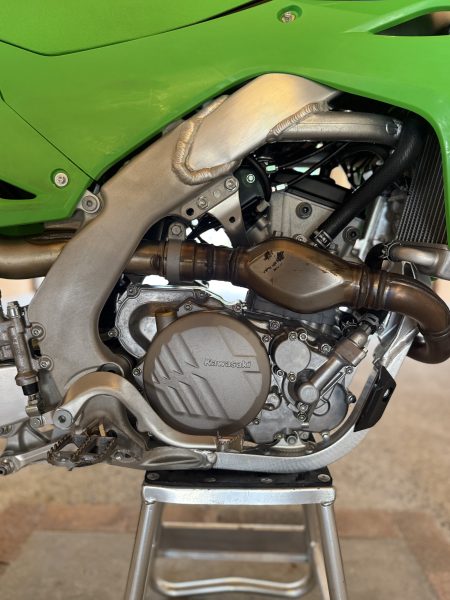
The 249cc liquid-cooled four-stroke got a symmetrically aligned intake and exhaust layout, similar to what the KX450 received in 2024. That meant centrally positioning the exhaust and revising the downdraft intake to create a straighter, more efficient airflow path. The intake cam was raised 10mm, the valve angles were narrowed by 1°, and the cylinder head was reshaped to suit the new layout.
What that translates to as a rider is better low-to-mid rpm performance. Accelerating up hills. Driving out of corners. Powering up up-hill step-ups. Anywhere you’re asking the engine to pull from the bottom.
The downdraft intake angle was made steeper, 32.5° to 34°, improving cylinder filling efficiency. The long, straight intake duct significantly boosts low-mid torque without sacrificing top-end power. This bike still revs hard thanks to finger-follower valve actuation, DLC-coated followers, titanium valves and aggressive cam profiles but it now has more meat in the bottom.
Dual injectors remain: one downstream for more accurate throttle response, one upstream for high-rpm performance. For 2025, the main injector was moved 11mm further downstream to improve fuel delivery into the airflow stream.
Compression ratio dropped slightly from 14.1:1 to 14.0:1 to improve power feel at low speeds. The piston crown was reshaped, the cylinder offset 3mm forward to reduce mechanical loss, and the engine tilted 5° forward to suit the intake/exhaust changes and improve efficiency.
There’s also a single-shaft primary balancer to smooth vibration, a hydraulic clutch borrowed from the KX450 for consistent feel, and an electric start system with a higher-torque starter motor and waterproofed switch housing.
Chassis & Handling Updates
The frame was redesigned based on the 2024 KX450 platform. It’s a lightweight aluminium perimeter design, roughly 250 grams lighter than the 2023 chassis.
The key change was rigidity balance. Kawasaki revised torsional rigidity to improve front-end feel in corners. The downtube Y-joint was repositioned higher to accommodate the new exhaust routing, cross pipes were moved, swingarm bracket shapes revised, and the shock mount adjusted.
What they were chasing was better rear wheel traction under acceleration and braking, with the front-end following the ground better while still keeping that nimble 250 feel.
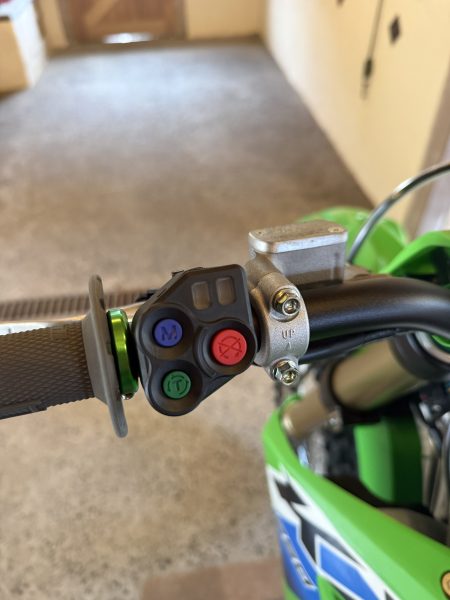
Mass centralisation improved too. The silencer moved 50mm forward. The exhaust resonator flattened and shifted inward. The shock reservoir relocated to the left side.
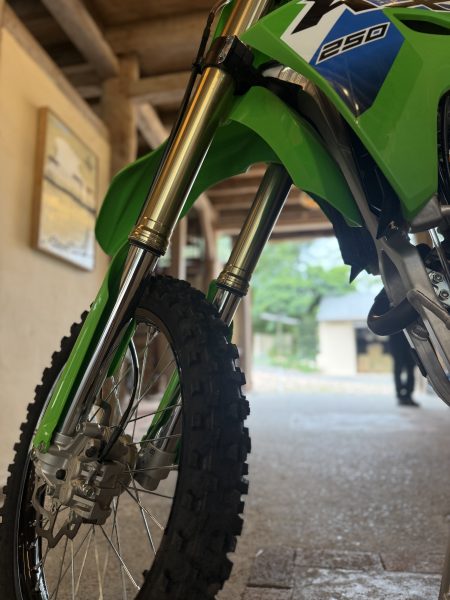
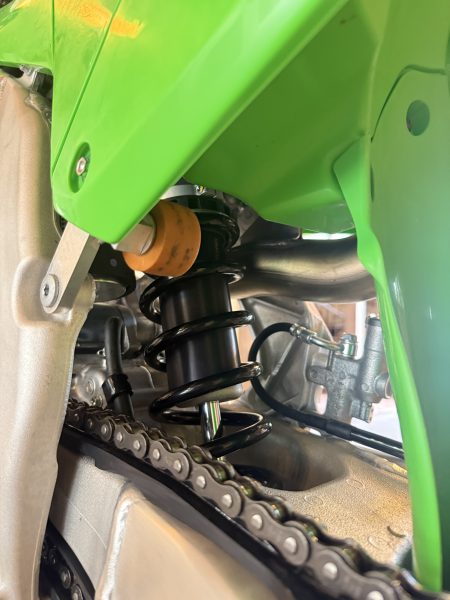
Up front you get Showa 48mm coil-spring forks with Kashima-coated outer tubes. Large 25mm damping pistons provide firm, race-ready damping. Out back, a Showa shock with Uni-Trak linkage offers high- and low-speed compression adjustability. The shock body is physically shorter to accommodate intake routing, but stroke remains the same.
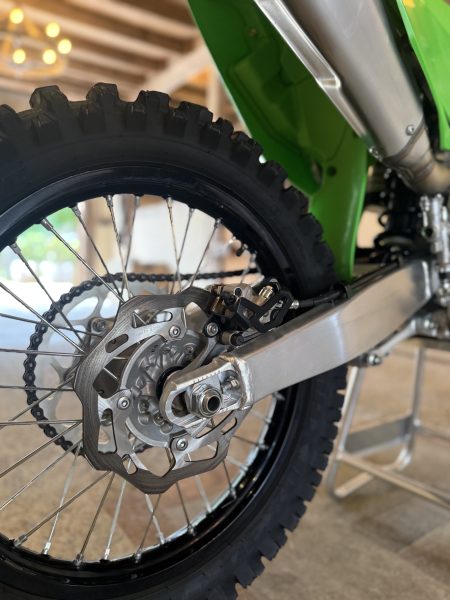
Braking is handled by a 270mm semi-floating front disc and 240mm rear, and the 2025 model switched to Dunlop MX34 tyres for improved longevity and traction.
Ergonomics & Tech
Ergonomically, the KX250 got a big clean-up for MY25. New bodywork eliminated hooking points. Shrouds taper more gradually. Side covers are firmer. Seams between seat and plastics are flush. The tank profile allows you to get further forward over the front wheel.
The seat is flatter, with a grippy top and smooth sides. Footpegs can be lowered 5mm. The Renthal Fatbar is standard, with four handlebar mounting positions available, as always.
On the tech side, Power Modes and Kawasaki Traction Control are selectable via a handlebar-mounted switch box. Smartphone connectivity allows engine mapping adjustments through the Rideology app, similar now to the Yamaha PowerTuner app.
And maintenance is easier too with a tool-less side cover removal and quick-release air filter hooks. For 2026, none of the above changes.
Suprise packet
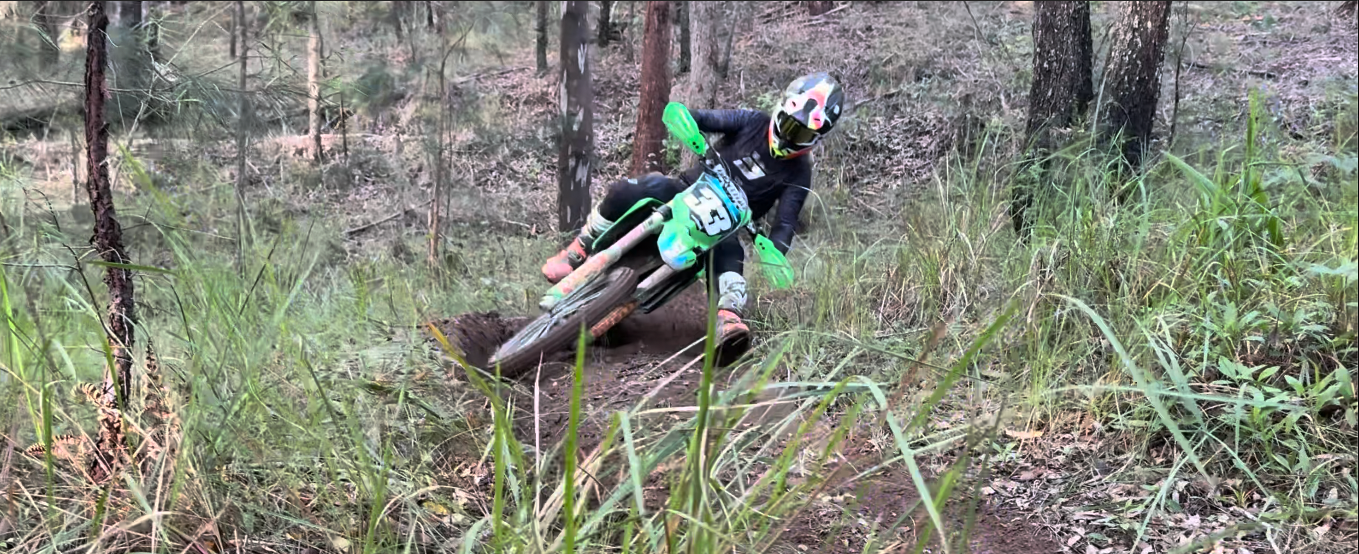
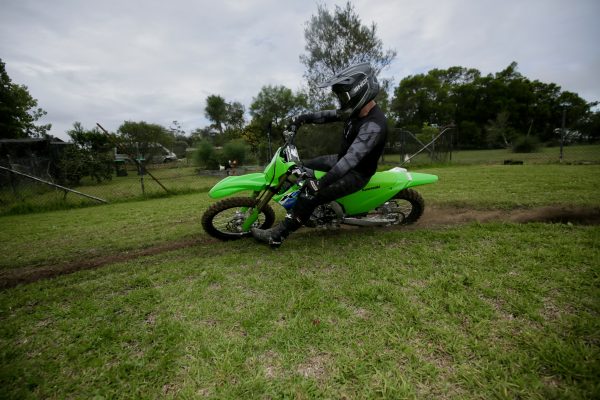
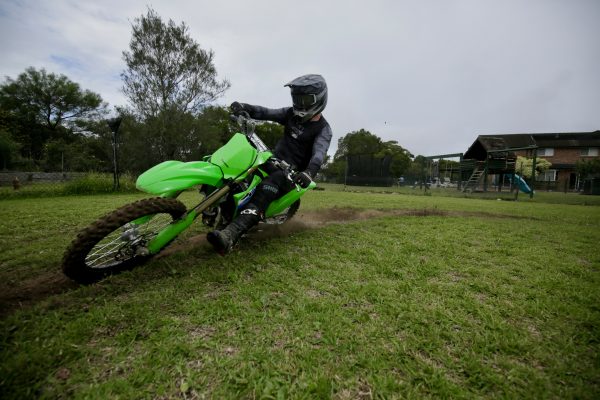
From the first lap I spun on this bike I felt at home on it. The cockpit is slim, the shrouds taper nicely, and that KX riding triangle has always been one of the easiest to jump on and feel comfortable straight away. At 170cm, I’m pretty sensitive to bikes that feel bulky or wide through the tank and radiator area, and the KX250 just doesn’t. It feels narrow between the knees and easy to move around on.
There’s been a bit of chatter over the last year about front-end feel and pushing in corners (thanks Chase), and I know some of that noise probably came from high-level race feedback. But in stock trim, on our tracks, I didn’t experience that at all. If anything, I found the front-end very compliant with loads of feel. And that brings me to what I think is the standout feature of this bike, the Showa fork.
Honestly, it’s one of the best forks I’ve ridden in the past ten years.
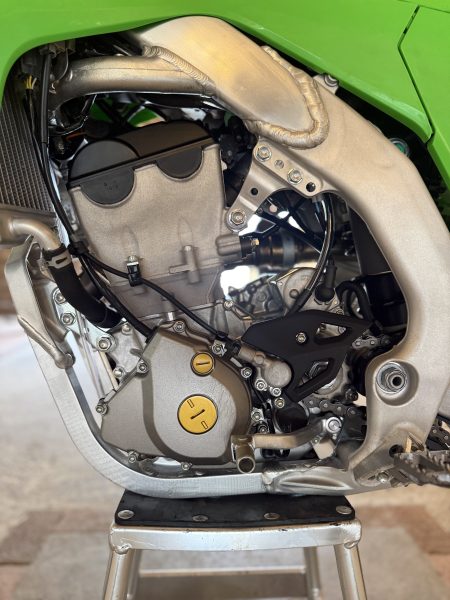
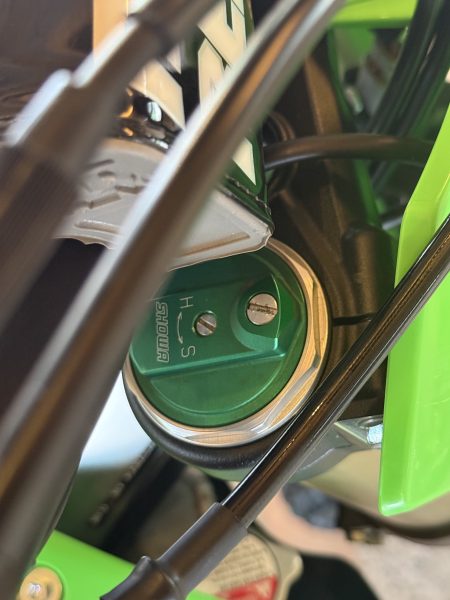
The 48mm Showa coil-spring fork with Kashima coating is just outstanding. It has that perfect blend of comfort and hold-up. The initial part of the stroke is plush enough that it takes the sting out of braking bumps and chatter, but as soon as you push harder it firms up and gives you support. There’s no harsh spike, no vague wandering feeling, just controlled, predictable action. I could load the front into a rut and trust it to stay planted. That’s huge for a 250F where you’re relying on corner speed and front-end confidence.
Under brakes it stays composed. Coming into rough corners it doesn’t dive unpredictably. And mid-corner it gives you proper feedback without deflecting. For me, that’s what separates a good fork from a great one, the ability to feel what the tyre is doing without getting beaten up. Kawasaki absolutely nailed the settings here. If anything, it feels like a factory-level fork straight out of the crate.
The rear shock complements it well too. The Uni-Trak linkage gives good traction on exit, and the bike tracks straight under acceleration. But the fork is the hero.
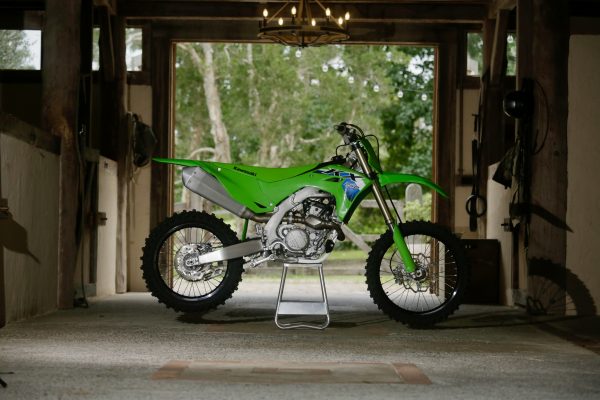
Motor-wise, I was pleasantly surprised. The changes they made in 2025, the symmetrical intake and exhaust layout, revised downdraft intake, and injector positioning, have really paid off. The engine feels broad and linear, but still powerful and exciting. In the stock map, it’s lively without being unpredictable.
It reminds me a bit of the YZ250F in character. It probably doesn’t have quite as much bottom-end grunt as the Yamaha, but the mid-range is a monster. Once it hits that mid-range, it just pulls hard and keeps screaming all the way to the top of the rev range. It’s an exciting engine to ride. You can short-shift it and keep momentum, or you can let it sing and really make the most of that high-revving nature.
I didn’t spend a heap of time playing with traction control. It’s a great feature to have, and it’s impressive that Kawasaki includes it from standard. But on a 250F, the power isn’t wild enough that I felt I needed it much. The standard map is honestly so good that I just left it there and rode. That was one of the big takeaways for me, the stock mapping is excellent. No need to rush out and reset it straight away. It works.
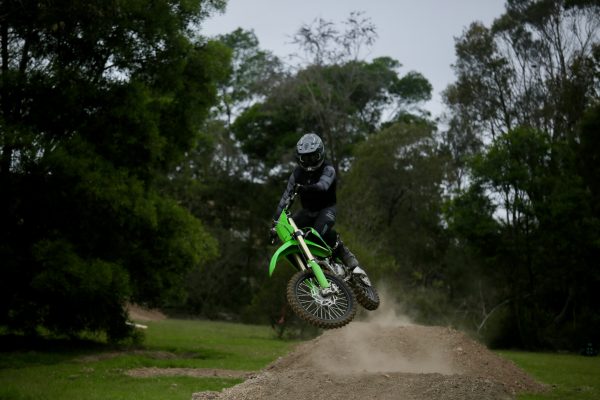
The Dunlop tyres are another win. Getting quality rubber straight from the showroom floor makes a big difference. There’s nothing worse than buying a bike and immediately wanting to swap tyres. These offered plenty of grip and feel.
If I had to pick one fault, it would be the footpegs. When you rail a rut or get into muddy conditions, the underside design can pack up with dirt. I had a few moments where the pegs folded up and then didn’t drop back down cleanly because dirt was trapped underneath. It’s not a deal-breaker, you could fix it with an aftermarket set of pegs, but it was the only real annoyance I came across during testing.
Also, the muffler might not win any beauty contests, it’s a bit ugly, but it works. It’s not choked up. The bike has plenty of bark. It feels angry in a good way. There’s a proper race-bike tone to it, and when you’re winding it out through the gears, it sounds and feels serious. Other than that, it’s just a great overall package.
I know the European brands love to talk about “race ready,” but this thing genuinely feels that way. Kawasaki should give themselves a pat on the back. And for someone my size who lives in the 125–250 world, it’s right in the sweet spot. I’m looking forward to spending more time on it.
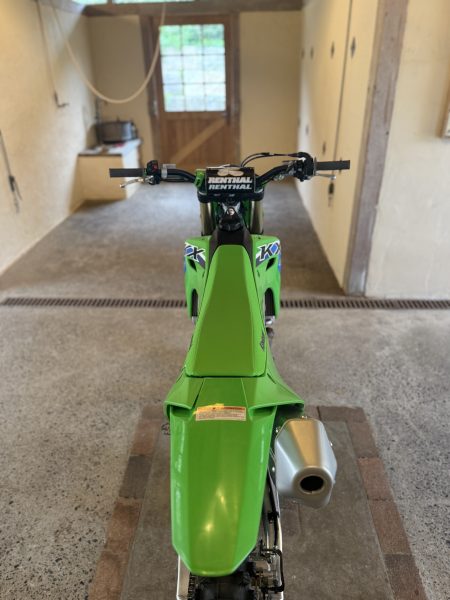
2026 Kawasaki KX250
ENGINE
Type: four-stroke Single, DOHC, 4 valves
Displacement: 249cc
Bore x Stroke: 78.0 x 52.2mm
Compression Ratio: 14.0:1
Fuel System: Fuel injection, ø44mm throttle body with dual injectors
Cooling: Liquid-cooled
Starting: Electric
Gearbox: 5-speed, return
Clutch: Wet multi-disc, manual
DIMENSIONS
Wheelbase: 1,485mm
Ground Clearance: 340mm
Seat Height: 955mm
Weight: 105kg (dry)
Fuel Capacity: 6.2L
SUSPENSION
Front: Showa 49mm inverted fork, adjustable compression and rebound damping, 305mm travel
Rear: Showa Uni-Trak linkage, adjustable dual-range (high/low-speed) compression, adjustable rebound damping, adjustable spring preload, 307mm travel
BRAKES
Front: Nissin, Semi-floating 270mm petal disc, dual-piston caliper
Rear: Nissin240mm petal disc, single-piston caliper
WHEELS & TYRES
Front Tyre: Dunlop MX32 80/100-21
Rear Tyre: Dunlop MX32 110/90-19 62M
RRP & Warranty
RRP: $14,444 Ride Away
Warranty: none
Browser: www.kawasaki.com.au