When Campbell Hall rolled into Alice Springs for the 2026 Tatts Finke Desert Race, he wasn’t arriving in a factory semi-trailer with a fleet of mechanics and unlimited resources.
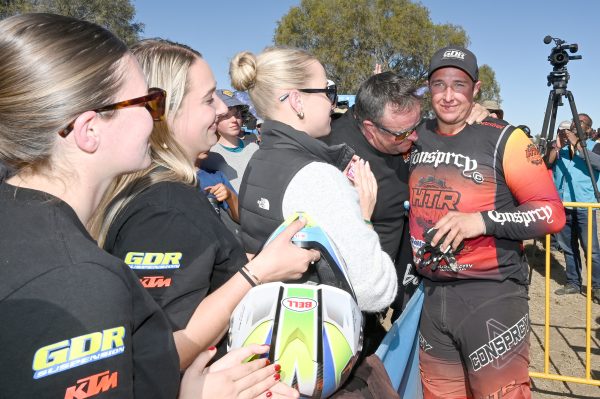
Instead, he arrived with HTR Racing, a small self-funded team built around family, mates and a whole lot of hard work. HTR stands for Halls Transport Repairs, the truck repair business owned by Campbell’s dad, and like many great privateer racing stories, the team has been built from the ground up with plenty of late nights, determination and passion.
The race truck itself was only purchased (by Campbell himself) late last year from the Smith brothers and has quickly become the centrepiece of the operation. While it’s still a relatively small setup compared to the factory efforts, Campbell sees it as the foundation for something bigger in the future.
“We’re only a privateer team, self-funded,” Hall explained. “We’re not really getting much support from KTM or anything. It’s mainly local businesses and my family. Mum and Dad are a huge part of it. Without them I wouldn’t be able to do any of this.”
While the team might not have factory resources, they certainly aren’t lacking professionalism. Campbell purchases his bikes through Dubbo City Motorcycles and credits Alex and Dave from the dealership for supporting him throughout his racing career. Suspension duties are handled by desert racing guru Chad’s Offroad Setups / GDR Suspension, whose knowledge of the Finke track has become a major part of Campbell’s success.
According to Hall, having a well-set-up motorcycle is more important than outright horsepower at Finke. “You don’t have to have the fastest bike. You need a bike you can trust. When things go wrong out there, they go wrong quickly.”
PROLOGUE: LEAVING TIME ON THE TABLE
Hall’s Finke campaign started strongly with fifth place in prologue. On paper it was an excellent result, but Campbell walked away convinced there was more time available. A few minor mistakes and clipped edges cost him valuable seconds around the short course, and while he wasn’t certain he could match eventual winner David Walsh, he believed there was another five or six seconds available.
Even so, breaking the five-minute barrier left him satisfied.
“I thought I’d blown it,” Hall admitted. “I honestly thought I was going to be around the 5:10 mark. Then I got back and saw where I was sitting and realised I was actually in a pretty good position.”
The result lined him up alongside Levi Day for the start of race day and immediately set the tone for the weekend.
THE RUN TO FINKE
The opening kilometres of Finke are always chaotic and 2026 was no exception. Levi got the initial jump in the stadium section, but Hall wasn’t overly concerned. He knew his speed through the whoops was one of his strengths and before the riders had even left the spectator area he had reclaimed the position. From there the focus became surviving the opening 20 kilometres without doing anything stupid.
Campbell isn’t a fan of the opening section of track. The combination of trees, edges, dust and constantly changing conditions means it’s one of the easiest places to make a mistake. Even with the staggered starts he found himself riding in dust and eventually caught Brody Waters around the Off Road Club section. Until that point, Hall had no idea who was ahead or behind him.
The challenge of Finke is that you’re often racing blind. You know where you started, but once the race settles down you’re left alone with your thoughts, your motorcycle and 226 kilometres of desert. Hall focused entirely on riding his own race rather than worrying about what anyone else was doing.
The first real issue arrived around the 60-kilometre mark when severe arm pump began affecting him. “I don’t normally suffer arm pump, but I pumped up pretty badly heading towards Deep Well,” he said.
Despite the discomfort, Hall continued pushing and reached the first fuel stop where he learned he was sitting inside the top three. The information surprised him because despite starting behind them, he’d never really seen race leader David Walsh or defending winner Corey Hammond on the track out in front of him.
The track was deteriorating rapidly and Hall had already experienced multiple flat tyres during pre-running. Rather than taking unnecessary risks, he focused on maintaining momentum while avoiding the worst of the punishment.
Even then, he wasn’t immune to drama. One particularly nasty moment arrived around the 78-kilometre mark when he landed in a hidden silt hole after a tabletop jump. “It bucked me pretty hard. Whoever was watching would have heard my bike. It was definitely on the rev limiter,” Hall laughed. “That one definitely woke me up.”
THE TRACK FROM HELL
According to Hall, the 2026 Finke course was the roughest he has seen in his three appearances. While many competitors focused on the deep whoops, Campbell believed the real challenge came from the endless square edges, hidden holes and bulldust that seemed to appear without warning. The course had evolved significantly from pre-running and many sections bore little resemblance to what riders had practised on.
The holes weren’t necessarily bike-swallowing monsters, but they were big enough to cause serious problems at racing speeds. “You’d be cruising along and suddenly hit a knee-deep hole hidden in bulldust. Next thing your bike is sideways and you’re hanging on for dear life,” he explained.
The dust made everything worse. With visibility often limited, riders were forced to trust memory and instinct. Hidden rocks, square edges and deep holes lurked everywhere, making concentration absolutely critical. Relax for even a second and the track would immediately punish you.
PASSING HAMMO
As Hall approached Finke township he received word that Corey Hammond had encountered problems. The defending Champ had been running strongly but suffered mechanical issues near the finish. Hall eventually came across Hammond pushing his KTM towards Finke and admits it was a difficult sight to witness.
“I felt bad for him to be honest,” Hall said. “He was still pushing and still trying to finish. A lot of people would have given up, but that’s not Corey. He kept going.”
The pass elevated Hall into second place. By the time he reached Finke he was approximately six minutes behind Walsh but held a comfortable margin over the riders behind him.
TRAGEDY AND PERSPECTIVE
Race morning brought a different challenge. News of serious incidents involving competitors weighed heavily on the paddock and Hall admits the events were impossible to ignore. Like everyone else in Alice Springs, he understood the risks associated with the race and hearing about tragedies inevitably affects your mindset.
“It definitely played on my mind a little bit,” Hall said. “You don’t want that stuff happening. It’s horrible.” But he remained focused and strong mentally. That mindset helped keep emotions under control as he prepared for the run back to Alice Springs.
BRINGING IT HOME
Hall actually preferred the return journey. While the track remained brutally rough, he felt more comfortable and more confident heading back towards Alice Springs. The opening stages were spent riding alone, with no real indication of where anyone else sat on corrected time.
At the 160-kilometre fuel stop the news was encouraging. He had pulled time back on Walsh and extended his advantage over the riders behind. While victory remained out of reach, Hall sensed an opportunity to prove he belonged at the front of the field.
“I just wanted to show I could run that pace,” he explained. “I wasn’t going to catch him, but I wanted to show I belonged up there.”
The final challenge came roughly 20 kilometres from the finish. Hall briefly left the track after being caught out by a brutal section of crossed-up whoops and bulldust. It wasn’t a crash, but it was enough to remind him how quickly things can unravel.
By that stage, however, he knew second place was his to lose. Rather than taking unnecessary risks, Hall backed the pace down and focused on bringing the motorcycle home intact. The final kilometres were ridden with patience and maturity, a far cry from the all-out aggression often associated with desert racing.
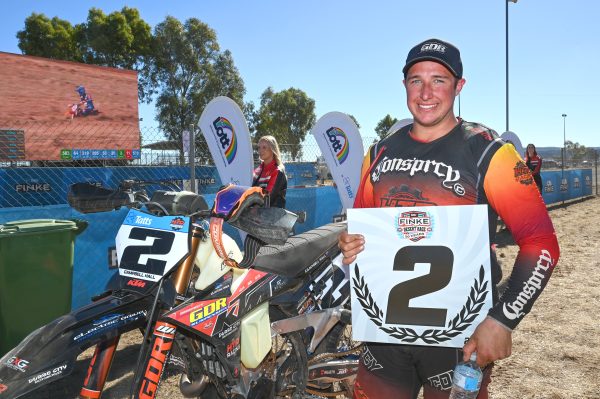
When he finally rolled into Alice Springs, second place was secured.
Again.
PROVING A POINT
Back-to-back runner-up finishes have now firmly established Campbell Hall as one of Australia’s premier desert racers. More importantly, they have proven that privateers can still run with the factory teams. Hall takes immense pride in beating riders with significantly larger budgets and support structures.
“When you pass a factory rider, it definitely means something,” he said. “Those guys have a lot of support behind them. We don’t. It’s good to show that you can still compete with a smaller setup and the right people around you.”
The result also silences any lingering suggestions that last year’s podium was a one-off. Second place once might be luck. Second place twice behind the greatest desert racer of the modern era is something entirely different.
Hall knows it too. “I’ve backed it up. Last year wasn’t a fluke. I’ve proven I belong up the front.”
With another Finke podium secured, attention now turns towards Baja, where Hall hopes to continue building both his racing résumé and the HTR Racing team. If 2026 proved anything, it’s that Campbell Hall is no longer simply a promising privateer. He’s one of the men to beat.