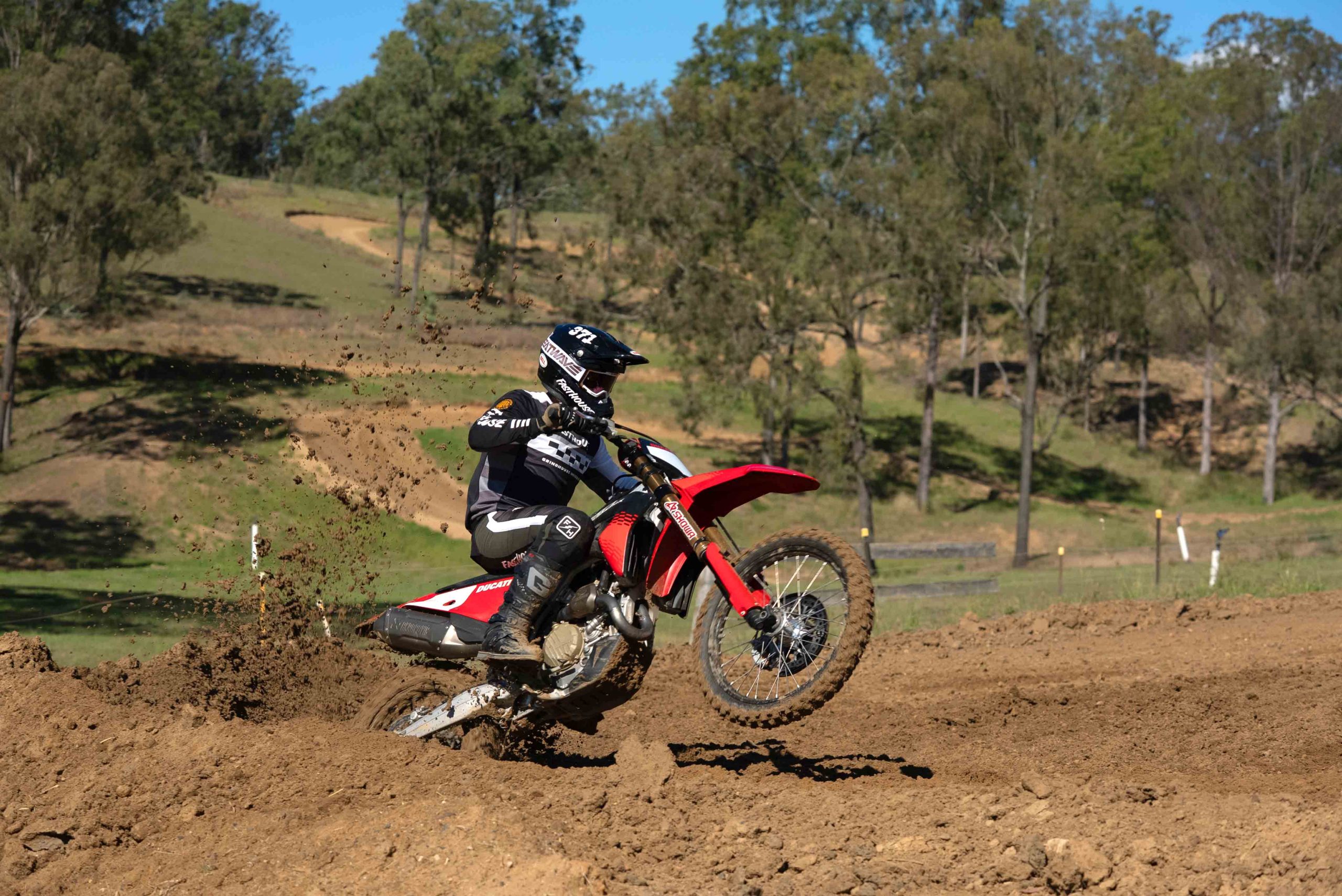
The 2026 Tatts Finke Desert Race was supposed to be Ducati’s statement weekend. After months of preparation, testing and anticipation, the Ducati Desmo450 MX had arrived in the desert under the Joe Rascal Racing banner ready to tackle one of the toughest off-road races on the planet. Callum Norton was the man tasked with showing what the Italian machine could do against Australia’s best desert racers.
Then prologue happened.
Norton had started strongly and was on pace through the opening kilometres. The Ducati looked planted and competitive, and everything was unfolding according to plan. Unfortunately, Finke has a nasty habit of changing plans very quickly.
A deceptively small section of track featuring a left-hand turn, a rise and a heavily deteriorated set of whoops would change the course of his weekend.
Norton had used a sneaky outside line that had worked previously, but late in the day the track had been hammered by trucks and hundreds of competitors. The dirt was loose, slippery and far rougher than expected. The Ducati got crossed up entering the whoops and the resulting high-side launched Norton into the Alice Springs dirt.
“It happened pretty quick,” Norton admitted. “I thought I fought it for a long time, but when I saw the footage it all happened pretty fast.”
The crash itself was only the beginning. The impact bent the handlebars so badly the front brake was effectively locked on. The throttle was twisted out of position and the Ducati was almost unrideable. Norton somehow managed to drag the machine back to the finish line and record a time, but it was a disastrous result for a rider who had arrived with much higher expectations.
The ankle then immediately became the biggest concern. Straight after the crash, Joe Rascal Racing principal Brett Metcalfe and the crew got to work trying to assess the damage. Norton underwent treatment almost immediately and spent the next several hours trying to determine whether he would even be fit enough to start race day. With Hattah only weeks away, there was a serious discussion about whether continuing was worth the risk.
“We didn’t really know if riding was the smart thing to do,” Norton explained. “The foot was getting stiffer by the minute. If I’d just gone back to camp and sat around, I reckon I would’ve struggled even more.”
Fortunately, race officials recognised the situation. Allowing a rider of Norton’s speed to start amongst the slowest competitors would have created an enormous safety issue. As a result, he was re-seeded for race day, but he still faced a monumental challenge. Instead of battling for podium positions, Norton would spend the next two days carving his way through a field packed with hundreds of riders.
The goal suddenly changed. Forget winning. Forget podiums. Forget outright results. The new target was simple: get to Finke and try to secure a top-30 result that would guarantee Ducati a starting position for 2027.
The charge
Starting from grid 74 and position 338, Norton launched into one of the most difficult rides of his career.
What followed wasn’t really racing in the traditional sense. It was survival, patience and calculated aggression. Riders were leaving every 30 seconds and the dusty conditions created some of the worst visibility many competitors had ever seen. Norton described the track as the dustiest he had encountered and the southerly wind only made matters worse.
The speed difference between Norton and many of the riders he encountered was enormous. Some competitors were cruising through sections at 50 or 60km/h while Norton knew those same sections could comfortably be ridden at well over 100km/h. The challenge wasn’t finding speed. The challenge was finding somewhere safe to pass.
“I had to ride the track completely differently,” Norton said. “If the whoops were meant to be ridden straight, I was zig-zagging through them trying to get around people. Some sections I simply couldn’t pass because the dust was so bad.”
On four separate occasions he came to a complete stop. Not because of mechanical issues. Not because of crashes. Simply because he couldn’t see where the track went. Even with extensive pre-running knowledge, the visibility was so poor that continuing would have been reckless.
As the kilometres rolled by, however, things began to improve. The deeper Norton worked into the field, the faster the riders became. Around the 160-kilometre mark he started encountering genuinely quick competitors and finally found himself able to race rather than constantly negotiate traffic. The pace increased, the dust eased slightly and the Ducati rider finally started enjoying himself.
Along the way he recognised several notable names, including Danny Foot and a talented two-stroke rider from his local area who had previously finished inside the top 15. Those encounters provided reassurance that significant progress was being made through the field.
When he finally reached Finke, the results stunned even him. Corrected time placed Norton 30th outright. From grid 338. On an injured ankle. On Ducati’s first serious assault on the race.
“It was massive,” Norton said. “Honestly, I had no idea where I’d end up. Top 50 was kind of my goal during the ride. To get there and see 30th was pretty cool.”
Phone home
With the top-30 objective achieved, attention immediately shifted towards the return trip. For the first time all weekend, Norton had the opportunity to actually race. The ride to Finke had been dominated by overtaking slower riders and managing risk. The ride home offered the chance to push harder and learn more about the Ducati in race conditions.
His benchmark was simple. Find riders around the top 10 and try to stay with them. The plan worked. Norton quickly worked through the riders ahead of him and began feeding off the momentum of each pass. One rider became two. Two became five. Five became ten. Eventually he found Mitchell Outram, who was sitting eighth outright at the time. That was the moment everything changed.
From that point onwards Norton enjoyed some of the cleanest riding conditions of the weekend. The Ducati was working well, the ankle was holding together and the pace was genuinely impressive. The final section of the race became the ride he had hoped to experience all weekend.
“I actually really enjoyed the ride home,” Norton said. “The crowd was still massive. We had helicopters overhead. It felt like what I’d come here to do.”
By the time corrected times were finalised, Norton had climbed all the way to 13th outright.
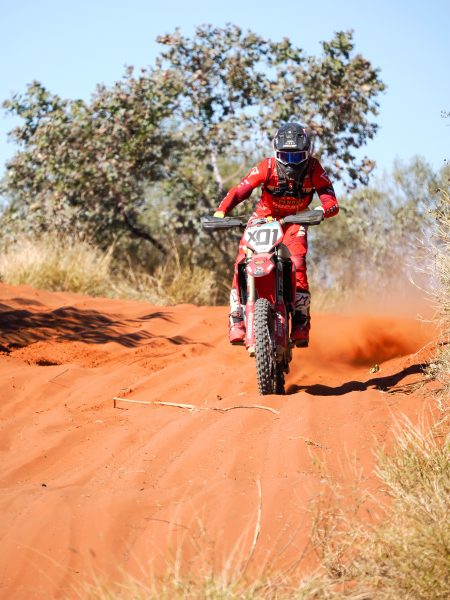
Considering where he started and what had happened in prologue, it was an extraordinary effort. More importantly, it gave Ducati and Joe Rascal Racing exactly what they needed. The bike had survived Finke. Valuable data had been collected and the team now had a solid foundation to build from heading into 2027.
For Norton, the result represented far more than a finishing position. The Ducati Desmo450 MX had arrived in the Australian off-road scene and immediately proven it could handle one of the toughest races in the world.
“It’s a testament to the bike,” Norton said. “We’ve learnt a lot. Ducati has been to Finke now. We know what we need to work on and we’ll come back stronger.”
Norton plans to have the ankle properly assessed before returning to racing, although he remains confident there is no major damage.
For many riders and spectators, it was the first opportunity to see Ducati seriously involved in Australian off-road racing. Judging by the interest generated across the Finke weekend, it certainly won’t be the last.
The result sheet will show 13th outright. What it won’t show is the crash, the injury, the hundreds of riders passed, the dust navigated, the frustration and the determination. Sometimes the most impressive rides at Finke aren’t the ones that win. Sometimes they’re the ones that refuse to quit.