In the awesome world of dirt bikes, crashes aren’t a possibility, they’re a guarantee. Whether you’re racing motocross, crawling through hard enduro, or just riding trails on the weekend, you’re going to hit the ground at some point. The real question isn’t if you crash, it’s how well your body handles it when you do. That’s where Mobius has carved out its place in the industry, not by following the traditional path of protective gear, but by completely rethinking how braces should work in the first place.
For Scott Watanabe, the journey into the world of protective equipment didn’t start with a grand plan to build a global brand. It started with a phone call and a problem that needed solving. “I got a call from a very close friend of mine,” Watanabe explains. “He said, ‘Hey, I’ve got this project, I’d love for you to take a look at it.’ It was a knee brace, but it was only about halfway there.” From that point, curiosity turned into obsession. Watanabe began digging into the product, not just from a design standpoint, but from a rider’s perspective, what it felt like, what it restricted, and ultimately, why so many riders simply didn’t want to wear them.
That initial feedback was brutally honest. “I called a lot of pro athletes and asked them straight up, what do you think of knee braces?” Watanabe says. “And the answer was pretty consistent… they hated them.” That wasn’t because riders didn’t believe in protection. It was because the existing options were uncomfortable, restrictive, and in some cases, raised concerns about transferring force to other parts of the body. As Watanabe put it, “They wore them because they had to, not because they wanted to.” That distinction became the foundation of everything Mobius would go on to build.
Rethinking the Brace
The biggest issue with traditional knee braces wasn’t just comfort, it was philosophy. Most designs relied on rigid materials like aluminium or carbon fibre to physically stop movement. That sounds good in theory, but in practice, it created a new problem. “When you have something that rigid,” Watanabe explains, “and you hit the ground hard, the energy doesn’t just disappear. It has to go somewhere.” Historically, that “somewhere” could be the femur or other parts of the leg, which is where the long-standing debate around braces causing secondary injuries came from.
Instead of doubling down on rigidity, Watanabe and his team took a different approach. They asked a simple but powerful question: what if the brace could manage energy instead of just resisting it? That shift in thinking led to years of development, testing, and collaboration with engineers, professional riders, and even an orthopaedic surgeon who understood both the medical and practical sides of injury prevention. “We needed someone who could look at it from both angles,” Watanabe says. “Not just how it works in theory, but how it actually performs on a bike.”
The result was the creation of Mobius in 2014, built around a completely new concept of how a brace should function.
The CCRS System
At the centre of every Mobius knee brace is the CCRS, Continuous Cable Routing System, and it’s the defining feature that separates it from everything else on the market. Rather than relying purely on rigid frames, the CCRS uses a continuous cable that wraps around the leg above and below the knee joint. “It’s one uninterrupted loop,” Watanabe explains. “And as the knee moves into a compromised position, that cable progressively tightens.”
The idea is simple but incredibly effective. Instead of the brace being static, it becomes dynamic. It reacts to movement, increasing support exactly when it’s needed most. “Think of it like a seatbelt,” Watanabe says. “It’s comfortable and flexible when you’re moving normally, but the moment something goes wrong, it locks in and protects you.” That analogy perfectly captures the intent behind the design.
The name Mobius itself reflects this concept. Inspired by the Möbius strip, a continuous loop with no beginning or end, it represents the idea of constant, uninterrupted support. “That loop is what defines our system,” Watanabe says. “It’s always working, always engaged.”
Materials That Matter
Another major departure from traditional braces is the material choice. Instead of going with ultra-rigid metals or composites, Mobius uses glass-filled nylon, which offers a unique balance of strength and controlled flexibility. “We wanted something that was extremely rigid in the vertical plane to stop hyperextension,” Watanabe explains, “but had just enough give in other directions to absorb energy rather than transfer it.”
This controlled flex is critical in real-world crashes. Dirt bike accidents are rarely clean or predictable. Riders get twisted, legs get caught, and forces come from all directions. A brace that’s too rigid can actually become part of the problem. “It’s about managing that energy,” Watanabe says. “Not just stopping movement, but controlling what happens when things go wrong.”
That philosophy extends to every part of the brace, from the frame to the hinges and even the liners.
Fit, Comfort, and Real-World Use
One of the biggest complaints about braces has always been comfort, and Mobius tackled that head-on. “If it doesn’t fit properly, it doesn’t work,” Watanabe says. “And if it’s uncomfortable, riders won’t wear it.” To solve that, Mobius developed an internal liner system inspired by ski boot technology. The material moulds to the rider’s leg over time, creating a custom fit that eliminates pressure points.
The importance of fit can’t be overstated. “If your leg is moving inside the brace, even slightly, you’re losing protection,” Watanabe explains. “It has to stay in place, but it also has to be comfortable enough that you forget you’re wearing it.” That balance is what Mobius has focused on from day one.
During the interview, the discussion turned to how riders should actually wear a brace. “You don’t need to crank it down to the point where it’s painful,” Watanabe says. “It should be snug, secure, but still comfortable. That’s when it works best.” It’s a small detail, but one that makes a huge difference in real-world use.
Knee Guards vs Knee Braces
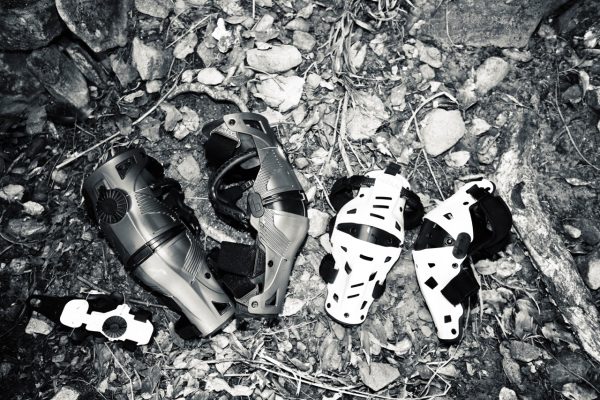
At this point in the conversation, we brought up a question that comes up all the time: why not just wear knee guards? Watanabe didn’t hesitate. “A knee guard protects against impact,” he says. “It’ll stop rocks, debris, that kind of thing. But it doesn’t provide any structural support.”
That’s the key difference. Guards are about surface-level protection, while braces are about preventing serious injury. “If your knee moves in a direction it shouldn’t, a guard isn’t going to stop that,” Watanabe explains. “A brace is designed to manage that movement.”
For riders who are still on the fence, Mobius has developed hybrid options that bridge the gap, but the message is clear, if you’re serious about protection, a brace is the way to go.
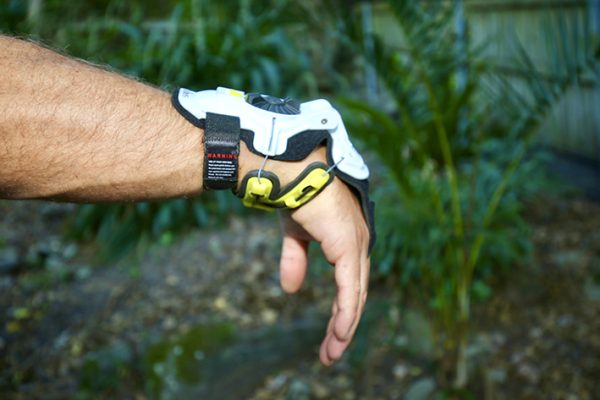
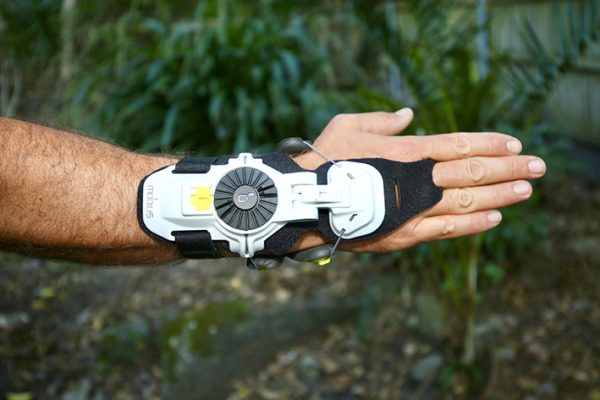
While Mobius built its reputation on knee braces, their wrist brace has become just as important, especially in recent years. “When you crash, your instinct is to put your hands out,” Watanabe says. “That’s just human nature.” The problem is that wrists are incredibly vulnerable, and injuries are common across all levels of riding.
Traditionally, wrist braces have been bulky and restrictive, making them impractical for motocross or off-road use. Mobius approached the problem with the same philosophy as their knee brace, dynamic support rather than rigid restriction. “We wanted something that allowed full control of the bike but still provided protection,” Watanabe explains.
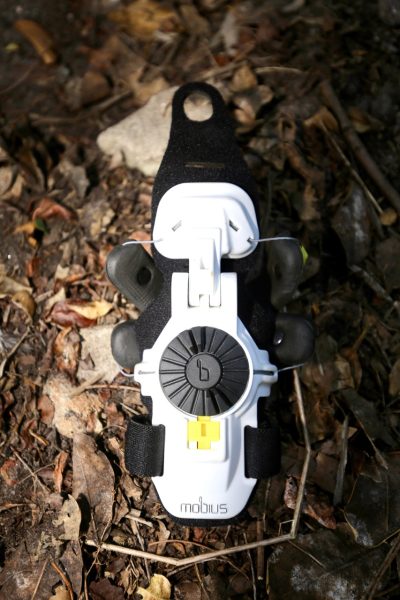
The Mobius wrist brace uses a cable system similar to the knee brace, but adapted for the wrist’s range of motion. “It acts like progressive suspension,” Watanabe says. “As your wrist moves toward its limit, the system tightens and absorbs energy.” The design allows riders to maintain a natural grip on the bars while still benefiting from support.
One of the standout features is the adjustable extension stop. “You can set it to limit how far your wrist can extend,” Watanabe explains. “That’s huge for both injury prevention and recovery.” It’s a level of adjustability that sets it apart from traditional designs.
Pro-Level Validation
As someone who has had two broken wrists, I was very interested in how the wrist brace could have prevented my injuries. The conversation then shifted to professional riders, and one name that stood out was Ken Roczen. After suffering a serious wrist injury, Roczen initially resisted the idea of wearing a brace. “He told me he wanted his full range of motion back,” Watanabe recalls. “He didn’t want anything restricting him.”
But after trying the Mobius wrist brace, his perspective changed almost immediately. “After two laps, he came back and said, ‘I forgot I was even wearing it,’” Watanabe says. I agree with Roczen, I often wear the Mobius wrist brace now, not because my wrists are still in pain or are vulnerable but because I don’t want them breaking gain and they’re so comfortable you hardly know they’re there.
Durability and Longevity
Protective gear isn’t cheap, and riders want to know it’s going to last. “We designed these braces to be serviceable,” Watanabe explains. “You can replace parts, rebuild them, keep them going for years.”
In fact, some riders have been using the same Mobius braces for over a decade. “From a business standpoint, that’s probably not ideal,” Watanabe laughs, “but from a rider’s perspective, it’s exactly what you want.” It’s a refreshing approach in an age where many products are designed with a limited lifespan. Howe long has your fridge or television lasted?
Prevention vs Reaction
I’ve always seen braces as a reactive option to an injury. Stupidly, I’ve only ever opted for any brace once it was already too late. I wish I had have worn them from the get-go. “Most riders don’t think about protection until after they’re injured,” Watanabe says. It’s a common pattern, ride without protection, get hurt, then start looking for solutions.
But Watanabe believes that needs to change. “It’s always better to prevent an injury than to recover from one,” he says. “Especially with things like ligaments, where recovery can take months or even years.” It’s a simple message, but one that resonates with anyone who’s spent time off the bike due to injury.
When asked who should be wearing braces, Watanabe didn’t hesitate. “Honestly, everyone,” he says. “If you’re riding a dirt bike, you’re at risk.” It doesn’t matter if you’re a professional racer or a weekend warrior, the forces involved are the same.