At first glance, Kawasaki’s KLX110R and KLX110R L look almost exactly the same. Same green plastics, same little four-stroke engine, same pitbike proportions and the same promise of cheap fun. Park them side by side and most people probably wouldn’t even notice the difference straight away.
But one small detail completely changes how these bikes ride and who they suit. One has a manual clutch. One doesn’t.
That single difference is enough to completely divide opinion, because depending on who you are buying the bike for, the clutch can either be the best thing ever… or the exact reason your kid crashes into the nearest tree.
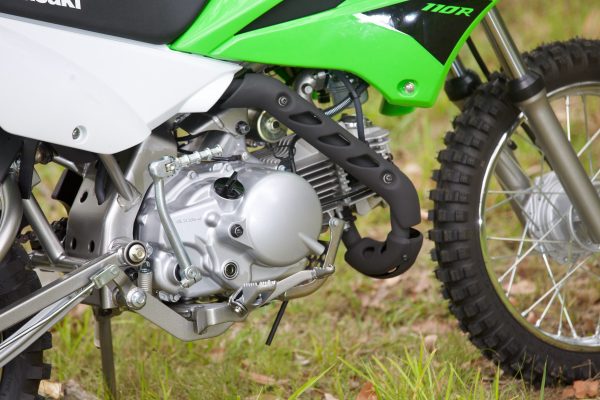
The whole KLX110 thing has become funny over the years because Kawasaki originally built these bikes for children. Simple. Cheap. Tough little learner bikes. Then adults got involved and ruined everything in the best possible way. Suddenly pitbike racing exploded, grown men were jumping kids’ bikes across mini supercross tracks, and people were spending the price of a new motocross bike modifying something designed for a ten-year-old.
Even now, while the pitbike craze isn’t as insane as it once was, nearly every motocross kid you know probably has some kind of 110 sitting in the shed getting absolutely flogged after school. They are still one of the best ways to have fun on two wheels without spending a fortune. The beauty of the KLX110 is that it works for almost everyone: kids, teenagers, adults, complete beginners, and blokes who probably should know better by now.
The problem is deciding which model actually suits you.
WHAT’S THE ACTUAL DIFFERENCE?
Mechanically, the two bikes are very similar. Both run the same basic air-cooled four-stroke engine, both use a four-speed gearbox, and both are designed to be simple and durable.
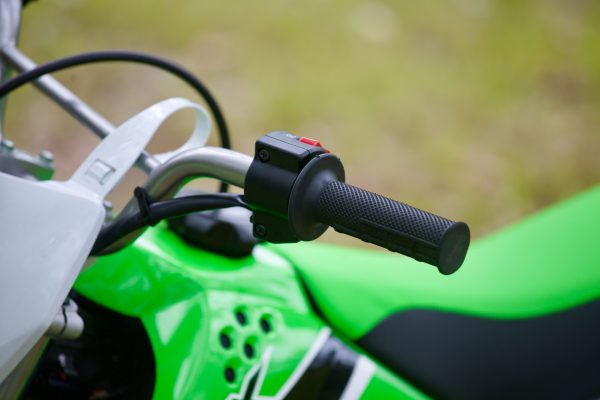
The standard Kawasaki KLX110R runs an automatic clutch. You still change gears with your foot, but there’s no clutch lever on the bars. You simply click gears and ride. It’s incredibly simple and almost impossible to stall. The seat height is also lower at 680mm, which makes it less intimidating for smaller riders.
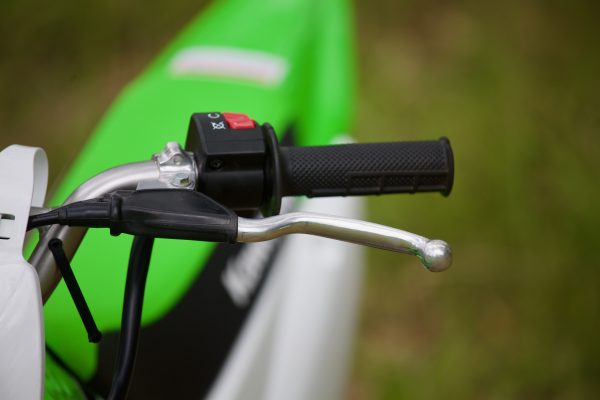
The Kawasaki KLX110R L changes things up with a taller chassis, more suspension travel and, most importantly, a manual clutch. Seat height jumps to 730mm, ground clearance increases, and suddenly the little KLX starts feeling much closer to a proper motorcycle.
That manual clutch changes the personality of the bike completely.
MORE SENSE FOR KIDS
If you are buying a KLX110 for a younger rider, the standard no-clutch version makes a huge amount of sense. Kids already have enough going on when they are learning to ride. They’re thinking about balance, braking, throttle control, standing up, looking ahead and not riding directly into the back of Dad’s ute. Throw a clutch into the mix too early and sometimes it just overwhelms them.
Some kids naturally understand clutch control almost immediately. Others simply don’t. And honestly, some riders never fully get comfortable with it no matter how long they ride. We all know grown adults who can’t drive a manual car or who still dump the clutch like they’re trying to launch a drag.
That’s why the automatic clutch model works so well. It removes one layer of panic and complexity from the equation. The rider can focus entirely on riding rather than worrying about stalling the bike halfway up a hill or whiskey-throttling into a fence because they panicked with the clutch lever.
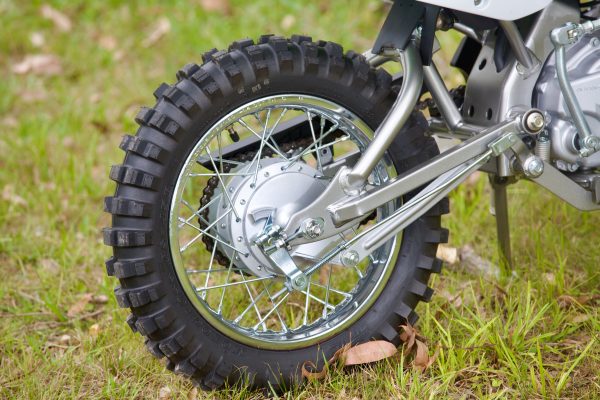
For nervous riders, timid kids or adults that are complete beginners, that simplicity is gold.
You can literally put them on the bike and within five minutes they are usually riding around happily without even thinking about gears. The low seat height helps massively too because they can touch the ground easier, which gives them confidence straight away. Confidence is everything when teaching kids to ride.
A confident kid progresses quickly. A scared kid usually doesn’t want to ride at all.
THE WEIRD IN-BETWEEN RIDER
Where things get interesting is with kids that physically need a bigger bike but mentally maybe aren’t ready for a clutch yet. Some kids grow like weeds. Suddenly they are way too tall for little 50cc bikes, cramped on smaller machines and physically need the room of a 110-sized bike, but they still haven’t grasped clutch control yet.
That’s where the standard KLX110R is brilliant. You get the larger chassis, bigger wheels and more physical room without forcing them into clutch control too early. It gives parents a stepping stone between tiny learner bikes and full manual-clutch motocross bikes.
Honestly, for family trail riding and casual riding around the paddock, the no-clutch version is probably the smarter option for most younger riders. It’s safer, easier to manage and less likely to end in tears halfway through the day.
Most kids aren’t using a clutch on a 110 to do anything technical anyway. They’re not hard enduro riding. They’re not railing ruts. They’re just trying to ride around and have fun.
SO WHY WOULD YOU WANT THE CLUTCH VERSION?
Because adults ruin everything. That’s basically the answer.
The moment teenagers and adults started riding pitbikes properly, the manual clutch suddenly made a whole lot more sense. The clutch-equipped KLX110R L feels much more like a real motorcycle. You can keep the revs up, fan the clutch through corners and actually attack the bike instead of just putting around. That’s why older riders almost always gravitate toward the “L” model.
Mat Boyd explained it perfectly in our old KLX110L test three years ago when he talked about riding the bike around a track as an adult. Having the manual clutch meant he could keep the revs up and drive harder out of turns, which made the bike far more fun when ridden aggressively.
THE BIGGER CHASSIS CHANGES EVERYTHING
The taller seat and increased suspension travel on the KLX110R L make a bigger difference than you’d think too.
Adults and teenagers simply fit on it better. The standard bike can feel tiny pretty quickly once you are over average height. Your knees are jammed up around your ears and you feel like a circus bear riding a tricycle.
That extra suspension travel helped too for heavier riders. Adults are obviously asking much more of these bikes than Kawasaki originally intended.
DO KIDS EVEN NEED A CLUTCH ON A 110?
Some parents think kids should learn clutch control as early as possible. Others reckon there’s no rush. Honestly, both arguments are kind of right.
We absolutely think every rider should eventually learn to use a clutch. If they want to ride motocross bikes, enduro bikes or really any full-size motorcycle properly, clutch control becomes an important skill. Learning early definitely helps.
But that doesn’t mean every kid needs to learn immediately. There’s no massive advantage to having a clutch on a bike this small unless the rider is actually trying to ride aggressively.
Horses for courses
So which one should you buy? If the bike is for a younger rider, nervous beginner or someone who simply wants easy, stress-free fun, the standard Kawasaki KLX110R probably makes more sense. The lower seat, automatic clutch and easier nature make it an awesome learner bike that removes a lot of intimidation.
If the rider is older, taller, more aggressive or simply wants the bike to feel more like a proper motorcycle, the Kawasaki KLX110R L is the better choice. The clutch, taller chassis and extra suspension travel make it much more suitable for teenagers and adults who want to push the bike harder.
Neither option is wrong. They just suit different riders. And honestly, if your kid eventually progresses to the clutch model anyway, that’s probably a good thing. Every rider should learn how to use a clutch eventually.
| SPEC | Kawasaki KLX110R | Kawasaki KLX110R L |
| Engine Type | 112cc air-cooled four-stroke single | 112cc air-cooled four-stroke single |
| Bore x Stroke | 53.0 x 50.6mm | 53.0 x 50.6mm |
| Compression Ratio | 9.5:1 | 9.5:1 |
| Valve System | SOHC, 2 valves | SOHC, 2 valves |
| Fuel System | Keihin PB18 carburettor | Keihin PB18 carburettor |
| Starting | Electric & kick start | Electric & kick start |
| Cooling | Air-cooled | Air-cooled |
| Transmission | 4-speed | 4-speed |
| Clutch | Automatic centrifugal wet multi-disc | Manual wet multi-disc |
| Front Suspension | 30mm telescopic fork | 30mm telescopic fork |
| Rear Suspension | Single shock | Single shock |
| Front Wheel Travel | 110mm | 140mm |
| Rear Wheel Travel | 110mm | 132mm |
| Front Tyre | 2.50-14 4PR | 2.50-14 4PR |
| Rear Tyre | 3.00-12 4PR | 3.00-12 4PR |
| Front Brake | 90mm drum | 90mm drum |
| Rear Brake | 110mm drum | 110mm drum |
| Dimensions (LxWxH) | 1560 x 650 x 955mm | 1560 x 650 x 990mm |
| Wheelbase | 1075mm | 1075mm |
| Ground Clearance | 215mm | 265mm |
| Seat Height | 680mm | 730mm |
| Curb Weight | 76kg | 76kg |
| Estimated Dry Weight | 72kg | 72kg |
| Fuel Capacity | 3.6L | 3.6L |